The veterinary emergency entrance was only a few feet away, but Cody could not make it through the doors on his own.
He remained on his side in the bed of a pickup truck, exactly where the people who found him had placed him. His brown-and-white coat was soaked with rainwater, roadside mud and grime.
One rear leg rested at a visibly unnatural angle.
Cody’s head lay flat against an old blanket. When the clinic doors opened and several people hurried toward the truck, his eyes moved in their direction.
He did not attempt to rise.
He no longer had the strength to lift his head.
Less than thirty minutes earlier, a driver had found Cody lying near the shoulder of a busy road. Cars were swerving around him, but none had stopped.
The driver initially believed the dog was already dead.
Then Cody’s front paw moved.
The man pulled his pickup onto the shoulder and approached carefully. Cody was conscious but barely responsive. He tried to move when the stranger spoke, but his front legs scraped weakly against the pavement while the rest of his body remained still.
His injured rear leg dragged behind him.
Because traffic continued passing nearby, the man knew Cody could not remain there. Another motorist stopped to help, and together they slid a blanket beneath him.
They avoided pulling on his limbs or twisting his spine.
Cody released one low cry as they lifted him into the truck bed. After that, he became silent.
There was no time to search for an owner.
The driver called the nearest veterinary emergency hospital and headed there immediately.
Rain began falling during the journey.
The truck’s covered cab had no safe space large enough to move Cody without repositioning him, so the driver stopped once to place another blanket over his body. Cody remained on his side for the rest of the trip.
When the pickup reached the ER, staff did not try to carry him by hand.
They brought a rigid stretcher directly to the tailgate.
One technician stabilized Cody’s head and neck while the others moved the blanket supporting his body onto the stretcher. His injured leg was held in place so the damaged bone would not shift further.
Cody’s breathing became faster when they lifted him.
His eyes widened, but he did not struggle.
Within seconds, the stretcher was rolling through the emergency doors.
Cody was transferred onto a padded treatment table, and the team began evaluating the problems that could kill him before the broken leg ever became the priority.
His gums were nearly white.
His body temperature was low despite the mild weather, and his blood pressure was dangerously weak. His pulse was rapid but difficult to feel.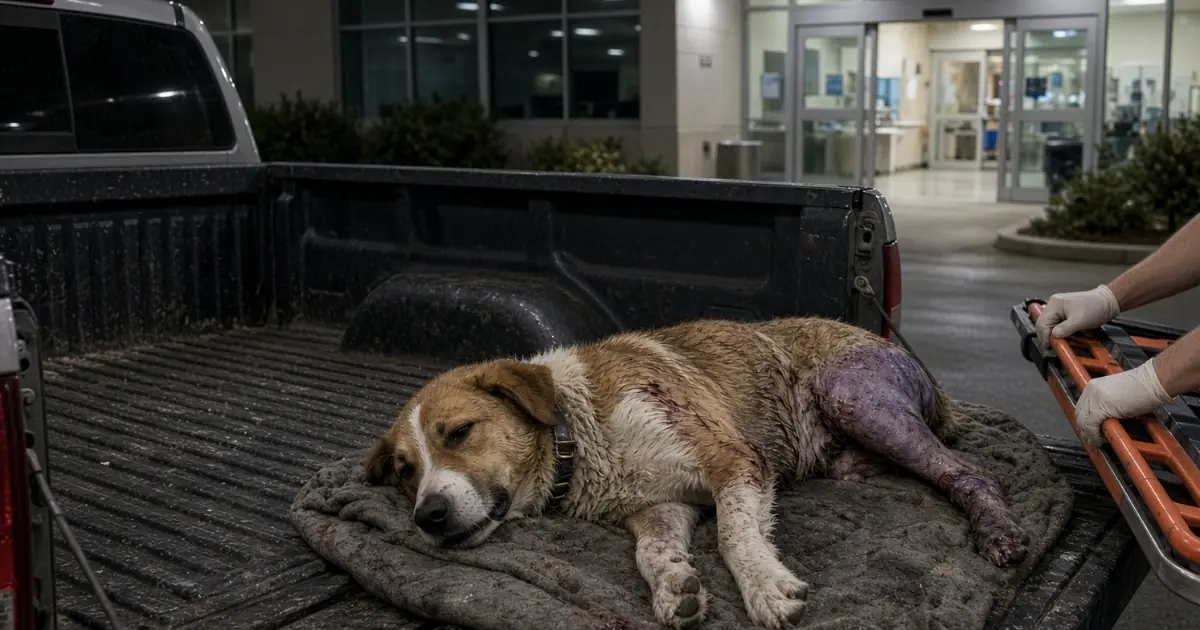
Cody was in shock.
An oxygen mask was placed over his muzzle. Staff clipped a small area of fur from one front leg and inserted an IV catheter so medication and fluids could begin.
His wet coat was covered with warm blankets.
The team examined his chest and abdomen while trying to disturb his body as little as possible. Bruising had already formed along one side of his rib cage, and his abdomen appeared tense.
Those findings raised concern for internal bleeding.
The rear leg was the most obvious injury.
The lower portion had twisted unnaturally, and swelling was spreading around the thigh and knee. The skin had not opened completely, but several roadside abrasions covered the leg.
Cody’s paw felt cooler than the one on the opposite side.
Before deciding whether the leg could be saved, the team needed to know whether Cody would survive the trauma affecting the rest of his body.
A rapid ultrasound revealed fluid inside his abdomen.
The amount was not yet large, but any unexplained fluid after a vehicle impact had to be treated seriously. It could represent blood leaking from the spleen, liver or another damaged organ.
Cody’s blood tests showed anemia.
Because no one knew his normal values, the team could not immediately determine how much blood he had already lost. Repeat tests would show whether the count continued falling.
X-rays were taken once his circulation became slightly more stable.
The images confirmed multiple fractures in Cody’s rear leg. The femur had broken above the knee, and the joint itself appeared damaged.
His pelvis also contained a fracture.
Two ribs were cracked, but there was no immediate evidence that they had punctured his lungs.
His spine remained aligned.
That was one of the first pieces of cautiously encouraging news.
The ultrasound was repeated.
The fluid in Cody’s abdomen had increased.
The emergency team prepared blood for a transfusion while contacting a veterinary surgeon. Cody was not stable enough for the long orthopedic procedure his leg would eventually require, but he might need immediate abdominal surgery if the internal bleeding continued.
No one could yet promise that he would leave the operating room alive.
Cody remained beneath oxygen support as the transfusion began. His heart rate slowed slightly, and some color returned to his gums.
He still could not raise his head.
Each time the treatment table moved, his eyes followed the people around him. Otherwise, his body remained nearly motionless.
A microchip scan produced no result.
Cody wore no collar, and the people who brought him in had not seen anyone searching the roadside. The clinic notified animal control and contacted a local rescue willing to authorize emergency treatment if no owner could be located.
Meanwhile, the medical team continued watching his abdomen.
The suspected source of bleeding appeared to be his spleen. The organ may have torn during the impact, allowing blood to collect internally.
For a short period, Cody’s blood pressure improved.
Then it fell again.
Waiting was no longer safe.
Cody was prepared for emergency surgery.
The injured rear leg was temporarily stabilized so it would not shift while he was moved. His abdomen was shaved and cleaned, and monitoring equipment was attached before anesthesia began.
The surgeons found a tear in his spleen.
They controlled the bleeding and removed the irreparably damaged portion. Other abdominal organs were bruised but did not appear ruptured.
The discovery explained why Cody had arrived so pale and weak.
The broken leg had been frightening to see, but the hidden bleeding inside his abdomen had been taking his life much faster.
Cody remained under close monitoring as the surgical team completed the procedure.
Repairing the leg during the same operation would have kept him under anesthesia too long. It was cleaned, supported and left for a later decision.
The immediate goal was to bring Cody out of surgery alive.
Recovery was slow.
He remained dependent on oxygen, warmed fluids and blood-pressure support. A second transfusion was required after repeat testing showed that his red blood cell level remained dangerously low.
For hours, Cody did not fully awaken.
His breathing stayed shallow, and his temperature repeatedly dropped despite active warming.
Staff watched the monitors for any sign that his heart or lungs were failing.
Shortly before midnight, Cody moved his front paw.
A technician spoke his name, which staff had chosen from the paperwork created at intake. His eyes opened briefly, then closed again.
The movement was small.
It was also the first deliberate response since surgery.
Cody survived the night.
By morning, his blood pressure had begun holding without as much medication. Repeat ultrasound showed no new accumulation of fluid inside his abdomen.
The internal bleeding appeared to be controlled.
His condition remained critical, but the immediate threat had eased.
Pain medication kept Cody comfortable while the orthopedic team reassessed his rear leg.
The fractures were severe.
The femur might be repairable with metal implants, but damage around the knee and reduced circulation to the lower leg complicated the prognosis. Swelling made it difficult to determine how much tissue would remain healthy.
The surgeons discussed two options.
They could attempt a complex repair and monitor the leg closely, knowing that further surgery might still be required.
Or they could amputate the limb, shortening the recovery and removing tissue at high risk of infection and chronic pain.
The decision could not be made from the X-rays alone.
As the swelling decreased, the team repeatedly checked warmth, pulses and sensation in Cody’s paw. He reacted faintly when pressure was applied between his toes.
Some nerve function remained.
That response gave the leg a chance.
The orthopedic repair was scheduled once Cody became stable enough for another anesthetic procedure.
Until then, he stayed in the intensive-care enclosure with the limb protected by a padded support. He was repositioned carefully to prevent pressure on his fractured pelvis and surgical abdomen.
Food was offered the day after surgery.
Cody smelled the small bowl but turned his face away. He remained nauseated and exhausted.
A technician tried again several hours later, holding a small amount of soft food near his mouth.
Cody licked once.
On the third attempt, he swallowed several bites.
His appetite returned slowly over the following day. Each portion remained small so his body would not be overwhelmed while recovering from shock and anesthesia.
Animal control inspected the place where Cody had been found.
Broken plastic and fresh tire marks were visible near the shoulder, but no vehicle parts provided a clear identification. Nearby businesses were asked to review exterior camera footage.
One recording showed a dog moving along the roadside shortly before the suspected collision.
Several minutes later, a vehicle slowed abruptly.
The impact itself occurred outside the camera’s view.
The vehicle continued driving.
Investigators could not determine whether the driver knew Cody had been struck. No one contacted authorities to report the accident.
Cody’s photograph was shared with surrounding shelters, veterinary offices and lost-pet groups.
No verified owner came forward.
At the hospital, Cody’s leg surgery proceeded.
The surgeon realigned the femur and stabilized it with orthopedic hardware. Damage around the knee required additional repair, while the abrasions along the limb were cleaned and covered.
The surgery went as planned.
But saving the leg would depend on what happened next.
Circulation needed to remain strong. The wounds had to avoid infection, and Cody would eventually need to use the limb enough to rebuild muscle without placing excessive force through the healing fractures.
For the first day after surgery, he remained mostly still.
His rear leg lay within a thick protective bandage, and an IV continued delivering fluids and medication. The hair around his abdomen and thigh had been shaved, revealing bruises that had been concealed beneath his wet coat.
Cody finally raised his head that evening.
He held it several inches above the bedding and looked toward the enclosure door.
The effort lasted only a few seconds.
Then he lowered his chin onto the blanket.
The moment marked a clear change from the dog who had arrived unable to lift his face from the pickup bed.
Over the next several days, Cody became more alert.
He ate every measured meal and began shifting his front legs beneath his chest. His abdominal incision remained clean, and blood tests showed that the anemia was no longer worsening.
The repaired rear leg stayed warm.
His paw responded to touch.
Those signs suggested the limb still had adequate circulation and nerve function.
Standing was another matter.
Cody had a fractured pelvis, abdominal surgery and a newly repaired leg. Supporting his body too soon could damage the healing tissues.
A padded sling was placed beneath his abdomen during brief bathroom breaks. Two caregivers supported him while keeping the injured leg away from the floor.
Initially, Cody made no attempt to help.
He hung quietly in the sling with his front paws touching the mat.
On the next attempt, he pushed through both front legs.
His chest rose.
Although most of his weight remained in the sling, Cody held himself upright for several seconds before tiring.
Rehabilitation began with movements small enough to protect every injury.
The therapist gently flexed and extended the joints that could be moved safely. Cody’s paws were repositioned regularly, and his remaining limbs were checked for strain.
Large dogs recovering from a severe leg injury can quickly overload the opposite side. Maintaining safe alignment was essential.
Cody tolerated the sessions quietly.
Whenever discomfort increased, his ears flattened and his body became tense. The therapist stopped before he had to struggle.
One week after the collision, Cody placed the toes of his repaired leg against the mat.
He did not bear meaningful weight.
He simply allowed the paw to touch the surface.
The next day, he pressed down slightly before lifting it again.
Progress came in brief, almost invisible moments.
A paw remaining on the floor for one extra second.
A front leg moving forward without the sling carrying all his weight.
Enough strength to turn his head toward the person holding his food.
The truck driver who had brought Cody to the hospital called regularly for updates. He had not known whether the dog was still alive after handing him over at the emergency entrance.
The rescue explained that Cody had survived both surgeries, but his long-term mobility remained uncertain.
The man provided every detail he remembered from the roadside, though none identified an owner or the vehicle involved.
Cody was transferred from intensive care to a medical recovery run once he no longer required continuous oxygen and blood-pressure support.
His enclosure contained a low orthopedic mattress, nonslip flooring and enough space for the sling to be used safely.
The first night there, Cody slept almost continuously.
In the morning, he raised his head before breakfast arrived.
He had begun recognizing the sound of the food cart.
Two weeks after the accident, new X-rays showed that the orthopedic repair remained properly aligned. Healing was still in its earliest stage, but no implant had shifted.
The skin wounds on the leg were also closing.
The risk of losing the limb had not disappeared, yet it had become less immediate.
Cody took his first supported steps soon afterward.
The sling carried most of the weight behind him. His front paws moved first, followed by the uninjured rear leg.
The repaired leg remained lifted.
After two steps, Cody stopped.
The therapist waited.
He lowered the injured paw until the toes touched the mat, shifted a small amount of weight toward it and then moved forward again.
Four steps exhausted him.
He returned to the mattress and slept for the rest of the afternoon.
Cody is now continuing his recovery under the rescue’s medical care.
He still requires restricted activity, wound monitoring and repeated imaging. The fractured pelvis must heal alongside the repaired leg, and the abdominal surgery has added another layer to his rehabilitation.
No confirmed owner has contacted the rescue.
The person who struck him has not been identified.
Cody cannot explain why he was on the road or how long he lay there before someone stopped. He cannot describe the vehicle or say whether the driver ever looked back.
His injuries provide only part of the story.
The deformed rear leg was what first caught everyone’s attention. It was visible from the moment he was lifted from the roadside.
The internal bleeding was not.
Had Cody reached the ER much later, the damaged spleen might have ended his life before anyone had time to examine the fracture.
Today, Cody can lift his head, sit upright with assistance and take several supported steps. His repaired leg remains weak, but it is warm, responsive and still part of his body.
The emergency doors had been only a few feet from the pickup bed that morning.
For Cody, crossing that distance required a stretcher, a transfusion and two major operations.
He is still learning how to cross a room.
But the dog who arrived unable to raise his head now watches the door—and pushes his chest upright whenever he hears someone bringing the sling.