When Cooper first arrived at the shelter, employees believed the yellow Lab-type mix would probably leave quickly. He was young, physically healthy enough for adoption, comfortable around people after a short introduction, and familiar enough with ordinary handling that staff suspected he had spent much of his life inside a home. His warm tan coat and large brown eyes also made him easy to notice, and visitors frequently stopped in front of his kennel even when they had originally entered the building to meet another dog. Nothing about those first few days suggested that Cooper would eventually become one of the animals whose future could be reduced to a single date on a shelter record.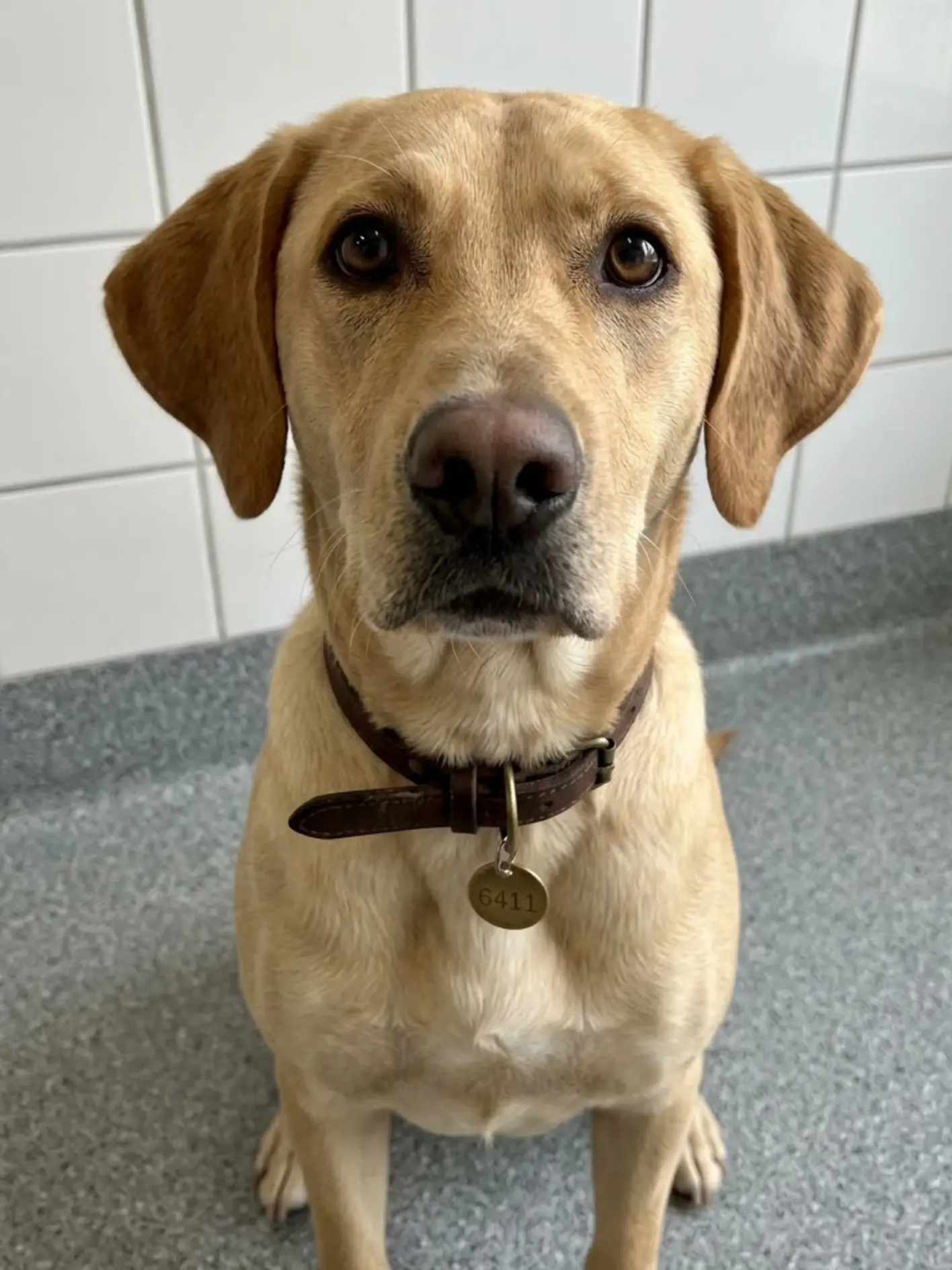
Cooper had been surrendered after his previous owner lost stable housing and moved temporarily into a place where pets were not permitted. According to the information provided during intake, the decision had not been planned far in advance, and the owner had attempted to find someone willing to keep Cooper before bringing him to the shelter. Friends were contacted, relatives were asked, and one temporary arrangement fell apart when the person offering help realized their landlord prohibited another dog. By the time Cooper entered the facility, the practical options available to his owner had narrowed to almost nothing.
Shelter employees did not describe Cooper as a dog surrendered because of aggression or a serious known behavioral problem. He accepted a leash, allowed routine handling, and had no known bite history during his stay. Staff noticed that he could become excited when other dogs passed closely in the kennel corridor, but once he was outside the building and given a little distance, much of that intensity disappeared. He spent more time investigating the ground than pulling toward other animals, and volunteers found that moderate exercise usually helped him settle.
During his first week, Cooper drew enough attention that staff had little reason to worry. Families paused near his kennel, people photographed him through the bars, and several visitors asked how long he had been available. More than once, employees heard someone say that a dog who looked like Cooper would not be there for long, and at the time there was nothing unreasonable about that prediction. He was exactly the kind of adult dog many people claim to want: past the smallest puppy stage, still young enough for years of activity, and seemingly comfortable around familiar adults.
The first serious inquiry came from a man who had recently moved into a house and wanted a dog to accompany him on walks. He spent nearly forty minutes with Cooper outside and appeared impressed by how quickly the dog relaxed once they were away from the kennel rows. The meeting ended only after the man explained that he traveled several times each month and had not arranged consistent care during those trips. He left saying he needed to solve that problem before taking responsibility for an animal.
A second visitor came several days later after seeing one of Cooper’s photographs online. She already had a small senior dog and asked whether Cooper could meet him before she made a decision. Staff arranged a controlled introduction, but the older dog became visibly uncomfortable when Cooper approached with youthful enthusiasm. Cooper responded to redirection and no fight occurred, yet the woman decided that bringing a much younger, larger dog into her senior pet’s home would create more stress than she was willing to risk.
Those were responsible decisions, even though they left Cooper exactly where he had started. A shelter dog’s need for placement does not make housing restrictions disappear, and it does not mean the needs of animals already living in a home should be ignored. A person who recognizes an unsuitable match before completing an adoption may prevent a stressful return later. For Cooper, however, each reasonable decision still meant another evening behind the same kennel door.
The opportunity employees had been waiting for finally appeared during his second week. A woman named Amanda visited with her adult son after seeing Cooper shared in a local community group. She had owned larger dogs before, lived in a house with a fenced yard, and had no other animals. After two meetings and a long conversation with shelter staff, she decided to adopt him.
For the first time since Cooper arrived, his kennel was expected to become available because he was actually going home. Records were reviewed, available medical information was transferred, and Amanda was advised to keep his first days quiet while he adjusted. Staff explained that a dog leaving a shelter can behave differently after entering a home and that immediate excitement, pacing, whining, accidents, or difficulty settling should not automatically be interpreted as a serious problem. Amanda listened, signed the paperwork, clipped on Cooper’s new leash, and walked him through the front doors.
The adoption lasted less than forty-eight hours.
Amanda contacted the shelter the following evening and said Cooper had been restless almost continuously since arriving. He followed her through the house, whined when she went into another room, barked when someone walked past the front window, and had knocked over a trash container while she was away briefly. None of the behaviors involved a bite or serious attack, but Amanda said the intensity was more than she had expected and that her son was concerned she had taken on too much.
Staff encouraged her to consider the possibility that Cooper was still decompressing. Less than two days in a completely unfamiliar environment was not enough time for most dogs to understand a new household, particularly after losing one home and spending time in a shelter. They discussed limiting stimulation, establishing a predictable routine, and consulting a trainer if needed. Amanda nevertheless believed she had made the wrong decision and asked to return him.
The shelter accepted Cooper back.
Nobody working there considered the return an ideal outcome, but blaming Amanda would not change what had happened. A person who genuinely believes they cannot safely or responsibly maintain an adoption may ultimately return an animal despite good intentions. The more useful question for staff was what Cooper’s brief stay had revealed and how that information could improve the next placement.
His updated notes now included the fact that he might experience significant uncertainty during the first days in a new home. He could follow people closely, struggle when separated from them, and require an adopter prepared for a decompression period rather than expecting immediate calm. Those details did not make Cooper unadoptable. They made the next match more specific.
When Cooper returned to his old kennel, employees noticed that he appeared familiar with the environment almost immediately. He knew where the water bowl was placed, recognized several workers, and responded quickly when volunteers he had met before approached with a leash. Whatever confusion he experienced about moving from one environment to another could not be known, but from a practical standpoint, the shelter was once again the only confirmed place available to him.
The timing of that return could hardly have been worse.
While Cooper had been outside the building, new animals had continued arriving. Several strays were admitted over the same weekend, including dogs whose owners still needed time to locate and reclaim them. A dog injured near a roadway required immediate housing after veterinary treatment, and two owner surrenders entered after their family experienced an emergency move. Employees had been expecting Cooper’s kennel to remain available after his adoption, but forty-eight hours later, he was occupying it again.
That did not mean staff blamed him for returning. It meant that the shelter’s physical capacity had already changed while everyone believed his case had been resolved. Kennels that had been available when Amanda adopted Cooper were now occupied, and the facility had fewer options for moving dogs internally. Cooper returned not to the same shelter situation he had left, but to a building under greater pressure.
Employees resumed promoting him immediately. His profile was updated honestly rather than hiding the failed adoption, because another family needed to understand what had happened. Staff emphasized that no bite had been reported and that the return followed restlessness and difficulty settling during the first two days. They also explained that Cooper would likely do best with someone who understood that the first week in a new home might look very different from the months that followed.
Some people responded positively to the honesty. Others saw the word “returned” and moved on.
That reaction created another challenge. Shelter dogs are sometimes treated as though any return proves there must be something fundamentally wrong with them, but placements fail for many reasons. A dog may enter a home that does not fit his energy level, a resident animal may be uncomfortable, a renter may discover an unexpected restriction, or an adopter may simply have underestimated the adjustment period. A return adds information to the placement process, but it does not automatically define the dog’s entire future.
For Cooper, however, the label made his next search slower.
Visitors continued noticing his face, but more people asked cautious questions once they learned he had already been adopted and returned. One family wanted a dog that could immediately be left alone throughout the workday, something staff could no longer recommend for Cooper without a gradual transition. Another adopter was interested until learning that his first days in the previous home had involved pacing and whining. Someone else said they wanted a dog that would be “easy from day one.”
Cooper could not promise that.
No shelter dog could.
A volunteer named Monica began spending more time with him because she worried that the return was becoming the first thing people knew about him. She understood why the information mattered, but she also knew it represented less than two days of Cooper’s life. During her walks with him, she saw a dog who became excited when the kennel door opened but typically settled after several minutes outdoors. He enjoyed sniffing along the fence line, accepted treats gently, and increasingly checked back toward Monica during walks without being called.
She began recording short videos of those ordinary moments. In one, Cooper was walking beside her after his initial excitement had passed. In another, he was resting in the shade while Monica sat on a bench. The videos were not designed to prove that he was perfect. They were meant to show that “returned after two days” was not the only thing there was to know about him.
The posts attracted attention again.
People commented that Cooper looked sweet and asked whether he was still available. Several expressed sympathy about the failed adoption, while others said he simply needed someone willing to give him more time. One person offered to pay his adoption fee, and another said she would contribute toward professional training for whoever eventually took him home.
The support was encouraging.
Cooper still had no placement.
This is where online rescue can become misleading. A dog surrounded by hundreds of comments may appear to have dozens of options when none of those options has been confirmed. One person sees several adoption inquiries and assumes another individual is already completing paperwork. Another sees money being offered and assumes a rescue organization must be preparing to take the dog.
A third person may genuinely be capable of fostering but decides not to call because the post looks busy enough already.
Visibility can help an animal enormously.
It is not the same thing as a destination.
Cooper’s photograph traveled through social media while Cooper himself remained inside the shelter.
As another week passed, the building became even more crowded. Staff moved dogs whenever safe alternatives existed and contacted rescue partners about animals needing additional placement options. Cooper was included in those conversations, but rescue organizations faced their own limits.
One rescue familiar with Lab-type dogs said it could probably help if someone volunteered to foster him. Every existing foster home in its network was already occupied. Another group shared his information with volunteers but had several dogs waiting ahead of him. A third organization asked whether the shelter could hold Cooper longer while it looked for space.
Staff could not promise how long that would remain possible.
People often imagine rescue groups as buildings with empty rooms ready for animals whenever a public shelter becomes crowded. Many operate very differently. They depend on private homes, volunteers, donations, and a limited number of people willing to temporarily add another dog to their households. If those foster homes are full, the rescue may have nowhere to place a dog regardless of how strongly its members want to help.
Cooper needed an actual opening.
For several days, none appeared.
One possible foster contacted the shelter and seemed promising until staff learned that the household already contained three dogs and had no practical way to keep Cooper separated during an adjustment period. Another woman wanted to foster but could not obtain permission from her landlord. A man offered to take Cooper temporarily, then stopped responding before the required process could be completed.
Each possibility created a little hope.
Each disappeared.
Meanwhile, the shelter’s intake continued.
Eventually, staff were told that several dogs needed immediate placement because capacity had reached a critical level. Cooper’s name appeared among them. His failed adoption, longer stay, and the continuing arrival of other animals had combined into a situation where employees could no longer assume another week would simply be available.
Volunteers shared him again with stronger language.
This time the response included anger.
Some people blamed the shelter for putting a dog at risk after he had already been through a return. Others criticized Amanda for not giving him more time. Several demanded that a rescue organization take him immediately.
Monica understood why people were upset, but she also understood that blame was not opening a kennel.
The employees feeding Cooper had not returned him.
Amanda had not intentionally adopted him with the goal of bringing him back.
Rescue organizations were not refusing him because they believed he lacked value.
The crisis existed because every available option had failed to become physical space.
That was the problem that needed solving.
The notice staff had hoped to avoid eventually became official. If no appropriate adopter, foster, or rescue placement could be confirmed, Cooper was scheduled to be euthanized for space.
The deadline was today.
For Monica, the word “today” changed the emotional weight of everything without changing Cooper’s routine at all. He ate his morning meal, watched employees pass through the kennel corridor, and stood when he saw her carrying the leash. Nothing about his behavior suggested that he understood this particular morning had been assigned a different meaning from the one before it.
Dogs do not understand shelter deadlines.
They understand patterns.
Food arrives.
Doors open.
Someone familiar appears.
A leash means the kennel is about to open.
Cooper knew those things.
The people around him knew that unless something changed before the day ended, there might not be another morning routine.
Monica took him outside.
She deliberately walked the same route they usually followed because there was no reason to transform Cooper’s familiar routine into a human farewell he could not understand. He investigated the fence line, stopped near a patch of grass, and then followed her toward the quieter side of the yard.
After several minutes, Monica sat on a bench.
Cooper remained beside her.
The scene contained none of the drama people might imagine from an urgent shelter post. He was not clawing at the gate or somehow pleading to be saved. He was simply a dog standing near someone he recognized.
That ordinary behavior made the situation harder for Monica.
She stayed longer than usual.
Eventually, they walked back inside.
Cooper entered his kennel.
The gate closed.
Staff continued working through the calls.
The morning post made the situation clear: Cooper still needed a confirmed exit today. Despite previous interest, donation offers, and thousands of views, there was no approved adopter, foster, or rescue placement attached to his record.
Several new inquiries followed.
A family asked whether the shelter could keep him until the weekend because they wanted to meet him then. Staff could not promise that.
A woman offered to adopt immediately but disclosed that her partner had not agreed to bringing a dog home. Employees encouraged her to resolve that first. Beginning an adoption inside a household where one adult already resented the decision could easily recreate the instability Cooper had just experienced.
Another caller owned several cats and wanted staff to guarantee compatibility.
They could not.
Urgency did not allow them to manufacture certainty.
The goal was not simply to move Cooper through the nearest available door before the clock ran out. The placement had to have enough structure to avoid another rapid return.
By midday, Cooper was still there.
Online, people were becoming increasingly desperate because the photographs were receiving enormous attention. Someone pledged several hundred dollars to any rescue organization willing to pull him. Others offered transportation.
The support could become valuable once an appropriate placement existed.
It still could not become a home by itself.
Monica posted another update that focused on this difference. Cooper did not need another person saying that somebody should save him. He needed someone whose housing, schedule, household, and willingness actually allowed them to do it.
Shortly afterward, the shelter received a call from a man named Adrian Brooks.
Adrian was 45 and owned a small landscaping business. He lived in a house by himself and had spent most of the previous year without a dog after his longtime companion died at fourteen. Several friends had encouraged him to adopt again, but Adrian had resisted because his previous dog had been unusually easy by the final years of his life, and he was not sure he wanted to return to training, adjustment, and uncertainty.
He had seen Cooper’s photograph that morning because one of his employees shared it.
The deadline got his attention.
The return history made him continue reading.
Adrian had adopted his previous dog as a young adult, and the first month had been difficult. The dog had chewed part of a doorframe, barked when left alone, and destroyed a cushion during the second week. None of those behaviors survived into the version of the dog Adrian remembered at fourteen years old.