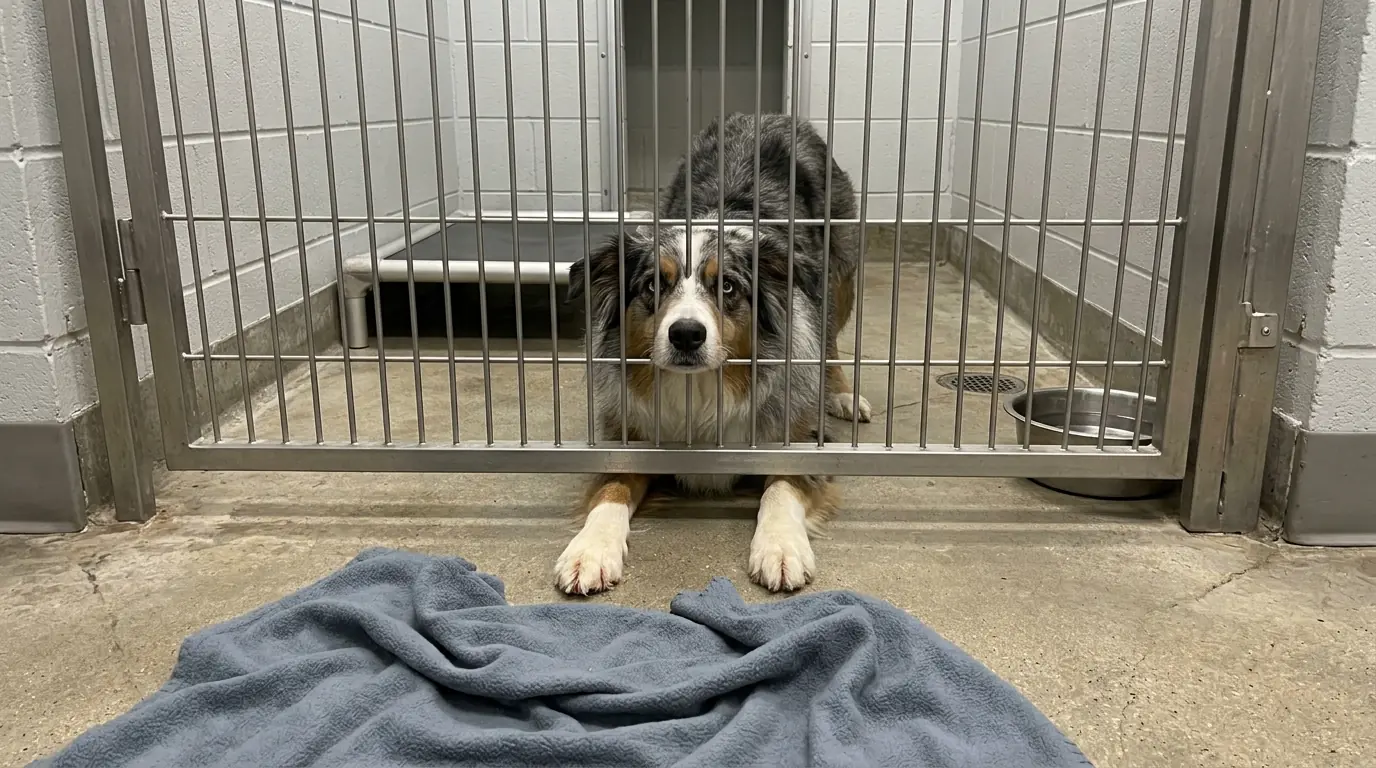
Dexter can be completely relaxed until the blanket touches the wrong part of his body.
The seven-year-old Australian Shepherd mix may spend twenty quiet minutes lying on the kennel floor with the blanket gathered beside him. Sometimes his chin rests on it. Sometimes he stretches one front paw across the fabric.
Nothing appears wrong.
Then Dexter shifts.
The blanket brushes against one of his back legs.
His reaction is immediate.
Dexter jerks upright as though something has startled him from behind. He spins toward the fabric, grabs it in his teeth, and begins dragging it across the kennel.
He does not stop when the blanket is several feet away.
He pulls it all the way to the barred door.
Then Dexter shoves and tugs until enough of the fabric slips beneath the gap that the rest follows.
The blanket lands in the hallway.
Dexter backs away.
He retreats to the corner, panting.
For a moment, it seems as though he has gotten exactly what he wanted.
Then, only minutes later, Dexter walks back to the gate.
He sees the blanket outside.
His ears shift forward.
A quiet whine begins.
Dexter pushes his muzzle between the bars.
Then he reaches one front paw through them, stretching toward the very blanket he had just fought so hard to remove.
He cannot reach it.
The whining grows louder.
And suddenly, the object Dexter could not tolerate touching his back legs has become the one thing he desperately wants returned.
The Blanket Itself Doesn't Seem to Frighten Dexter
That is the first important clue.
If Dexter simply feared blankets, his behavior would be easier to interpret.
But he does not avoid this one all the time.
He lies beside it.
He sniffs it.
He sometimes rests his head on it.
When it is folded away from his hindquarters, Dexter can appear completely comfortable.
The reaction begins when the fabric makes contact with the back of his body.
It Doesn't Take Much Contact
The blanket does not need to cover him.
Nobody has to wrap it around his legs.
Sometimes one loose edge is enough.
Dexter shifts backward.
The fabric brushes a hind paw.
His head snaps around.
His body rises.
Within seconds, he is trying to get the blanket away from himself.
That specificity makes staff look beyond the obvious explanation.
Is Dexter Afraid—or Does Something Hurt?
A sudden reaction to touch can have many possible causes.
Pain is one.
A dog with discomfort in the hips, knees, spine, paws, or surrounding soft tissues may react strongly when an object unexpectedly contacts a sensitive area.
Neurologic problems can also change sensation.
A light touch may be perceived differently than expected.
There can be behavioral explanations too.
The reaction alone cannot tell staff which one applies to Dexter.
His Hind Legs Need Attention
Dexter is seven—not extremely old, but old enough that orthopedic issues are possible.
Staff begin paying closer attention to how he moves.
How does he rise?
Does he put equal weight on both hind legs?
Does he hesitate before jumping or turning?