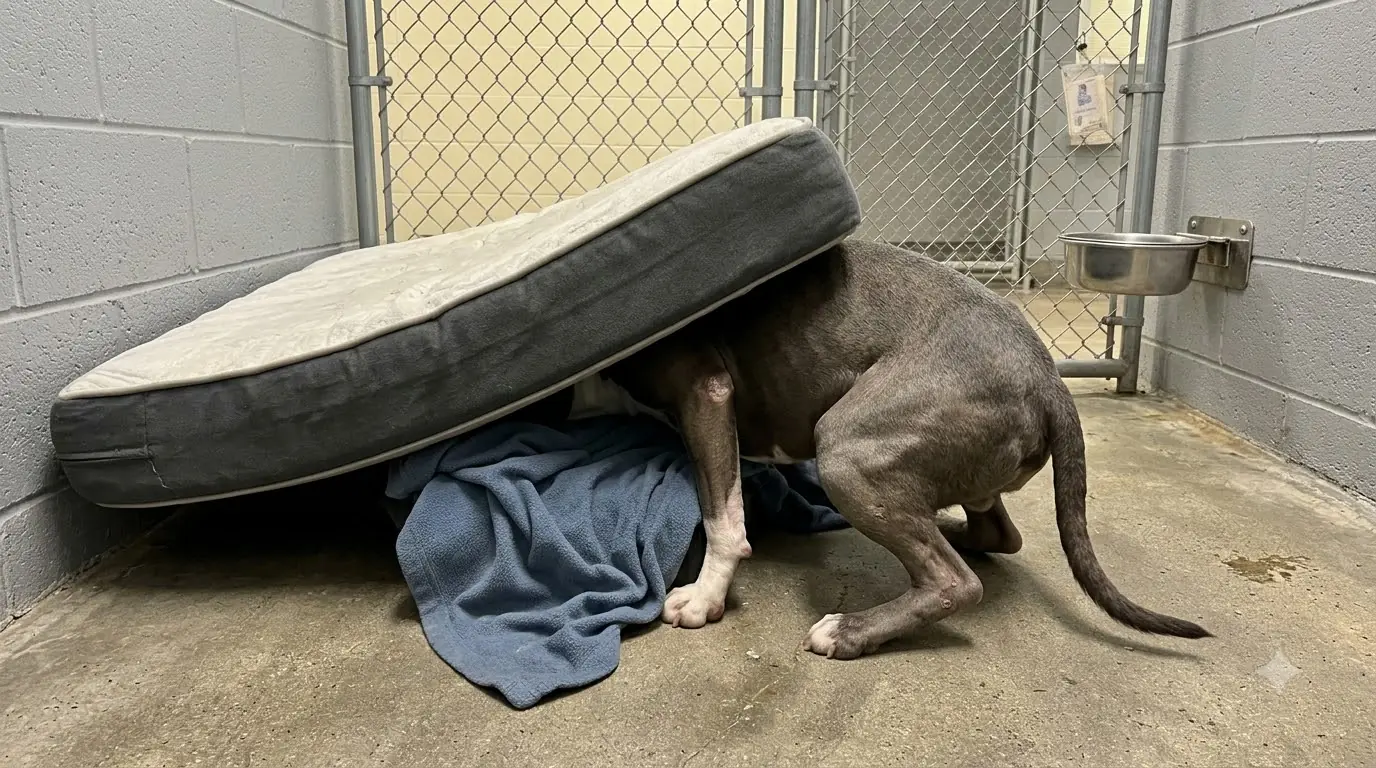
Diesel had an entire orthopedic bed to lie on.
Instead, the 7-year-old American Pit Bull Terrier kept trying to disappear beneath it.
A shelter worker watched as Diesel lowered his head, caught the edge of the mattress with one paw, and pushed it upward.
Then his muzzle disappeared underneath.
His head followed.
Diesel kept crawling until his shoulders and nearly half of his body were wedged beneath the raised edge.
Only his hindquarters remained visible.
His body was trembling.
The worker didn't pull him out.
They didn't lift the mattress away.
Instead, the person sat down on the kennel floor several feet away.
For a while, Diesel remained exactly where he was.
Then his head appeared.
He watched the person.
Slowly, Diesel began crawling out.
He moved across the floor until he reached the worker's feet.
Then he lowered his head beside them and stopped.
For the first time since the worker entered, Diesel no longer seemed determined to get underneath the bed.
Diesel Had Been Found Somewhere Very Different
Before the shelter kennel, there had been a garage.
Animal control found Diesel confined inside during dangerously hot conditions.
He was dehydrated.
Several areas of his skin were scraped and irritated.
His body trembled uncontrollably.
Getting Diesel out of the garage was urgent.
But removing him from the environment did not instantly reverse what his body had been through.
He still needed medical attention.
Dehydration Was an Immediate Concern
Heat and inadequate hydration can become dangerous quickly.
A dog arriving dehydrated needs careful assessment because the problem can involve much more than simply feeling thirsty.
Veterinary staff needed to evaluate Diesel's overall condition and determine the supportive care he required.
They also had to consider the circumstances of his heat exposure.
Was his body temperature appropriate by the time he was evaluated?
How was his circulation?
Was he alert and responsive?
Could he drink normally?
Were there signs that required more intensive monitoring?
Those questions had to be answered by Diesel's actual examination.
The Trembling Couldn't Automatically Be Blamed on Fear
Diesel looked frightened.
His posture was low.
He sought cover.
He was reluctant to expose himself in the kennel.
But the shelter could not assume every tremor was behavioral.
Shaking can accompany stress.
It can also occur with pain, weakness, temperature changes and other medical problems.
Diesel had just arrived dehydrated after being removed from a hot garage, with visible abrasions on his body.
His physical condition needed to be taken seriously.
The shelter could address his fear-like behavior while still investigating medical reasons for the trembling.
His Skin Showed More of What His Body Had Been Through
The scraped areas required attention too.
Staff checked the wounds and irritated skin rather than assuming they would simply heal once Diesel was indoors.
Depending on severity, abrasions may require cleaning, protection, pain management and monitoring for complications.
Nobody needed to invent exactly how each scrape had occurred.
The garage explained where Diesel was found.
It did not provide a reliable account of every injury.
The shelter documented what was actually there.
Then Diesel Was Given Somewhere Soft to Rest
Once he was stable enough for the shelter environment, caregivers prepared a supportive resting area.
The orthopedic bed seemed particularly useful.
Diesel's body had already been through significant physical stress.
A padded surface could keep him off the hard kennel floor and provide a more comfortable place to recover.
Diesel approached it.
But instead of climbing onto the center and stretching out, he began manipulating the edge.
At first, staff thought he was simply arranging the bedding.
Then he pushed his entire head underneath.
It Became a Pattern
Diesel pawed at the mattress.
Lifted the edge.
Pushed his face underneath.
Then crawled farther.
Sometimes his shoulders disappeared.
Sometimes nearly half of his body was covered.
Once he settled, Diesel could remain there with very little movement.
The orthopedic bed was supposed to support him.
Diesel was using it as cover.
That changed how staff looked at the behavior.
They Couldn't Know Why He Wanted to Be Underneath It
The obvious temptation was to connect the bed directly to the garage.
Perhaps Diesel had learned to hide.
Perhaps enclosed spaces felt familiar.
Perhaps the open kennel was overwhelming.
All were possible interpretations.
None could be established simply by watching him crawl beneath a mattress.
Dogs often seek sheltered spaces for different reasons.
Environmental stress could certainly be relevant.
But pain, illness, fatigue, temperature preference and other factors could also influence where a dog chooses to rest.
Staff needed to remain curious without turning speculation into Diesel's history.
Pulling Him Out Wouldn't Answer the Question
The first concern was safety.
Could Diesel breathe comfortably beneath the mattress?
Could he exit without difficulty?
Could his abrasions rub against the bedding?
Was he putting uncomfortable pressure on injured areas?
Those questions mattered.
But if the setup could not be made safe, the answer would be to provide another appropriate sheltered option—not repeatedly drag Diesel into the open.
The shelter wanted to reduce his need to wedge himself beneath heavy bedding.
It did not want to punish him for seeking cover.
One Worker Tried Something Simpler
The kennel door opened.
Diesel reacted immediately.
His body lowered.
He moved toward the bed.
Soon his head was underneath again.
The worker entered but stopped several feet away.
No leash appeared.
No hand reached under the mattress.
The person sat down on the floor.
Diesel stayed hidden.
Minutes passed.
Nothing Was Asked of Him
The worker did not repeatedly call his name.
They did not pat the floor.
They did not try to lure him out by moving closer.
Diesel could remain beneath the bed.
For a while, he did.
His visible hindquarters still trembled.
Then the mattress shifted.
Diesel's nose appeared.
He stopped.
Watched.
The person remained still.
Diesel Began Coming Out on His Own
His head emerged first.
Then his shoulders.
Diesel kept his body low to the ground.
He did not stand and walk confidently across the kennel.
He crawled.
A few inches.
Pause.
Another few inches.
The worker did not reach for him.
Eventually Diesel crossed the space between them.
His nose reached the person's shoe.
Then he lowered his head to the floor beside the worker's legs.
And stayed.
His Body Hadn't Suddenly Become Completely Relaxed
That distinction mattered.
Diesel was not “cured” because someone sat beside him.
His body still carried tension.
He remained cautious.
And the underlying medical concerns that came with his rescue had not disappeared.
But his behavior had changed without anyone physically removing him from his hiding place.
Diesel had chosen to come out.
Staff remembered that.
The Next Day, He Went Under the Bed Again
The mattress lifted.
Diesel pushed his head underneath.
His shoulders followed.
From outside the kennel, it looked as though nothing had improved.
But the shelter did not expect one quiet interaction to erase an established response.
A new environment can take time to become predictable.
Diesel had experienced a significant physical ordeal before arrival.
His body was still recovering.
Caregivers continued working at his pace.
His Medical Recovery Had to Come First
As Diesel's hydration improved, staff continued watching his overall condition.
Was he eating?
Drinking appropriately?
Moving comfortably?
Were the abrasions healing?
Was the trembling changing?
Did it occur primarily during stressful interactions, or was it also present when he was resting undisturbed?
That last question could be particularly useful.
If Diesel trembled even when apparently settled and alone, staff would want to consider that information alongside his medical examination.
If it intensified mainly when people or environmental stimuli approached, that pattern could also be documented.
Observation was more useful than assumptions.
The Bed Wasn't Taken Away Without an Alternative
Diesel still needed padding.
So caregivers considered how to provide both physical support and an appropriate sense of shelter without allowing him to become dangerously wedged beneath bedding.
The answer was not simply an empty concrete kennel.
His environment could be adjusted.
A safer sheltered resting option could give Diesel some visual separation while allowing staff to monitor him.
Soft surfaces could remain available.
The goal was to give him choices that did not require him to bury half his body beneath a mattress.
Staff Also Stopped Expecting Him to Approach the Kennel Door
Diesel did not need to come forward for every interaction.
If a caregiver could safely bring necessary care closer to him, they did.
People could sit at a distance.
They could allow Diesel to observe.
If he approached, the decision came from him.
That mattered because forcing a fearful or physically compromised dog through repeated interactions can make every person entering the kennel another event to endure.
Diesel needed a different pattern.
People Started Sitting With Him Regularly
Not every visit produced the same result.
Sometimes Diesel remained beneath his bedding the entire time.
The worker eventually stood and left.
Sometimes his head appeared but he went no farther.
On better days, Diesel crawled out and rested near the person's feet.
Nobody demanded consistency.
The fact that he had approached yesterday did not mean he was required to approach today.
Then the Distance Began Getting Shorter
A worker sat down.
Diesel was under the bed.
This time his nose appeared sooner.
He watched.
His front legs moved forward.
Instead of crawling the entire distance with his belly pressed to the floor, Diesel rose slightly.
He took a few cautious steps.
Then lowered himself again beside the worker.
It was not a dramatic transformation.
But it required less effort and less hesitation than before.
The Trembling Began to Change Too
Staff noticed periods when Diesel's body was quieter.
Not always.
A sudden sound could still make him tense.
An unfamiliar person could still send him toward cover.
But during some interactions with familiar caregivers, the shaking became less intense.
That was encouraging.
It still did not prove the original trembling had been entirely caused by fear.
Diesel's medical condition and behavioral responses had to be considered together.
One Afternoon, Diesel Used the Bed Differently
He walked toward it.
Staff expected the familiar sequence.
Paw beneath the edge.
Lift.
Head underneath.
Instead, Diesel stepped onto the mattress.
He turned carefully.
Then lay down on top.
His head remained visible.
A worker sat nearby.
Diesel watched for a while.
Eventually his chin lowered onto the bed.
Nobody moved closer.
Nobody tried to turn the moment into more than it was.
Diesel was simply resting where the bed had originally been intended for him to rest.
The Next Night, He Crawled Under It Again
That did not erase the afternoon.
Recovery rarely works that neatly.
Some periods in a shelter are louder than others.
Physical discomfort can fluctuate.
A dog may use different coping behaviors on different days.
Diesel still needed the ability to retreat safely.
The important change was that hiding beneath the mattress was no longer his only option.
His Body Was Recovering on Its Own Timeline
The dehydration that had accompanied his rescue needed appropriate treatment and monitoring.
His abrasions needed time.
His strength needed to be reassessed as his overall condition stabilized.
If other medical problems were identified, those would have their own treatment plans.
There was no reason to rush Diesel into appearing energetic simply because he was no longer inside the garage.
Sometimes recovery looks like sleeping.
Sometimes it looks like drinking.
Sometimes it is a dog remaining on top of a bed instead of trying to disappear underneath it.
Nobody Knows Exactly What Diesel Remembers About That Garage
Animal control found him there.
It was dangerously hot.
He was dehydrated.
His skin was scraped.
His body trembled.
Those facts are enough.
The shelter does not need to add a detailed emotional history that Diesel cannot confirm.
What caregivers can see now is that he repeatedly seeks cover when overwhelmed.
They can respond to that behavior without pretending to know exactly where it came from.
What Happens After He Hides Is Beginning to Change
The kennel door opens.
Diesel looks toward it.
Sometimes he still pushes beneath the bed.
A caregiver enters.
They sit.
They wait.
The mattress may remain still for several minutes.
Then a nose appears.
A head.
Two front paws.
Diesel slowly comes forward.
Some days he stops halfway.
Other days he reaches the person.
When he does, he no longer needs someone to pull him from beneath the mattress.
He Still Likes to Put His Head Near Their Feet
Diesel crawls close.
Then lowers himself.
His chin rests beside a shoe or against the floor near the worker's leg.
The person does not trap him there.
Diesel can move away whenever he wants.
Sometimes he does.
Sometimes he remains until the worker eventually stands.
These are quiet interactions.
For Diesel, quiet appears to be useful.
The Shelter Isn't Trying to Make Him “Brave”
That isn't the immediate goal.
Diesel needs to be physically comfortable.
He needs to recover from the condition in which animal control found him.
He needs appropriate veterinary care.
And he needs an environment where every unfamiliar sound or approaching person does not require him to find the smallest place available and hide half his body beneath a mattress.
Confidence, if it grows, can come gradually.
Some Days, the Mattress Edge Never Moves
Diesel lies on top.
Someone passes.
His head lifts.
Then lowers again.
Another worker enters.
Diesel watches.
He remains where he is.
There is no dramatic breakthrough.
No cheering.
No sudden transformation into a completely different dog.
Just an American Pit Bull Terrier resting on a bed instead of underneath it.
For the people who first watched him trying to disappear beneath that mattress, the difference is enough to notice.
And Some Days, He Still Hides
The old behavior has not vanished.
Diesel catches the edge with his paw.
Pushes his muzzle underneath.
Then his head.
Sometimes his shoulders follow.
When that happens, staff do not punish him.
They make sure he is safe.
They pay attention to his physical condition.
And when appropriate, someone sits nearby.
No reaching.
No pulling.
Just a person on the kennel floor.
Eventually the mattress shifts.
Diesel's face appears.
He looks toward the worker.
Then, little by little, he crawls out.
He crosses the short distance and lowers his head beside their feet.
Rescuers may never know exactly why Diesel began trying so hard to disappear beneath his shelter bed after being carried out of that hot garage.
But they have learned something more useful.
When Diesel hides, forcing him into the open is not what brings him out.
Sometimes the thing that changes the entire scene is simply giving him somewhere safe to go—and someone patient enough to sit beside him until he decides he no longer needs to hide.