DOCTORS WARN: IF YOU OFTEN BREATHE THROUGH YOUR MOUTH...
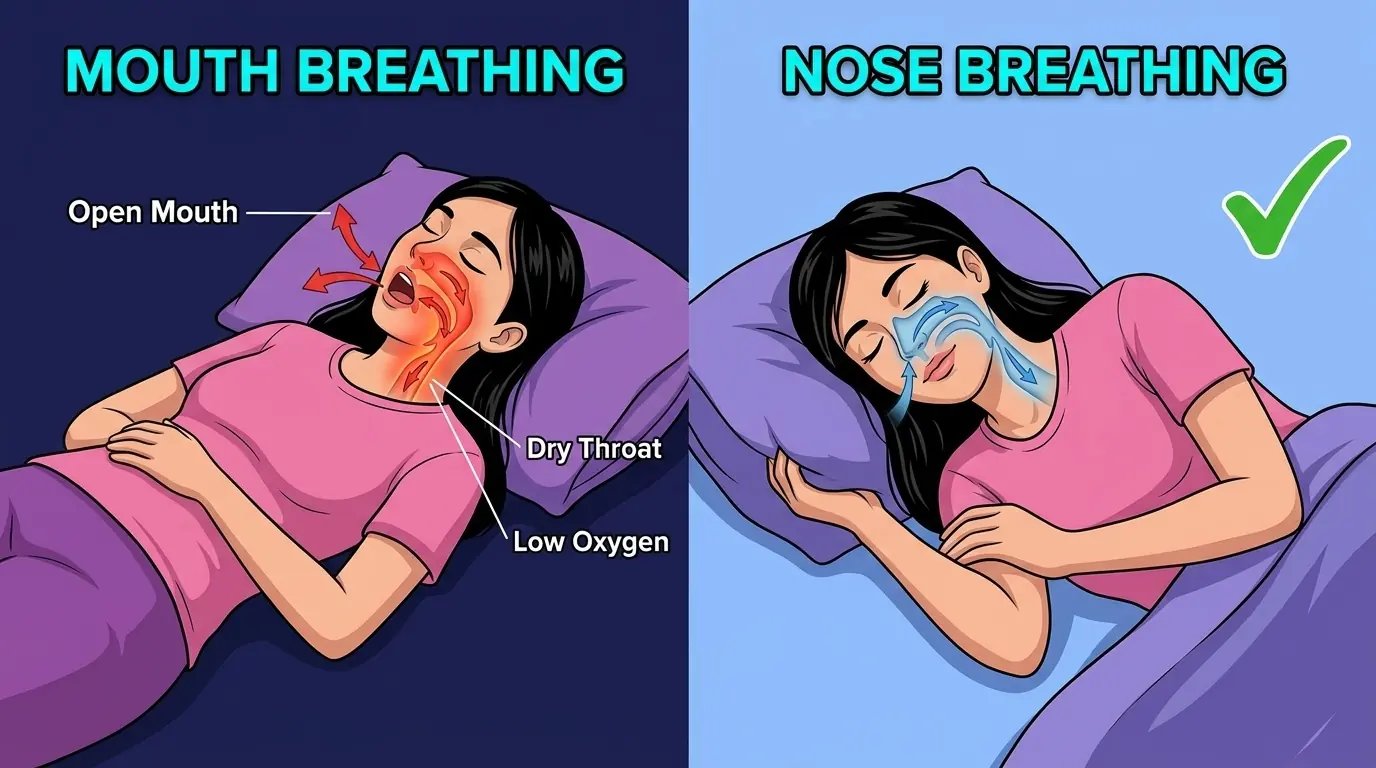
You go to sleep breathing normally.
Eight hours later, you wake up with your mouth open, your tongue feeling like sandpaper, your throat dry, and your breath much worse than it was the night before.
You drink some water and forget about it.
But then it happens again.
And again.
Maybe your partner tells you that you sleep with your mouth open.
Maybe you snore.
Maybe you wake several times during the night without knowing why.
Or perhaps you've been breathing through your mouth for so many years that you assume it's simply the way you breathe.
But here's the important part:
Regular mouth breathing, especially during sleep, isn't something you should automatically dismiss as a harmless habit.
The biggest concern isn't that air entering through your mouth is somehow poisonous.
And mouth breathing by itself does not prove that your blood oxygen is low.
The real story is more interesting.
Your nose isn't simply an alternative hole for air to travel through.
It conditions the air before it reaches deeper parts of your respiratory system.
Your mouth was never designed to perform all of those functions in exactly the same way.
And when you routinely bypass your nose for hours every night, one of the first places you may notice the consequences isn't your lungs.
It's your mouth.
Your Nose Does More Than Let Air In
Take a normal breath through your nose.
Before that air reaches your throat, it passes through a remarkably complex structure.
The nasal passages help warm and humidify inhaled air.
Mucus helps trap particles.
Tiny hair-like structures called cilia participate in clearing material from the respiratory tract.
The nose therefore doesn't merely provide a pathway.
It conditions incoming air.
Now breathe through your mouth.
Air has a much more direct route into the throat.
That's extremely useful when you need more airflow during intense exercise or when your nose is temporarily blocked.
Humans are perfectly capable of mouth breathing.
The problem is when it becomes the default for hours at a time, particularly while you're asleep.
Because the first thing that changes is moisture.
Why You Wake Up With a Dry Mouth
Your mouth is normally coated in saliva.
Most people think of saliva as nothing more than “water in your mouth.”
It isn't.
Saliva performs several protective functions.
It helps lubricate tissues.
It assists with chewing and swallowing.
It helps wash material away from teeth.
It contributes to maintaining a healthier oral pH.
It also helps protect teeth and oral tissues from microbial and chemical challenges.
The American Dental Association emphasizes that adequate saliva is essential for oral health and that reduced salivary function can increase the risk of tooth decay, demineralization and oral infections.
Now imagine sleeping for seven or eight hours with air repeatedly passing across the surfaces of your mouth.
Dryness becomes much easier to understand.
And nighttime already works against you.
Saliva production naturally drops during sleep.
The ADA specifically notes that dry-mouth symptoms may worsen at night because salivary output reaches its lowest circadian levels during sleep, and mouth breathing can make the problem worse.
That combination can explain why your mouth feels normal at bedtime but terrible at 6 a.m.
Your Morning Breath May Be Giving You a Clue
Everyone can have less-than-perfect breath in the morning.
But persistent dry mouth and unpleasant breath can occur together.
When saliva decreases, the mouth loses some of its natural cleansing ability.
Bacteria and their metabolic products can contribute to odor.
The ADA lists halitosis, or bad breath, among symptoms that can accompany xerostomia, the medical term for the sensation of dry mouth.
So if you repeatedly wake with an extremely dry mouth and bad breath, don't immediately assume your toothbrush isn't good enough.
Your nighttime breathing pattern may be part of the explanation.
But this is where we need to be careful.
Mouth breathing isn't the only cause of dry mouth.
Far from it.
Sometimes the Problem Isn't Your Breathing Habit at All
Many medications can cause dry mouth.
The effect becomes especially relevant as people get older and begin taking several medications.
The ADA notes that medications are among the most common contributors to reduced salivary function, with certain antidepressants and medications used for conditions such as overactive bladder among those associated with dry mouth.
Dry mouth can also occur with dehydration, Sjögren disease, uncontrolled diabetes, cancer treatment involving the head and neck, and other medical conditions.
So waking with a dry mouth doesn't automatically mean:
“I breathe through my mouth.”
And mouth breathing doesn't automatically explain every dental problem.
But if your mouth is visibly open during sleep and you repeatedly wake dry, the connection becomes much more plausible.
Here's Why Your Teeth May Care
Saliva is one of the mouth's natural defense systems.
It helps wash away food debris.
It buffers acids.
It participates in remineralization.
When the mouth becomes chronically dry, those protections decrease.
The ADA reports that reduced salivary flow can increase the likelihood of dental caries, tooth demineralization, sensitivity and oral infections.
That doesn't mean:
“Sleep with your mouth open tonight and you'll wake up with a cavity tomorrow.”
Dental disease doesn't happen that way.
The concern is repeated exposure over time.
Night after night.
Month after month.
Especially when mouth breathing is combined with other risk factors such as poor oral hygiene, frequent sugar intake or an existing dry-mouth condition.
The environment of the mouth matters.
Your Gums May Notice Too
Dryness doesn't affect only teeth.
The oral tissues themselves can become irritated.
The ADA notes that people with xerostomia may experience dry or fragile oral tissues and can show plaque accumulation, gingivitis or periodontal problems.
Again, mouth breathing isn't automatically the sole cause.
But if you're drying the mouth repeatedly while asleep, you're removing some of the moisture that normally protects those tissues.
This is one reason dentists may notice signs of chronic mouth breathing before patients think to mention it.
You may think you're discussing your teeth.
The dentist may be wondering how you're breathing at night.
But Why Are You Mouth Breathing in the First Place?
This is the question that matters most.
Because mouth breathing can be the symptom rather than the disease.
Imagine trying to breathe through your nose while one or both nasal passages are chronically obstructed.
Eventually, your body chooses the easier route.
Your mouth opens.
Air enters.
Problem solved.
At least temporarily.
But what caused the obstruction?
Possibilities include chronic nasal congestion, allergies and structural problems such as a deviated nasal septum.
Mayo Clinic notes that a deviated septum can obstruct one or both nostrils and make nasal breathing difficult.
Someone may live with that obstruction for years and simply think:
“I've always been a mouth breather.”
But habitual behavior may actually be compensating for anatomy.
Your Nose May Be Blocked Only at Night
This is another interesting possibility.
During the day, you breathe through your nose without thinking.
Then you lie down.
The nasal tissues become more congested.
One side feels blocked.
You fall asleep.
Your jaw relaxes.
Your mouth opens.
Hours later, you wake completely unaware that anything changed.
You may never consciously experience “difficulty breathing.”
Your only clues may be:
Dry mouth.
Dry throat.
Snoring.
A partner noticing your mouth hanging open.
Or repeatedly waking thirsty.
That's why nighttime symptoms matter.
Your sleeping body can reveal problems your waking body hides.