DOCTORS WARN: IF YOU OFTEN OVERLOOK ONION FOR YOUR EYES...
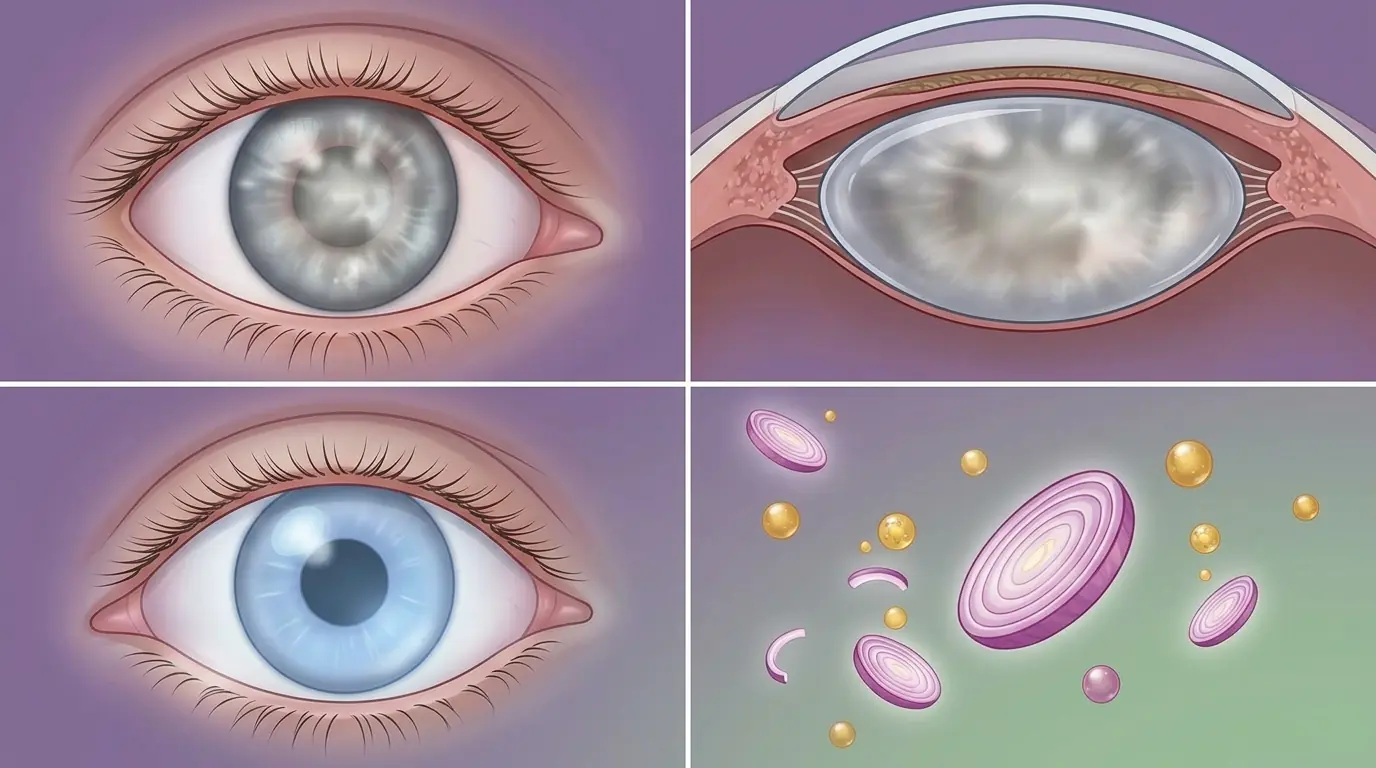
Most people cut an onion without thinking about their eyes until the tears begin.
Within seconds, your eyes sting.
They water.
You blink.
You may even step away from the cutting board.
So it sounds almost ridiculous to suggest that onions have anything interesting to do with eye health.
But underneath that irritating chemistry is a vegetable packed with plant compounds scientists have studied for a very different reason.
One of the most interesting is quercetin.
Quercetin belongs to a family of plant compounds called flavonoids. Onions, particularly certain varieties, are an important dietary source.
And researchers have been investigating compounds like quercetin because oxidative stress is involved in many biological processes associated with aging, including changes that occur inside the eye.
That has led to an intriguing question:
Could compounds found in foods such as onions contribute to the nutritional environment that helps protect aging eyes?
The answer is more interesting than either extreme you'll find online.
No, eating onions has not been proven to remove a cataract.
No, onion juice should not be put into your eyes.
And no food can make a cloudy lens suddenly become transparent again.
But onions contain biologically active compounds that make them genuinely interesting from a nutritional and laboratory research perspective.
To understand why, you first need to understand what actually happens when a cataract develops.
Your Eye Contains a Tiny Transparent Lens
Behind the colored iris of your eye sits a lens.
When you're young and healthy, that lens is normally transparent.
Light passes through it and is focused toward the retina at the back of the eye.
The retina converts light into signals that ultimately allow your brain to construct what you see.
For this system to work well, the lens needs to remain remarkably clear.
But the lens is made largely from water and highly organized proteins.
Over decades, those proteins and the environment around them change.
Eventually, proteins can aggregate and the lens becomes progressively less transparent.
Instead of light passing cleanly through, it begins to scatter.
That clouding is what we call a cataract.
And cataracts are extremely common with aging.
Cataracts Usually Don't Appear Overnight
One of the reasons cataracts can sneak up on people is that they often develop slowly.
You don't necessarily wake up one morning unable to see.
Instead, the world changes little by little.
Colors may seem less vivid.
Night driving becomes harder.
Headlights create more glare.
You need brighter light to read.
Your glasses prescription changes more frequently.
Things begin to look hazy.
Because the progression can be gradual, your brain adapts.
You may not realize how much vision you've lost until an eye examination reveals it.
Or until one eye is compared with the other.
Age Is the Biggest Part of the Story
The National Eye Institute describes aging as the most common cause of cataracts.
After around age 40, proteins in the lens begin breaking down and clumping together. Over time, these clumps can make the lens increasingly cloudy.
But aging isn't the only factor.
Diabetes can increase cataract risk.
Smoking is associated with increased risk.
Long-term exposure to ultraviolet radiation matters.
Certain medications, particularly corticosteroids, can contribute.
Eye injuries can cause cataracts.
Family history can also influence risk.
So if someone tells you cataracts occur simply because you “didn't eat enough antioxidants,” that's misleading.
Cataract development is multifactorial.
Nutrition is only one piece of a much larger biological puzzle.
Where Oxidative Stress Enters the Picture
Every day, cells undergo countless chemical reactions.
Some of those processes generate reactive molecules collectively referred to as reactive oxygen species.
Your body has antioxidant systems that help control them.
The problem occurs when oxidant production and antioxidant defenses become imbalanced.
That state is called oxidative stress.
The lens is particularly interesting because its transparency depends on maintaining an unusually organized environment over many years.
Oxidative modifications to lens proteins have therefore been studied extensively in relation to cataract formation.
This doesn't mean antioxidants automatically prevent cataracts.
And it certainly doesn't mean swallowing one antioxidant reverses an established cataract.
But it explains why researchers are interested in antioxidant systems when studying lens aging.
And that's where onions enter the conversation.
The Onion Compound Researchers Keep Studying
Onions contain several flavonoids.
Quercetin is among the best known.
It has demonstrated antioxidant and anti-inflammatory activities in experimental research, which has made it the subject of studies across many areas of biology.
In laboratory experiments involving lens tissue or cells, researchers have investigated whether quercetin and related compounds can influence oxidative damage and processes associated with cataract formation.
Some experimental findings are promising.
But there is a critical distinction:
A protective effect in cells, isolated tissue, or animals is not the same as proving that eating onions prevents cataracts in humans.
That gap is enormous.
Many substances produce interesting effects in a laboratory.
Far fewer become clinically proven treatments.
This Is Where Viral Health Advice Usually Goes Wrong
A study finds that quercetin affects oxidative stress in an experimental model.
Someone writes:
“Quercetin may have protective effects against oxidative damage.”
Then somebody else simplifies it to:
“Quercetin protects the eyes.”
Then:
“Onions prevent cataracts.”
And eventually:
“Eat this every day and cataracts disappear.”
Four steps later, an interesting scientific observation has become a fake cure.
That's not how evidence works.
The laboratory finding can still be interesting.
We simply need to stop at the point where the evidence stops.
Can Eating Onion Clear a Cloudy Lens?
No evidence currently supports that claim.
Once a cataract has significantly clouded the natural lens, eating onions does not make that lens transparent again.
Neither does drinking onion juice.
Neither does rubbing onion near the eye.
Neither does taking huge doses of quercetin supplements.
The established treatment for a cataract that significantly interferes with vision is cataract surgery.
During the procedure, the cloudy natural lens is removed and replaced with a clear artificial intraocular lens.
It is one of the most commonly performed operations in medicine.
That is fundamentally different from “clearing” the old lens with food.
Never Put Onion Juice Into Your Eyes
This deserves its own warning because home remedies spread rapidly online.
Onions make your eyes water because cutting them releases volatile compounds that irritate sensory nerves at the eye's surface.
Tearing is a protective response.
The fact that something makes your eye produce tears does not mean it is cleaning, detoxifying or healing the eye.
Your cornea is delicate tissue.
Homemade onion preparations are not sterile ophthalmic medications.
Putting raw onion juice directly into an eye can cause substantial irritation and potentially expose the eye to contaminants.
Eating an onion and putting onion juice into your eye are completely different things.
One belongs in a meal.
The other does not belong in your eye.
Why Do Onions Make You Cry Anyway?
This is actually one of the most fascinating parts of onion chemistry.
When you cut into an onion, you rupture its cells.
Compounds that had previously been separated interact.
A series of chemical reactions produces volatile sulfur-containing molecules.
One important tear-producing compound reaches the surface of the eye and stimulates sensory nerves.
Your lacrimal glands respond by producing tears.
So when an onion “makes your eyes water,” it isn't pulling toxins from your eye.
Your eyes are defending themselves from an irritant.
That distinction matters because “it makes you tear” is sometimes transformed online into “it cleans the eye.”
It doesn't.
But Eating Onions Can Still Be Part of a Healthy Diet
Rejecting a miracle claim doesn't make onions unhealthy.
Quite the opposite.