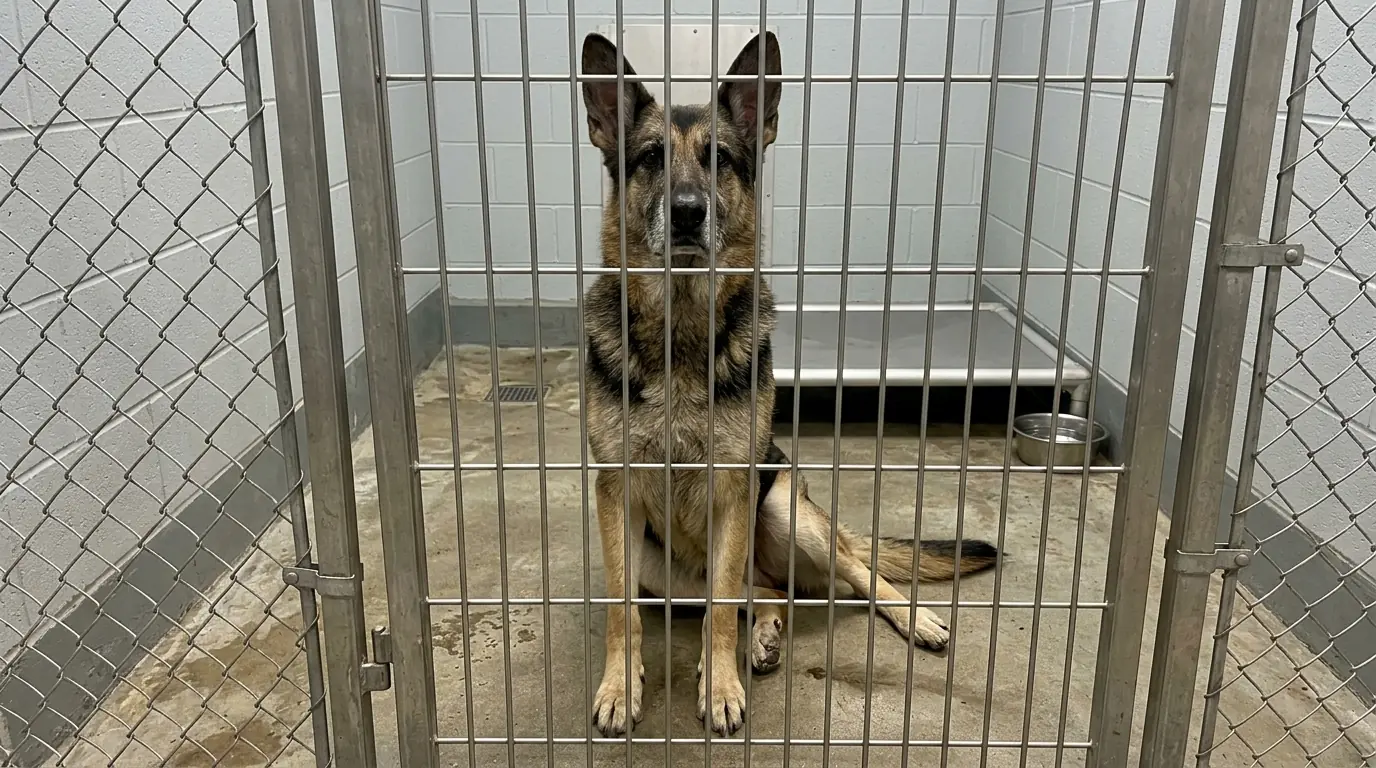
Every morning, Duke hears the keys before the kennel door opens.
The sound is small.
A few pieces of metal shifting together somewhere in the hallway.
But the ten-year-old German Shepherd reacts almost immediately.
His head comes up.
His ears turn toward the door.
Then Duke begins the difficult process of getting himself upright.
Years ago, Duke worked as a detection K-9. Now severe arthritis and weakness in both hind legs have made even standing a challenge.
Still, when those keys approach, Duke pushes.
His front legs straighten first.
His rear paws search for traction.
His hindquarters rise slowly.
Then Duke moves toward the kennel door and sits.
Not loosely.
Not casually.
He positions himself upright beside the gate, chest lifted and head forward, in the same kind of attentive posture associated with waiting for direction.
For a few seconds, the old working dog looks remarkably steady.
Then his back legs begin to tremble.
His hips drift sideways.
Duke corrects himself.
The shaking gets worse.
Still, he remains seated.
Until eventually his aging body makes the decision for him.
Duke’s Working Days Are Over
Duke spent part of his life as a detection K-9.
That kind of work can involve highly structured routines, repeated cues, searching tasks, transportation, training, and close coordination with a handler.
But at ten years old, Duke's body is very different from the one that performed those duties.
His arthritis is severe.
His hindquarters have weakened.
Getting up after rest can take considerable effort.
He is no longer physically capable of returning to the demands of working life.
Yet some familiar patterns remain visible.
The morning keys are one of them.
The Sound Changes Duke Immediately
Before the keys, Duke may be lying on his bed.
His hips are positioned carefully.
His back legs rest to one side.
He looks comfortable enough that there seems to be little reason for him to move.
Then the keys jingle.
Duke becomes alert.
Sometimes he attempts to rise before anyone has reached his kennel.
Getting Up Is the First Challenge
For a healthy dog, rising from a bed can happen in one fluid movement.
Duke no longer has that luxury.
He shifts his front paws underneath himself.
Pushes his chest upward.
Pauses.
Then tries to bring the rear half of his body with him.
His hind paws may slide slightly before finding stable footing.
His back legs shake.
Sometimes his first attempt fails.
Duke lowers himself again.
Then tries once more.
His Front End Is Doing More of the Work
That is common when the hindquarters become painful or weak.
Duke uses his shoulders and front legs to pull his body forward and upward.
His rear legs participate, but less efficiently.
Once standing, he may shift extra weight toward the front.
That compensation helps him move.
It can also make every transition more physically demanding.
Then Duke Goes to the Door
He does not rush.
He cannot.
He takes several careful steps.
The hind legs follow with shorter, less certain movements.