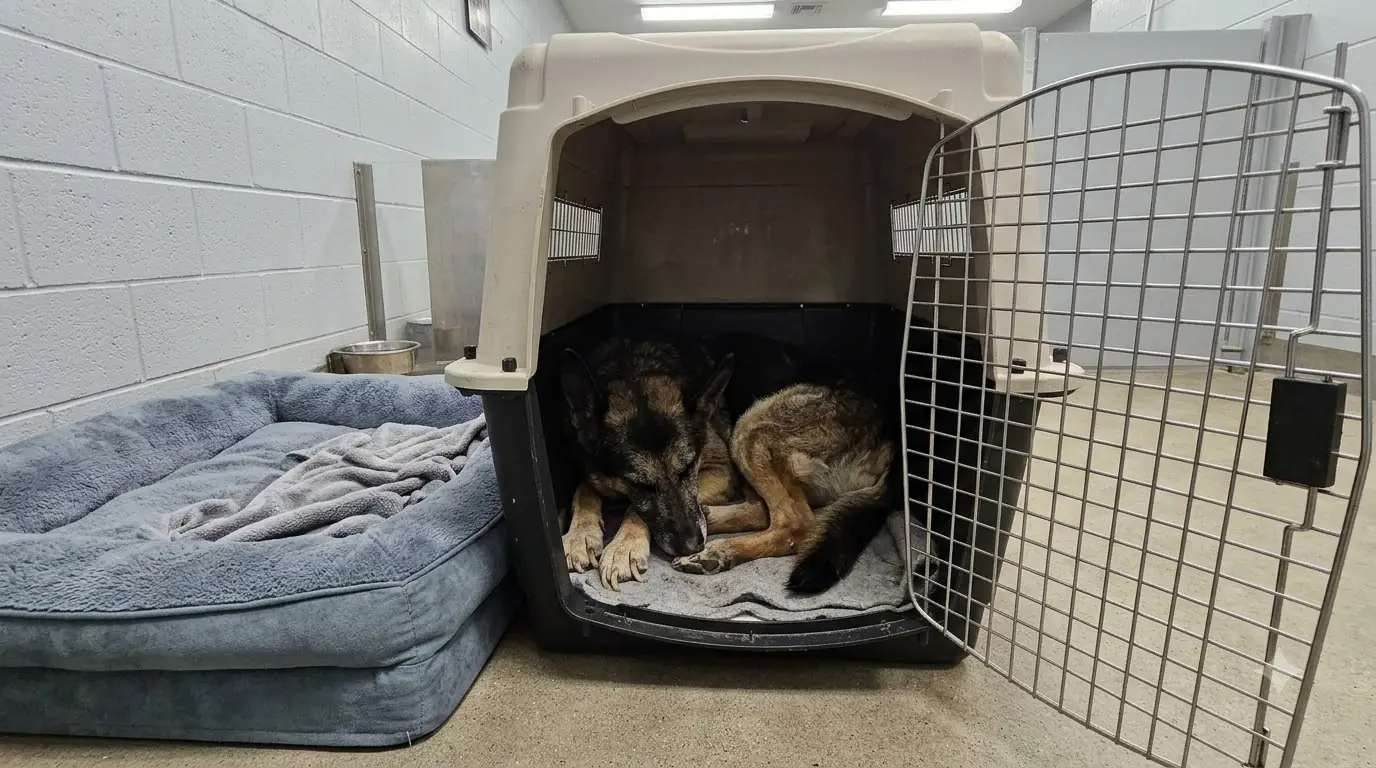
The crate door was finally open.
Duke could leave whenever he wanted.
Beside it, staff at the rehabilitation center had placed something his aging body desperately needed: a supportive orthopedic bed large enough for the 9-year-old German Shepherd to stretch out completely.
But Duke didn't choose it.
He stood unsteadily beside the open crate, his weakened hind legs struggling to support him.
Then he lowered himself.
Using his front legs, Duke slowly pulled his body toward the same cramped space humane officers had removed him from.
His shoulders passed through the doorway.
Then his hips.
Once inside, Duke curled himself into the smallest shape his large body could manage.
His head dropped between his front legs.
And he stayed there.
The crate was no longer locked.
Nobody was making Duke remain inside.
But for days after his rescue, staff could barely convince him to rest anywhere else.
Humane Officers Had Found Duke Living in a Space Too Small for Him
When officers reached the property, Duke's physical condition immediately raised concerns.
He was a large senior German Shepherd living in a crate that did not provide appropriate space for his body.
His hindquarters were weak.
His nails had grown excessively long.
There were obvious callused areas around his elbows.
Those findings could tell veterinarians and caregivers important things about Duke's current physical needs.
They could not establish every detail of what had happened to him.
Staff did not need to invent a precise timeline or claim that every medical problem had been caused by the crate.
But prolonged restriction and inadequate opportunities for normal movement can contribute to physical deterioration, particularly in an older dog.
Duke needed a thorough evaluation.
And he needed space.
His First Steps Outside the Crate Were Difficult
Simply opening the door did not mean Duke could suddenly walk normally.
His hind legs lacked strength.
When he tried to rise, much of the effort came from the front half of his body.
His rear feet were slower to position beneath him.
The overgrown nails complicated his footing.
Even a short movement required concentration.
This was not a dog who needed someone pulling on a leash and encouraging him to “walk it off.”
Duke's mobility had to be assessed carefully.
Weakness in a senior German Shepherd can have many possible contributors, including orthopedic, muscular and neurological problems.
His veterinary team needed to determine what was actually affecting him.
His Elbows Told Another Part of the Physical Story
The thickened areas on Duke's elbows were also impossible to ignore.
Dogs can develop calluses over pressure points, particularly when they spend significant time resting on firm surfaces.
In Duke's case, those areas were part of a larger picture that included limited mobility and a history of confinement.
Staff checked his skin carefully.
Pressure areas can become irritated or develop additional complications, especially in animals who have difficulty repositioning themselves.
A softer resting surface could help reduce pressure.
That was one reason the orthopedic bed seemed like such an obvious improvement.
Duke didn't agree.
He Looked at the New Bed—and Went Back Into the Crate
The rehabilitation area gave him room.
The bed was close.
He did not have to cross a large space to reach it.
Still, Duke repeatedly returned to the crate.
He approached slowly.
Lowered his body.
Then crawled inside.
Once there, he curled tightly instead of stretching his legs.
Sometimes his head disappeared between his forelegs.
From outside, staff could see how little room remained around him.
The behavior created an uncomfortable question.