Ember Arrived Barely Moving After an Abandoned-House Fire—His Burned Paws Were Only Part of the Danger
Ember lay almost completely still beneath the oxygen mask.
The small puppy had been placed on a padded treatment table minutes after arriving at the shelter clinic. Most of the fur across his face and back was singed, leaving it shortened, curled and blackened at the ends.
All four paws were blistered.
His breathing was shallow and rapid, and each breath appeared to require more effort than the one before it.
He did not cry.
He did not pull away when the veterinary team examined him.
Only his eyes moved beneath the burned fur around his face.
The puppy had been discovered that morning inside an abandoned house after firefighters extinguished a blaze.
The property had reportedly been vacant for months. Its windows were boarded, the front yard was overgrown and neighbors believed no one was living there.
When smoke began pouring from the roof, someone called emergency services.
Firefighters entered only after controlling the heaviest flames. The interior was badly damaged, with collapsed material blocking several rooms.
A faint sound came from the rear of the house.
At first, it was mistaken for water moving through the debris.
Then it came again.
A puppy was crying.
Ember was found pressed against the wall inside a small back room. Burned wood and fallen insulation surrounded him, and smoke filled the remaining air near the floor.
He tried to rise when the firefighters approached.
His front paws touched the hot, debris-covered floor, and his legs immediately folded beneath him.
The puppy had nowhere else to go.
A firefighter wrapped him in a clean cloth and carried him outside. Ember’s body was warm, but his extremities were beginning to cool as shock developed.
No other animals were immediately visible.
The puppy was given oxygen at the scene before being transferred to the local shelter’s emergency veterinary team.
Staff began calling him Ember after the scorched house where he had been found.
The name felt frighteningly appropriate.
On the treatment table, the team’s first priority was not the visible burns.
It was Ember’s airway.
Animals exposed to structural fires may inhale smoke, hot gases and toxic chemicals. Damage inside the throat and lungs can worsen for hours, even when an animal initially appears to be breathing.
Ember had soot around his nostrils and mouth.
When a technician gently opened his jaw, dark residue was visible along his gums and tongue. His voice was almost gone, reduced to a faint, rough sound whenever he attempted to whine.
Those signs raised concern for smoke inhalation.
Oxygen support began immediately.
An IV catheter was placed in one front leg above the burned paw, and carefully controlled fluids were started to treat shock. Pain medication was given while the team monitored his heart rate, blood pressure and temperature.
Ember remained too weak to lift his head.
His lungs produced harsh sounds through the stethoscope. Blood testing showed that his body was struggling to carry oxygen normally, consistent with significant smoke exposure.
The shelter’s basic clinic could not provide every level of respiratory care he might need.
A veterinary emergency hospital was contacted, and preparations were made to transfer him as soon as he could tolerate the journey.
Before transport, the team examined his burns.
The worst visible injuries covered the paw pads and the skin between his toes. All four feet had been exposed to heat as Ember attempted to move across the floor.
Several pads were blistered and swollen.
The burns across his face and back appeared less severe on the surface, but the true depth could not yet be determined. Burn injuries often evolve over the following days as damaged tissue declares itself.
Some areas that initially look mild can become much more serious.
Ember’s eyes were flushed with sterile solution to remove smoke and ash. Fortunately, there was no immediate evidence that the surfaces of his eyes had been severely burned.
His vision still needed monitoring.
The singed fur around his face was clipped only where necessary. Staff avoided unnecessary handling because every touch caused Ember’s skin to twitch beneath the medication.
Sterile, nonstick dressings were placed around his paws.
He was then moved into a portable oxygen enclosure for transport.
At the emergency hospital, imaging showed changes inside Ember’s lungs consistent with smoke inhalation. The tissue had become irritated, and fluid was beginning to collect in areas responsible for oxygen exchange.
The visible burns were painful.
The damage inside his chest posed the greatest immediate threat to his life.
Ember was admitted to intensive care.
He received continuous oxygen while staff monitored whether his breathing became more difficult. Nebulization helped moisten his irritated airways, and gentle chest therapy assisted in moving secretions.
Antibiotics were not automatically used simply because he had inhaled smoke. The team watched carefully for evidence of secondary infection while providing the respiratory support his lungs needed.
His paw injuries required a separate treatment plan.
The burns were cleaned gently and covered with dressings designed to protect exposed tissue without sticking to it. Each foot was wrapped individually, leaving Ember with four small padded bandages.
Standing was impossible.
Even if his lungs had allowed it, placing weight on the injured paws would have caused significant pain and additional damage.
Ember remained on thick bedding and was repositioned frequently.
During his first several hours, he became less responsive.
His breathing rate increased despite oxygen, and his chest moved more forcefully with each attempt to draw air. The medical team prepared equipment in case he could no longer breathe effectively on his own.
Ember’s oxygen level dropped twice that evening.
The concentration inside his enclosure was increased, and treatment continued while staff watched for complete respiratory failure.
There was no way to predict whether his tiny lungs would recover.
The puppy slept with his head resting sideways on a folded towel. His bandaged paws remained positioned away from the bedding to reduce pressure.
Whenever the enclosure door opened, his eyes followed the movement.
His body did not.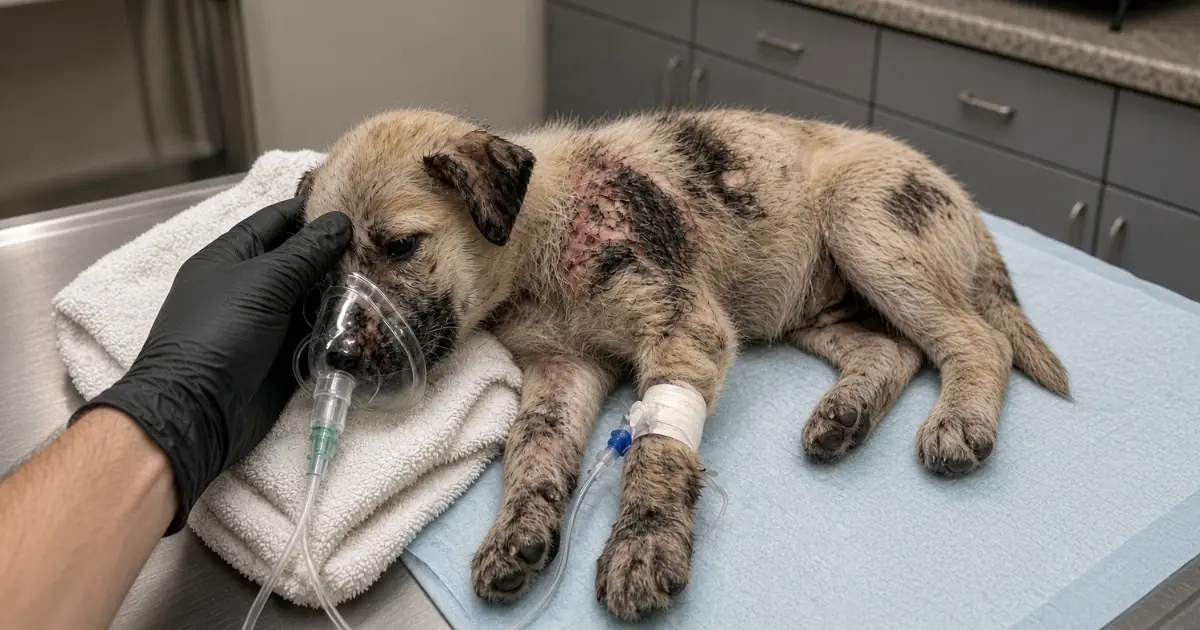
Food could not be offered normally while his breathing was so unstable. Trying to eat could increase the risk of aspiration and force him to use energy he did not have.
Nutrition would soon become essential for healing his burns, but first Ember needed to survive the smoke damage.
During the night, the medical team placed a feeding tube so he could receive small, controlled amounts of liquid nutrition without struggling to chew or swallow.
His first night remained critical.
Shortly after midnight, Ember’s breathing became irregular. The team stood ready to intubate him if necessary.
For several minutes, his oxygen level hovered dangerously low.
Then it began to rise.
The change was small, but it held.
By morning, Ember still required a high level of oxygen support, yet he had avoided mechanical ventilation.
He was not safe.
He had simply made it through the first night.
Investigators returned to the abandoned house once the structure was considered stable enough to enter.
No residents were found.
The utility service had reportedly been disconnected, and the cause of the fire remained under investigation.
In the rear room where Ember was discovered, officers found a shallow plastic bowl and a torn piece of blanket.
There was no crate.
A damaged door may have trapped the puppy in that section of the house as the fire spread.
No collar, leash or identification was found.
A microchip scan produced no result.
Neighbors were asked whether they had seen anyone entering the property or heard a puppy before the fire. One person remembered occasional movement near the back of the house but assumed stray animals were sheltering inside.
Another reported seeing an unfamiliar vehicle near the property several nights earlier.
No information could confirm who had left Ember there.
Investigators also searched for other animals.
None were located.
It remained unclear whether Ember had wandered into the house by himself or had been abandoned inside it.
His young age made either possibility troubling.
At the hospital, the burns on Ember’s paws were reassessed.
Some blisters had opened, revealing deeper damage beneath them. The dressings were removed after being moistened, and each paw was cleaned carefully.
The team preserved every area of healthy tissue.
Burned paw pads can sometimes heal, but severe injuries may require weeks of care. Scar tissue can remain sensitive and may not tolerate rough surfaces normally.
Ember’s paws would need protection long after the original wounds closed.
The burned area along his back also began changing.
Several patches of skin became darker and less responsive. Those sections had sustained deeper thermal injury than initially visible.
They would need removal once Ember was stable enough for the procedure.
His face remained swollen.
The fur around his muzzle and forehead had been burned short, but much of the underlying skin appeared capable of healing. Small sores formed near the edges of his ears, where the tissue was thin and vulnerable.
Staff kept Ember’s eyes clean and moist.
On his second day, he lifted his head.
The oxygen enclosure door had opened for a bandage check, and Ember raised his chin slightly from the towel.
His neck trembled.
After a few seconds, he lowered it again.
The effort exhausted him, but it was the first voluntary movement beyond his eyes.
His respiratory readings began improving slowly over the next 24 hours. The fluid and irritation inside his lungs remained serious, yet his body was requiring slightly less oxygen to maintain safe levels.
The change allowed staff to perform longer wound-care sessions.
Ember’s damaged skin was treated in stages. Dead tissue was removed only where necessary, and the remaining areas were covered with nonstick dressings.
Pain control was adjusted before each procedure.
Despite the medication, Ember began trembling whenever the bandage cart entered the room.
Staff moved slowly and kept the sessions as brief as possible.
Afterward, a technician rested one gloved hand beside his shoulder until his body relaxed.
The third day brought the first attempt to reduce his oxygen support.
Ember tolerated several minutes at a lower concentration before his breathing rate increased. The level was raised again.
No one considered that a setback.
His lungs needed time.
Later that afternoon, he lifted his head toward the sound of a food container opening. He was still receiving nutrition through the tube, but the reaction showed that his interest in food was returning.
A tiny amount of soft puppy food was placed near his nose.
Ember smelled it and licked once.
The dish was removed before he became tired.
On the fourth morning, he ate several bites on his own.
His bandaged feet remained extended in front of him, and his chest stayed flat against the bedding. He could not move toward the dish, so it was held at the correct height.
Ember swallowed slowly.
After finishing, he rested his chin on the edge of the bowl.
The team continued tube feeding while gradually encouraging safe voluntary eating.
His condition remained delicate.
Burn patients use enormous amounts of energy while repairing damaged tissue. Ember needed adequate calories and protein without placing excessive strain on his weakened body.
Repeated blood tests also monitored anemia, infection and organ function.
Fortunately, his kidneys and liver continued working normally.
The greatest concerns remained his lungs and the depth of his burns.
Five days after the fire, Ember was able to spend a short period outside the oxygen enclosure.
A technician held a mask near his face while his bedding was changed. Ember’s oxygen level remained stable for several minutes before beginning to fall.
He returned to the enclosure.
Each attempt lasted slightly longer.
The investigation into the house produced no confirmed owner. Photographs of Ember were circulated among nearby shelters and veterinary clinics, but no matching report appeared.
No one came forward to explain why a young puppy had been inside a vacant, boarded structure.
Ember could offer no answers.
His behavior suggested that people were not entirely unfamiliar to him. He watched hands closely but did not panic when touched. Once his breathing improved, he began pressing his chin weakly toward the technicians who fed him.
Someone may once have cared for him.
That person was not present when he needed help most.
At the end of the first week, Ember no longer required constant high-concentration oxygen.
He still received respiratory therapy and returned to oxygen support when tired, but his lungs were beginning to recover.
His voice also returned gradually.
The first sound was a soft, hoarse whine when a feeding ended.
Staff considered it progress.
A puppy with enough energy to protest had more strength than the silent animal who arrived on the treatment table.
His paws remained the largest barrier to movement.
All four were still wrapped, and weight-bearing had to be introduced carefully. Specialized padded booties were prepared to protect the healing tissue.
During his first supported standing attempt, a sling held most of his body above a soft traction mat.
Ember extended his front legs.
The moment his feet touched the surface, he pulled them back and lowered his chest.
The therapist did not try again that day.
Pain and fear had become connected to standing.
Before Ember could walk, he needed to learn that the ground beneath him was no longer burning.
Several days later, the sling was used again.
This time, his paws touched a thick foam pad covered with a soft sterile layer. Ember remained tense but did not immediately withdraw.
He held his position for two seconds.
Then his legs folded, and he was returned to bed.
Progress continued that way—measured in seconds and individual paw placements.
The deeper burns along his back required a minor surgical procedure. Damaged tissue was removed, and the area was covered with a protective dressing to support healing.
His face needed no surgery.
As swelling decreased, the skin beneath the singed fur appeared pink but viable. New hair would take time to grow, and several areas might remain permanently thin.
Ember spent nearly two weeks in intensive care.
By then, he could breathe normal room air for most of the day. He continued receiving nebulization treatments, and his lungs required follow-up examinations because scarring or infection could still develop.
He could also eat without the feeding tube.
When the tube was removed, Ember immediately licked the small amount of food left near his mouth.
His paws were healing unevenly.
The rear paws had suffered the deepest burns and remained too sensitive for normal walking. His front paws could support a small amount of weight through the protective booties.
A rehabilitation specialist began helping him move with most of his body supported.
Ember’s first step was barely visible.
He shifted one front paw forward while the sling carried his weight.
Then he stopped.
The next day, he moved both front paws.
His rear feet remained lightly against the padded surface, protected from pressure.
Over time, the sling was lowered enough to let him bear more weight.
Three weeks after the fire, Ember crossed a small section of the rehabilitation room.
His movement was slow and stiff. Each paw was wrapped and covered, giving his steps an awkward, oversized appearance.
He completed four steps before lying down.
But he had moved away from the bed on his own.
Ember is now recovering in a medical foster setting.
His bandages still require regular changes, and his paws must remain protected from rough ground, hot pavement and contamination. Veterinarians will continue monitoring his lungs as well as the scar tissue forming across his back.
No owner has been identified.
The cause of the fire and the reason Ember was inside the abandoned house remain unresolved.
What rescuers know is that he could not have escaped without help.
His blistered paws made every surface painful, while smoke gradually deprived his body of oxygen. By the time firefighters heard him, Ember had already stopped trying to move.
When he reached the shelter, he could only lie still beneath an oxygen mask.
Now, when his padded booties are placed on the mat, Ember raises his chest and looks toward the short path ahead.
He still hesitates before touching the ground.
Then he carefully places down one paw—and tries again.