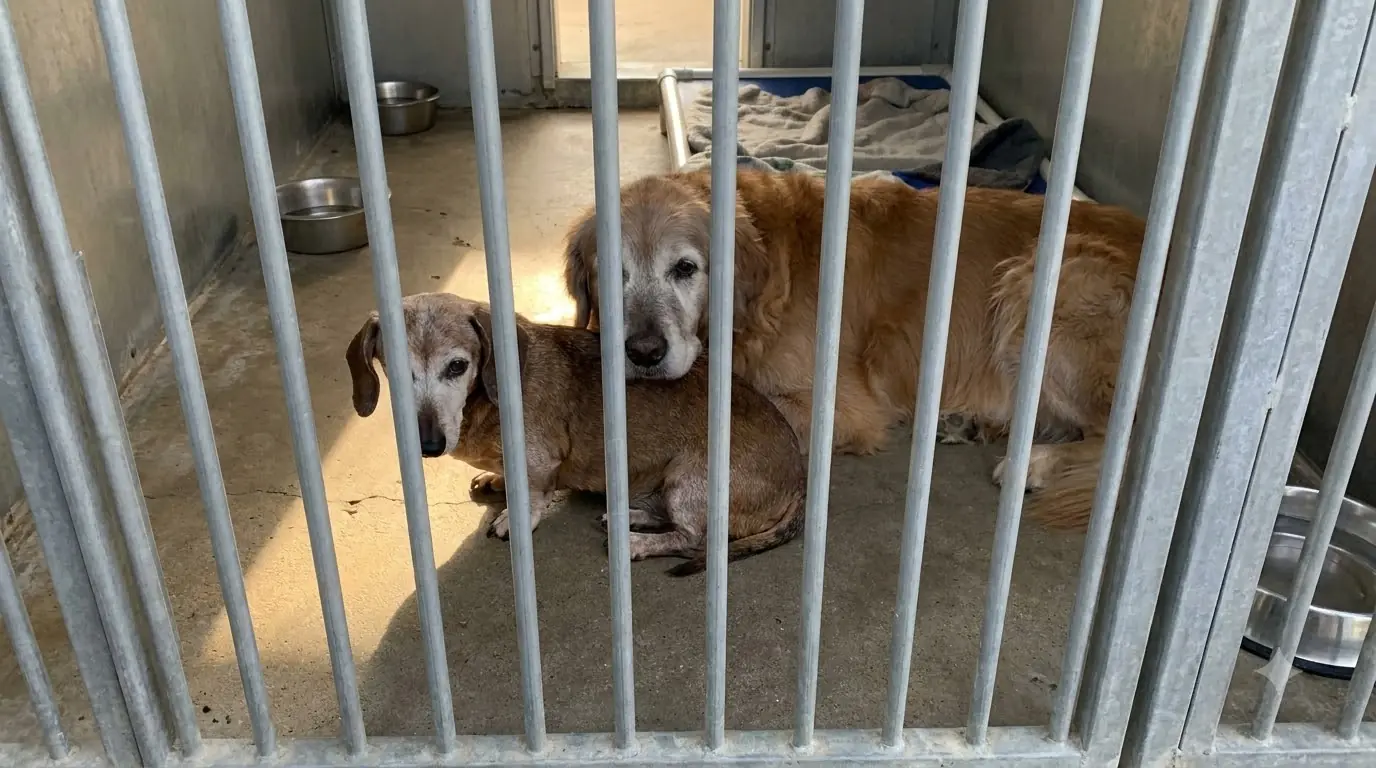
The patch of sunlight only lasted part of the afternoon.
It came through a narrow shelter window, crossed one section of the shared kennel floor, and then slowly disappeared as the sun shifted.
It was not large.
Barely enough room for one small dog to curl up comfortably.
The senior Dachshund noticed it first.
She was an older dog with degenerative spinal disease and chronic rear-body stiffness. When she rested, especially after periods of inactivity, her muscles sometimes trembled. The shaking was more obvious on cooler days or after she had been lying still for a while.
The senior Golden Retriever had come into the shelter with her.
They had lived together before intake.
Staff did not know every detail of that previous life.
They did not know whether they had shared beds every night.
They did not know whether the Dachshund had always slept against him.
They did not know whether the Golden had always chosen the colder side of a room.
What they did know was what happened every afternoon in the kennel.
When the rectangle of sunlight appeared on the floor, the Dachshund would move toward it.
Slowly.
Her back was stiff.
Her hind legs did not move with the easy flexibility of a younger dog.
Sometimes she needed a moment before lowering herself.
Then she curled entirely inside the warm patch.
The Golden Retriever followed.
But he did not lie in the sun.
He stopped at the edge.
His chest and front legs stayed just outside the light.
Then he lowered himself beside her.
His head came down near her back.
The smaller dog remained fully inside the warmest part.
The larger dog stayed in the cooler shadow.
That happened often enough that staff began noticing the pattern.
At First, It Looked Like an Accident
The Golden was much larger.
Even if he wanted the same patch of sunlight, he could not fit there without covering most of the Dachshund.
So the first few times, staff assumed the arrangement was simply about space.
Small dog fits.
Large dog does not.
That explanation was reasonable.
Then they noticed what happened when the Golden reached the sunlight first.
He would approach.
Stand partly inside it.
Look around.
Sometimes lie down briefly.
Then, when the Dachshund came toward the same spot, he shifted.
Not dramatically.
A few inches.
Then more.
Until the smaller dog could settle entirely inside the warm patch.
The Golden ended up beside it again.
Staff Did Not Call It “Giving Her the Sun”
That phrase was emotionally tempting.
But the shelter stayed careful about intention.
The Golden Retriever could not explain why he repositioned.
Maybe he preferred the cooler surface.
Maybe the Dachshund's arrival caused him to shift because of their established resting pattern.
Maybe he wanted proximity and simply did not care where his own body landed.
What staff could say was that the same spatial arrangement happened repeatedly.
The Dachshund occupied the sun.
The Golden rested immediately beside her.
And when the available warm space was limited, he usually did not displace her from it.
The Dachshund’s Spinal Disease Made Warmth More Noticeable
Degenerative spinal conditions in older Dachshunds are not unusual.
Their long backs and short limbs can place particular mechanical demands on the spine.
This dog had chronic weakness and stiffness that affected how she moved and rested.
The veterinary team assessed her carefully.
Gait.
Paw placement.
Rear-limb strength.
Spinal discomfort.
Reflexes where appropriate.
Ability to rise.
Ability to walk.
Whether the weakness was stable or progressing.
Whether she could urinate and defecate normally.
Those details mattered more than simply saying she had a “bad back.”
She Was Still Ambulatory
That was important.
The Dachshund could walk.
Slowly.
Carefully.
The hind legs sometimes looked stiff.
Her belly traveled closer to the floor than it might have in a younger, stronger dog.
She did not need to be carried constantly.
The goal was to preserve as much safe independent mobility as possible.
She Trembled During Rest
That was one of the more visible behaviors.
Small dogs can shake for many reasons.
Cold.
Pain.
Stress.
Neurologic weakness.
Muscle fatigue.
Excitement.
Because the Dachshund had known spinal disease, staff did not assume the shaking was purely emotional.
They watched patterns.
Did it happen after movement?
During cold periods?
When resting?
Was pain control adequate?
Did she appear tense?
Could she relax once warm?
The tremor was treated as information, not symbolism.
The Sun Patch Seemed to Help Her Settle
On many afternoons, once she curled in the warm light, the shaking became less visible.
That did not prove the sunlight was treating the spinal disease.
Warmth can simply make resting more comfortable.
The shelter did not frame it as medical therapy.
But the Dachshund clearly chose the warm area when it appeared.
That preference was easy to respect.
The Golden Retriever Had His Own Senior Needs
He was not the healthy caretaker in the pair.
He was older too.
His muzzle had lightened.
He moved more slowly than a young Golden.
He benefited from supportive bedding.
His joints needed protection.
That mattered because the emotional image could easily make people forget his body had needs too.
He Did Not Spend All Day Sacrificing Comfort
That would have been an inaccurate version of the relationship.
When the sunlight was not present, the Golden used soft bedding.
He stretched out.
Rested wherever he preferred.
Sometimes the Dachshund slept separately.
Sometimes he occupied the warmer resting surface first.
Their day was not organized around one continuous act of caretaking.
The sunlight pattern was specific.
Repeated.
And limited to a certain part of the afternoon.
That Made It More Believable
Real relationships between dogs are often built from small recurring choices.
Not constant dramatic gestures.
A preferred sleeping distance.
A familiar walking pace.
One dog waiting at a doorway.
Another choosing the same bed.
Here, the pattern happened when the environment created one unusually desirable spot.
The Dachshund took it.
The Golden stayed close.
Staff Wanted to Know Whether the Dachshund Needed More Warmth in General
The sun patch raised a practical question.
If she consistently sought the warmest place, perhaps the kennel setup should offer more than one.
So staff added additional soft bedding.
A fleece layer.
A warmer low bed positioned away from drafts.
No electric heating device without appropriate shelter protocols and safety considerations.
Just a warmer, more insulated resting option.
She Used It
Especially in the morning when there was no sun.
That confirmed comfort mattered.
The Dachshund did not spend all day waiting for the window.
She could use other warm surfaces.
The sunlight remained a preferred afternoon spot, not her only way to settle.
The Golden Used the New Bedding Too
That mattered.
The environmental change benefited both dogs.
Now, if he chose not to lie in the sun patch, he did not have to rest on a hard or cool surface.
A supportive mat could sit just outside the warm area.
That created a better version of the same behavior.
Dachshund in light.
Golden beside her.
Both padded.
The Shelter Learned Not to Romanticize the Hard Floor
The original image looked touching.
Golden in shadow.
Dachshund in sun.
But if the Golden's older joints were lying on an unforgiving surface, that was not something to preserve.
So the floor around the sun patch was padded.
The visual became less dramatic.
The care became better.
The Dachshund’s Pain Plan Was Reviewed
Because trembling can be a pain signal, the veterinary team made sure her medication and overall management were appropriate.
Chronic spinal disease can require careful multimodal treatment.
Not every dog needs surgery.
Not every dog benefits from aggressive intervention.
Conservative care can include controlled activity, weight management, traction, supportive bedding, and appropriate pain medication.
The specific plan depends on neurologic findings and progression.
The Shelter Watched for Warning Signs
Loss of the ability to walk.
Dragging the rear limbs.
Knuckling that worsened.
Loss of bladder control.
Severe spinal pain.
Sudden decline.