The first car pulled into the parking lot just after noon.
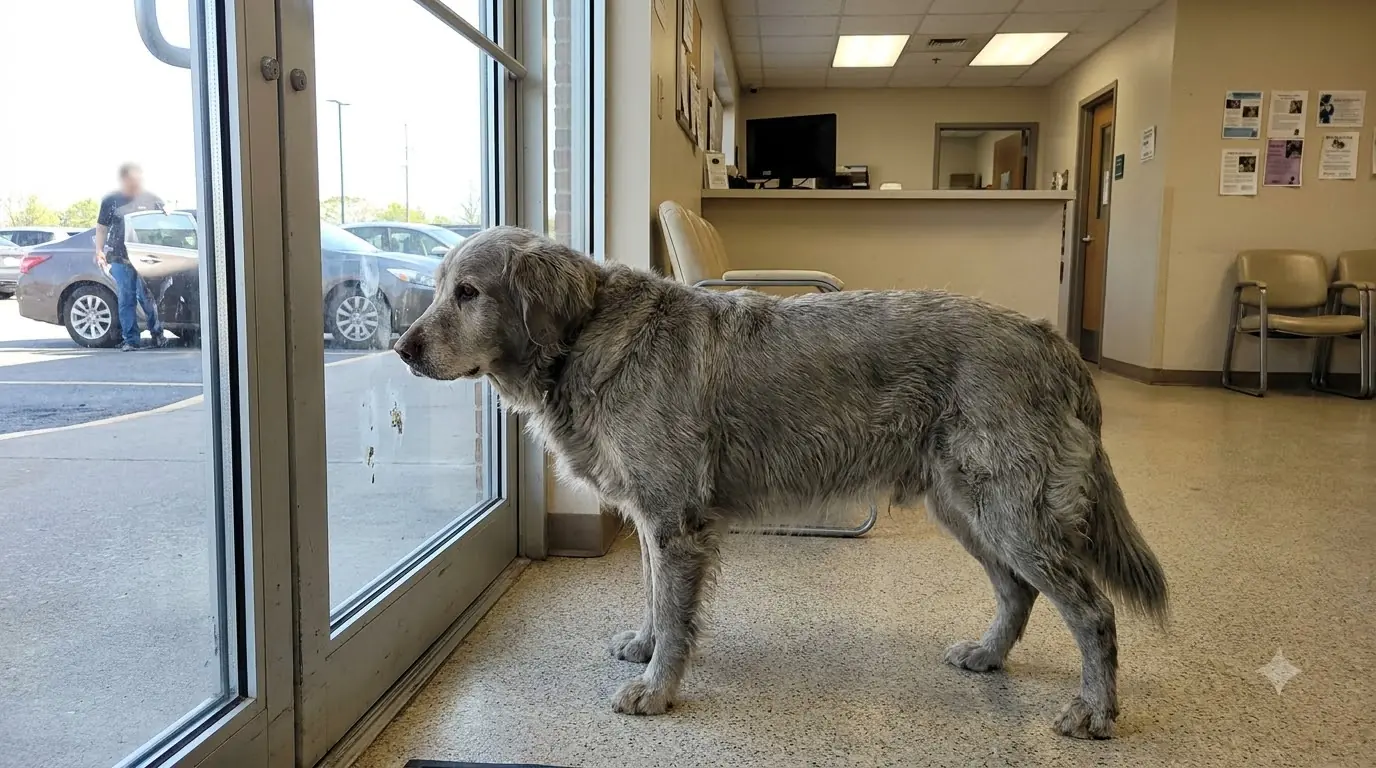
The senior Golden Retriever had already been standing at the shelter’s front window for several minutes.
His nose was close enough to the glass to leave a faint mark.
Behind him, a padded mat had been placed near the lobby wall so he could rest without returning all the way to his kennel. He knew it was there. He had used it earlier.
But when the sound of tires reached the building, his body changed.
His head lifted.
His ears moved forward.
Then he leaned closer to the glass.
Outside, a car stopped.
The driver's door opened.
A woman stepped out.
The Golden Retriever stared through the window.
His hind legs were already stiff from age and arthritis, and standing still was harder for him than walking a short distance. After nearly ten years in one home, he had arrived at the shelter with an older body that no longer tolerated prolonged weight-bearing easily.
Still, he remained there.
The woman crossed the parking lot.
The dog watched every step.
She reached the entrance.
The automatic door opened.
For a moment, she and the Golden Retriever were only a few feet apart.
Then she turned toward the reception desk.
She had not come for him.
The Golden Retriever stayed at the glass.
Another minute passed.
A tremor appeared in one hind leg.
Then the other.
A staff member moved toward him, expecting him to turn back toward the mat.
He did not.
Instead, he lowered himself into a sit directly in front of the door.
His eyes remained on the parking lot.
Then another car pulled in.
And the senior Golden Retriever tried to stand all over again.
This Started After Nearly Ten Years in One Home
The dog had not spent his entire life moving between shelters.
For almost a decade, he had lived with the same family.
That history mattered.
It meant his surrender was not simply a change of building.
Nearly every predictable part of his adult life disappeared at once.
The people he knew.
The rooms he recognized.
The place where he slept.
The familiar sequence of mornings and evenings.
The ordinary sounds of one household.
The shelter did not publicly invent motives for the surrender or turn the family's circumstances into a cruelty story.
What staff could confirm was that the Golden Retriever had been surrendered after close to ten years with the same household.
There was no need to make that more dramatic than it already was.
For an old dog, ten years is most of a lifetime.
He Did Not Start at the Front Door
During his first days, the Golden Retriever spent most of his time in the kennel.
He was subdued.
He ate, though not with much enthusiasm at first.
He accepted quiet handling.
He went outside for short bathroom breaks.
He did not show much interest in toys.
His body moved slowly.
When he stood after resting, his hind legs took time to straighten.
His first few steps were often short and stiff.
The shelter's veterinary team evaluated him as a senior dog rather than dismissing those changes as simply “being old.”
His joints were examined.
His gait was observed.
His spine and hindquarters were assessed.
The pattern was consistent with chronic arthritis and age-related loss of strength.
That explained why standing was difficult.
It did not explain what happened once staff began allowing him quiet time outside the kennel.
The Lobby Changed Him
The shelter sometimes gave him supervised breaks in the lobby because the kennel environment was busy and he appeared to enjoy calmer human activity.
At first, he wandered.
He sniffed the edges of furniture.
Investigated the reception desk.
Accepted attention from staff.
Then he discovered the front window.
The building had a large glass entrance facing the parking lot.
From there, the Golden Retriever could see vehicles approaching.
People getting out.
People walking toward the building.
It became his preferred place almost immediately.
The First Time, Staff Thought He Was Just Watching
Dogs are curious.
A parking lot contains constant movement.
People.
Vehicles.
Doors.
Smells entering whenever the lobby opens.
There was nothing inherently unusual about a dog watching through glass.
Then a car arrived.
The Golden Retriever stood closer.
A person entered.
The dog tracked them.
The person walked past him.
He remained at the door.
A few minutes later, another car appeared.
Same response.
Within days, staff realized that vehicle arrivals produced a much stronger reaction than ordinary lobby movement.
Every Car Became Worth Standing For
That was where his arthritis made the routine difficult to watch.
The Golden Retriever could be lying comfortably on the mat.
A vehicle entered the lot.
His head lifted.
Then came the effort.
Front legs positioned beneath him.
Chest forward.
Hind feet searching for traction.
Push.
Sometimes he stood on the first attempt.
Sometimes his rear end lifted halfway, then settled again.
He waited.
Tried a second time.
Once upright, he walked to the window.
The distance was not long.
The standing afterward was the problem.
He Watched the Person, Not Just the Car
Staff began paying attention to where his eyes went.
He followed the vehicle at first.
But once the door opened, his attention shifted to whoever stepped out.
A man.
A woman.
A couple.
A family.
A delivery driver.
His eyes tracked the person across the lot.
If they walked toward the entrance, he remained intensely focused.
The glass door opened.
He watched them enter.
Then, if they continued toward reception or turned down the hallway without approaching him, he stayed where he was.
That was the part that repeated.
The Shelter Would Not Claim He Thought His Family Was Returning
It was the obvious human interpretation.
An old dog surrendered after ten years.
Standing at a shelter door.
Watching every person arrive.
The emotional conclusion almost writes itself.
But no one could know what the Golden Retriever believed.
Dogs recognize familiar people using scent, voice, movement, appearance, and context.
He may have been monitoring arrivals because vehicle sounds had always predicted someone coming home.
He may have learned that the lobby entrance was where social interaction happened.
He may simply have been interested in people.
Perhaps the abrupt change in his life made arrivals especially important.
The rescue could not prove which explanation was correct.
So they did not say he was “waiting for his family to come back.”
They described what he actually did.
Every car pulled his attention toward the glass.
Every arriving person made him stand.
And after they passed without approaching, he often remained there until his legs could no longer comfortably support him.
The Trembling Became the Medical Limit
Staff could tell when he had stood too long.
His rear stance narrowed.
Weight shifted toward the front legs.
Then one thigh began to tremble.
Sometimes only slightly.
If he continued standing, both hind legs became involved.
That was not an emotional signal.
It was physical fatigue.
Arthritic joints and reduced muscle strength were being asked to support a senior body for too long.
Once caregivers understood the pattern, they stopped letting him remain upright indefinitely.
At First, They Tried Calling Him Away
A staff member would move toward the mat.
Offer a treat.
Invite him to follow.
Sometimes he did.
But if a vehicle was visible, food could lose the competition.
He looked from the caregiver back to the glass.
On other occasions, he took the treat and then returned immediately.
Staff realized they were approaching the problem backward.
He did not need to be convinced that the lobby was uninteresting.
His body needed a way to remain there safely.
They Put a Bed Near the Door
The mat moved closer.
Then closer again.
Eventually, it sat only a short distance from his preferred viewing area.
The change reduced the amount of walking required.
It did not stop the standing.
A car arrived.
He stood.
Glass.
Watch.
Legs shake.
The caregiver encouraged him down.
Now at least he could lower himself onto padding without walking back across the lobby.
Sitting Became His Compromise
As weeks passed, staff noticed another consistent sequence.
He would stand as long as he could.
Then, instead of walking away, he sat.
His hindquarters lowered carefully.
Sometimes the rear feet slipped slightly before he found balance.
Once seated, he remained facing the glass.
That told staff something important.
He did not need to be upright to continue the behavior.
He needed to remain at the front.
So they began encouraging the sit earlier.
Before the trembling became pronounced.
Visitors Learned to Come to Him
The Golden Retriever's quietness made him easy to misunderstand.
He did not bark at everyone entering.
He did not jump against the glass.
He did not bounce toward visitors.
He watched.
A person who stopped might see an old dog sitting near the entrance and assume he was simply tired.
Staff began explaining.
“He likes to watch people come in. His back legs get tired, so you can sit with him.”
That changed interactions.
Instead of waiting several feet away for the Golden Retriever to walk over, visitors approached slowly.
They crouched.
They let him sniff.
The dog could remain seated.
His joints did not have to pay for the greeting.
His Social Interest Was Clearer Up Close
Once people came to him, the shelter saw more of his personality.
He sniffed hands.
Accepted gentle strokes around his neck and shoulders.
Sometimes leaned slightly into a person's leg.
He did not interact with everyone identically.
Some visitors held his attention longer than others.
Some he sniffed and then looked back toward the window.
That variability was healthy.
The rescue did not need him to fall in love with every person.
They needed to understand whether he still wanted human connection.
He clearly did.
Toys Still Did Very Little for Him
A plush toy might receive a sniff.
A ball could roll across the lobby unnoticed.
A food puzzle worked better if it contained something especially appealing.
But the Golden Retriever's strongest enrichment was often simply being where people were.
That mattered for his care plan.
Not every shelter dog needs more toys.
Sometimes a senior dog needs a softer place near human activity.
The Parking Lot Became His Clock
He learned patterns.
Morning arrivals.
Midday visitors.
Afternoon appointments.
The lobby's busiest periods corresponded with more time at the window.
During quiet hours, he could sleep deeply on the nearby mat.
Then a car door closed outside.
Eyes open.
Head up.
The old sequence began.
His Medical Care Continued Behind the Behavior
The story could easily have become only about the door.
Staff did not allow that.
His arthritis required real management.
Pain control was adjusted based on veterinary assessment.
His weight was monitored carefully.
Extra pounds would increase load on already painful joints.
Nails were kept at a traction-friendly length.
Nonslip surfaces were added to routes he used frequently.
Controlled exercise helped preserve muscle.
Too much activity worsened fatigue.
Too little could accelerate weakness.
The balance changed from day to day.
Standing Still Was Often Worse Than Walking
This became particularly relevant in the lobby.
A short walk allowed continual shifts in loading.
Standing at the window kept his hindquarters working in one position.
That was why he could manage a slow sniffing outing and still begin trembling after several minutes at the door.
Visitors sometimes found that confusing.
The staff explained that endurance is task-specific.
An arthritic dog may tolerate movement better than prolonged static posture.
They Started Timing the Standing Without Making It a Test
Not with a stopwatch in front of visitors.
Just through observation.
How soon did the tremor start today?
Was it faster after a walk?
Was one leg more affected?
Did he recover after sitting?
Did he appear painful afterward?
These details helped staff adjust his activity.
The goal was not to increase his “door-standing record.”
It was the opposite.
Prevent him from reaching the point of obvious fatigue.
He Still Tried to Beat Them to the Window
Some habits are persistent.
A car appeared.
The caregiver saw it.
The dog saw it too.
The Golden Retriever began rising before the person could redirect him.
On good days, the movement looked controlled.
On harder days, the first attempt failed.
Those failed stands were difficult to watch.
His chest would rise.
His hind legs would not.
He would settle back.
Pause.
Then try again.
The staff rarely let him make repeated attempts.
A support harness could help when needed.
Or the caregiver simply moved closer and gave him assistance.
There was no reason an elderly dog had to prove he could get up alone.
The Window Was Not Removed From His Life
That would have solved the physical problem in one sense.
Keep him away from the lobby.
No cars.
No repeated standing.
But it would also remove one of the few activities he consistently chose.
Good senior care is not simply eliminating every physically demanding behavior.
It is adapting meaningful behavior so the dog can continue it safely.
So he still got lobby time.
Just differently.
The Mat Went All the Way to the Glass
Eventually, staff positioned a supportive resting surface directly where he liked to watch.
Now he could lie down and still see outside.
At first, that did not stop him from standing when cars arrived.
But it changed what happened afterward.
The moment the tremor began, he could lower himself without leaving the window.
Over time, he started sitting sooner.
Then something even more important happened.
One Afternoon, He Stayed Down
A car pulled into the lot.
The Golden Retriever was already lying on the mat.
His head came up.
His ears moved forward.
Staff expected the usual struggle to stand.
He shifted his front paws.
Then stopped.
The car door opened.
A man stepped out.
The dog watched from the floor.
The man entered.
Walked past.
The Golden Retriever followed him with his eyes.
Then put his head back down.
No standing.
No shaking.
No failed attempt.
It was the first time staff could remember him allowing an arrival to happen without using his hind legs to meet it.
It Did Not Happen Every Time After That
The next day, he stood again.
Recovery and adaptation are not straight lines.
A family arrived.
The Golden Retriever pushed himself upright.
Reached the glass.
Watched.
His legs trembled.
Staff helped him sit.
That did not erase the previous day's change.
It simply showed that the behavior still held value for him.
Foster Care Became Increasingly Important
Months in a shelter is a long time for any dog.
For an arthritic senior, the physical demands add up.
The shelter began prioritizing a foster home that could provide a quieter environment while continuing to evaluate his social needs.
The ideal setup was straightforward.
Nonslip floors.
Few or no stairs.
Supportive beds.
Short walks.
People around enough that he did not need to monitor a hallway for social contact.
And ideally, a place where he could still watch the outside world without having to stand.
His First Foster Home Had a Front Window
Nobody chose the house because of that.
But the similarity became obvious immediately.
A large window faced the driveway.
The Golden Retriever noticed it within the first day.
He walked toward it.
Looked outside.
Then returned to his bed.
The foster caregiver wondered whether the shelter behavior would follow him.
It did.
But not exactly.
The First Car Made Him Stand
A vehicle pulled into the driveway.
The Golden Retriever's head came up.
He rose.
His hindquarters were stiff.
He walked toward the window.
The foster was prepared.
A nonslip rug covered the floor.
A low orthopedic bed had been placed beside the glass.
He watched the driver get out.
It was a neighbor.
The person walked toward another house.
The Golden Retriever remained at the window for a moment.
Then turned around.
He went back to the bed.
That was already different.
In a Home, Cars Did Not Always Mean Someone Entered His Space
He learned this gradually.
Vehicles passed.
Neighbors arrived.
Delivery drivers stopped.
People walked on the sidewalk.
At the shelter, a car entering the lot often predicted a person walking directly through the door in front of him.
In the foster home, many cars had nothing to do with him.
The pattern became less intense.
He still noticed.
He did not always stand.
The Front Door Changed Too
The foster caregiver could leave and return.
That repetition mattered.
A person going through a door did not disappear permanently.
The Golden Retriever watched.
At first, he often stood when the caregiver returned.
Later, he sometimes remained on his bed and waited for the person to come to him.
That was a huge physical improvement.
Not stronger joints.
A less demanding social routine.
His Arthritis Did Not Improve Miraculously in Foster Care
He was still stiff.
Still senior.
Some mornings required more help.
His hind legs could still tremble if he stood too long.
He still needed pain management.
Short controlled walks.
Weight control.
Traction.
Rest.
The home did not cure anything.
It simply stopped asking his body to respond to hundreds of passing people.
He Became More Interested in Other Things
Slow sniffing in the yard.
Following the foster into the kitchen.
Sleeping near the couch.
Investigating food.
Resting in sunlight.
His world no longer revolved around one glass door.
That gave staff valuable information.
The fixation had not been a fixed personality trait.
Environment had amplified it.
He Still Preferred the Entrance in the Evening
Some habits remained.
Around the time people typically returned home, the Golden Retriever sometimes chose a bed with a view of the door.
He watched.
That could reflect years of household routine.
It could reflect simple preference.
Again, the rescue did not claim to know.
What mattered was how his body handled it now.
Usually, lying down.
Someone Finally Stayed After Walking Through the Door
This was perhaps the most important difference from shelter life.
At the shelter, people entered and continued somewhere else.
Reception.
Another kennel.
An appointment.
They might stop briefly.
Then they left his field of view.
In foster care, the person who entered often came into the same room.
Sat down.
Stayed.
The Golden Retriever did not need to maintain his position at the door to keep them close.
His Need to Stand Began Fading
Not disappearing.
Fading.
A car door outside.
Head up.
Sometimes front paws repositioned.
Then he reconsidered.
Stayed down.
Someone entered.
He watched.
The caregiver approached him.
The Golden Retriever remained on his bed.
The relationship came to him.
That was exactly what the shelter had hoped would happen.
The Dog Behind the Glass Had Been Easy to Misread
Some people described him as waiting.
Others as hopeful.
Others as sad.
Staff understood why.
The image was difficult.
An old Golden Retriever surrendered after nearly ten years.
Standing at the glass.
Watching cars.
Looking at every arriving person.
Legs shaking.
Still refusing to turn away.
But behavior is often shaped by multiple things at once.
History.
Habit.
Social interest.
Environment.
Physical limitation.
The rescue did not need one dramatic explanation to make his experience meaningful.
He Was Learning a New Rule
People can come to him.
That rule mattered more than almost anything else.
At the shelter, he seemed to operate as if he had to be present at the entrance before an opportunity disappeared.
In foster care, he learned that someone could notice him from across the room and close the distance.
He could remain on the bed.
He could sit.
He could rest.
The person did not vanish simply because he failed to stand.
His Adoption Profile Changed Because of Foster Care
The shelter could describe him more accurately now.
He was a senior Golden Retriever with arthritis and reduced hind-end endurance.
He enjoyed human proximity.
He did not need vigorous exercise.
He preferred calm social environments.
He could settle in a home.
He liked watching the outside world.
And he benefited from people who came to him instead of expecting him to repeatedly rise and greet them.
That was far more useful than simply calling him “the dog who waits at the door.”
A Future Home Would Need to Protect His Legs
Traction would be essential.
Stairs should be minimized.
Supportive bedding should be placed where family life happens.
A rear-support harness could be useful on harder days.
Long periods of standing should be discouraged.
His arthritis would require ongoing veterinary monitoring.
Medication might need adjustment with age.
Walks should preserve mobility without exhausting him.
He would still be an old dog.
That was not a flaw to be overcome.
He May Never Stop Watching Cars
And he does not need to.
The goal is not to make him uninterested in the world.
He can watch from a bed.
From a mat.
From a window.
He can lift his head when tires crunch outside.
He can notice people.
Curiosity remains part of quality of life.
The only thing staff want to change is the idea, expressed through his behavior, that every arrival requires him to struggle onto aching legs.
One Day He Watched Three Cars Without Standing
The foster documented it.
First car.
Head up.
Eyes toward the window.
Body stayed down.
Second car.
Same.
Third car stopped directly outside.
The Golden Retriever lifted his chest slightly.
For a moment, it looked as though he would rise.
Instead, the foster walked over.
Sat beside him.
The dog looked outside.
Then leaned against the person's leg.
The car drove away.
His hind legs never had to carry him.
The Shelter Remembered the Early Months
Before foster care, staff had watched the opposite scene countless times.
A vehicle.
The old dog rises.
Sometimes on the second try.
Walk to glass.
Person exits.
Person enters.
Dog stands.
Leg tremor.
Person passes.
Dog stays.
Eventually sit.
Wait for next car.
That sequence had become so common that caregivers could predict it from the sound of tires outside.
It Was Never the Watching They Wanted to Stop
It was the cost.
Every unnecessary stand depleted his hindquarters.
Every prolonged hold increased discomfort.
Every failed rise risked a slip.
The behavior mattered emotionally.
The physical consequence mattered more medically.
Good care had to respect both.
When He Returned to the Shelter for a Recheck, the Door Pulled Him Back
The reaction was almost immediate.
Familiar lobby.
Familiar glass.
A car arrived.
The Golden Retriever stood.
Staff recognized the old pattern.
His foster caregiver did too.
But this time, nobody waited to see how long he could hold himself there.
The foster walked to the glass.
Sat on the mat.
The dog looked down.
Then slowly lowered himself beside them.
A person entered through the door.
The Golden Retriever watched from the floor.
He stayed down.
That Was the Version Staff Had Been Trying to Reach
Not a dog who no longer cared.
A dog who could care while resting.
He could watch.
Notice.
Engage.
Without making his arthritic hind legs carry the entire emotional burden of every arrival.
His Brown Eyes Still Follow People
That has not changed.
A person crosses a parking lot.
He notices.
A door opens.
He looks.
Someone stops near him.
His attention sharpens.
The difference is that his entire body no longer has to follow his eyes every time.
That is a meaningful adaptation for a senior dog.
There Is No Promise That He Has Forgotten Ten Years
Nor should there be.
The rescue does not frame progress as forgetting the family he lived with.
Dogs can adapt to new environments without humans pretending their previous relationships never mattered.
Whatever memories, routines, or associations remain are his.
The shelter's responsibility is not to erase them.
It is to make the present safe enough that he can form new routines too.
The Front Door Is Still One of His Favorite Places
Even now.
If given the choice, the Golden Retriever often selects a resting place where he can see who comes and goes.
His foster has accepted that.
There is a supportive bed nearby.
A rug provides traction.
He does not have to cross a slick room.
He does not have to stand.
If he chooses to, someone watches the legs and encourages rest before the trembling gets strong.
His preference stays.
The hardship around it changes.
Recently, a Car Pulled Into the Driveway
The Golden Retriever was asleep.
The sound woke him.
His eyes opened.
His head lifted.
Outside, a car stopped.
Years of habit—or whatever combination of association and curiosity drives him—seemed to take over for a second.
His front paws moved beneath his chest.
The foster expected him to stand.
He did not.
The passenger door opened.
A person stepped out.
The Golden Retriever watched through the window.
His hindquarters remained on the bed.
The person walked toward the house.
The front door opened.
The dog still did not stand.
Instead, the visitor came into the room.
Walked toward him.
Crouched beside the bed.
The Golden Retriever sniffed their hand.
His tail moved once against the cushion.
Nobody needed him to get up.
That Is the Difference Between Then and Now
At the shelter, every arriving person seemed to create a deadline.
Car.
Door.
Stand.
Watch.
Maybe this one will stop.
Then the legs shake.
Sit.
Wait.
Another car.
Try again.
In a home, the person can cross the room instead.
That tiny logistical change has given an old dog something his body badly needed.
Permission to stay down.
He Still Has Days When He Gets Up Anyway
There are habits that do not disappear neatly.
Sometimes a familiar vehicle arrives and the Golden Retriever stands before anyone can reach him.
His hind legs are still stiff.
The first steps are still slow.
If he stays up too long, the tremor still appears.
His foster does not scold him.
They simply shorten the distance.
Come closer.
Offer support.
Help him sit.
The body is respected without turning the behavior into a problem.
Nearly Ten Years Cannot Be Replaced in a Few Months
The rescue never pretends otherwise.
A senior dog's transition after long-term surrender can take time.
He may retain patterns that make sense only in the context of his former life.
Watching doors may be one of them.
Cars may remain important.
Certain times of day may keep pulling his attention toward an entrance.
Those behaviors are allowed to exist as long as they can be managed safely.
The Best Progress Is Visible in His Back Legs
Not because arthritis has disappeared.
It has not.
Because they are being asked to do less unnecessary work.
He stands when he needs to.
Walks when he wants to sniff.
Gets up for meals.
Moves to another room.
But he does not have to rise for every stranger.
That leaves more strength for the parts of life that actually require movement.
Staff Still Remember Him Against the Glass
Especially the moment after someone walked through the shelter door and passed him.
The Golden Retriever would remain standing.
The person's footsteps moved away.
His eyes stayed forward.
Then the shaking started.
One hind leg.
Then both.
He still did not turn.
Eventually, the body forced the decision.
He sat.
But even seated, he remained in the same place.
Looking outside.
These Days, He Can Watch Someone Arrive Without Paying That Price
That is the callback staff care about.
The front window is still there when he visits.
Cars still appear.
People still step out.
His eyes still follow.
Sometimes his body begins the old sequence.
But more and more often, it stops at the first movement.
Head up.
Eyes forward.
Everything else remains on the bed.
And when the person comes through the door, the Golden Retriever no longer has to stand there until his back legs tremble just to find out whether they will come close.
The people who know him now already understand.
If they want to meet him, they walk the last few feet themselves.