Staff First Noticed the Empty Space After the Puppies Were Gone
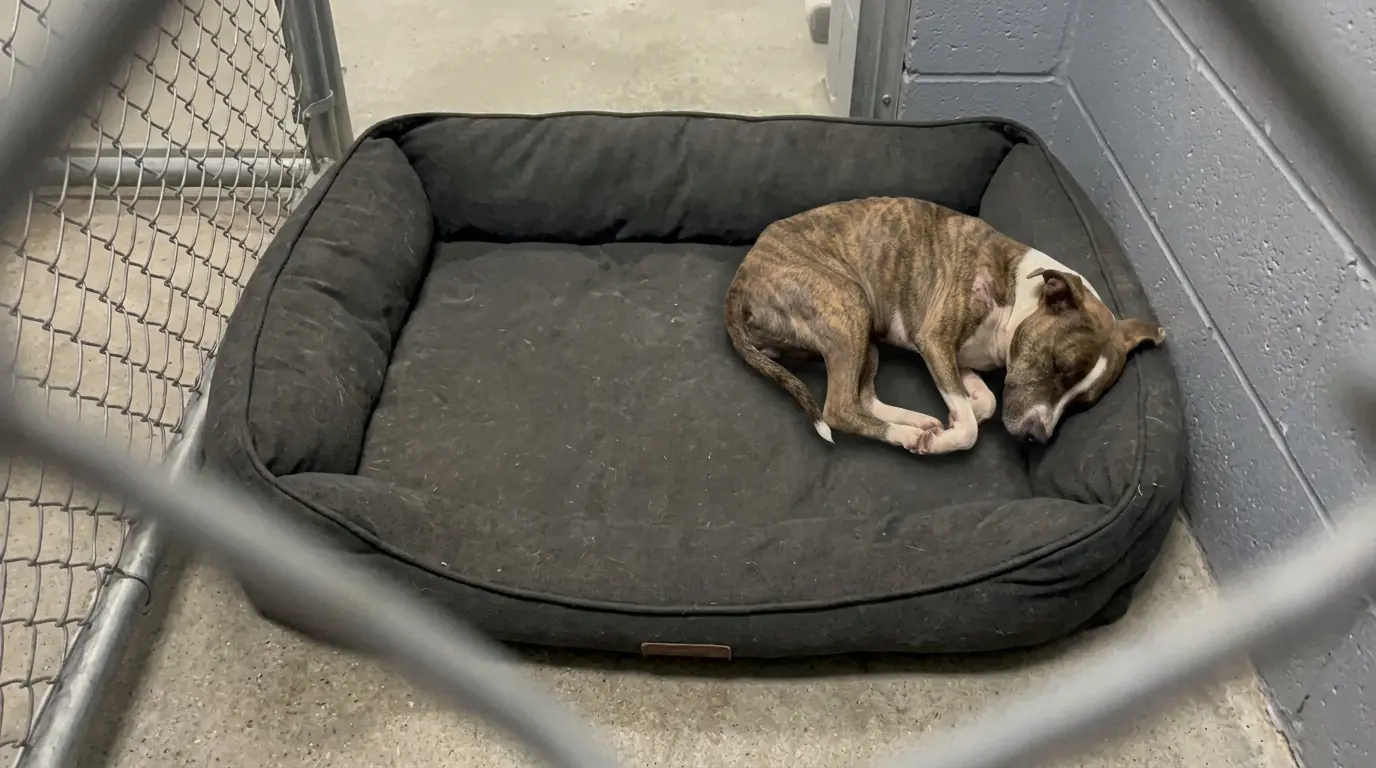
The bed was large enough for the Pit Bull mix to stretch out.
She did not.
Instead, every evening, she arranged herself into the same curved position she had used while nursing.
Her spine formed a loose arc along one side of the bedding.
Her hind legs folded beneath her.
Her front legs rested several inches apart.
And between them, she left a wide empty space.
When her puppies were still with her, that space had never been empty.
They had crowded against her abdomen.
They had climbed over one another.
They had rooted through her fur looking for a place to nurse.
They had fallen asleep in a warm pile pressed against her chest and belly.
Now the puppies were strong enough to continue growing in foster care.
They had been moved out of the medical kennel.
Their mother remained behind.
She was still underweight.
Her skin disease still needed treatment.
And every night, when she settled onto her bed, she continued leaving room for bodies that were no longer there.
Staff did not know whether she understood the absence the way a person would.
They did know that her sleeping posture had not changed with the room.
She Had Arrived Depleted
The Pit Bull mix came into care with a body that had been carrying more demand than it could comfortably support.
She was thin.
Her ribs were visible.
Muscle over her shoulders and hindquarters was reduced.
Her coat was patchy in several places.
The skin along her belly, flanks, and legs was irritated enough that staff immediately knew this was not simply a cosmetic problem.
She had also been nursing.
That mattered because lactation places a substantial nutritional demand on a mother dog.
Producing milk requires calories, protein, water, and minerals.
If those needs are not met consistently, the mother's own body reserves can decline.
The rescue could document what she looked like at intake.
They could not responsibly reconstruct exactly how long she had been underweight or what had caused every change in her skin.
The veterinary team treated each problem separately.
Her Puppies Needed Their Own Assessment
The litter was evaluated one puppy at a time.
Each pup was weighed.
Hydration was checked.
Mouths, hearts, lungs, abdomens, skin, and overall development were examined.
The rescue did not assume that active puppies were automatically healthy enough to continue nursing indefinitely.
Their growth had to be tracked.
Their stool had to be monitored.
Their parasite-prevention plan had to be age appropriate.
Their transition toward solid food had to happen gradually.
The goal was not to keep them nursing simply because the image of a mother surrounded by puppies was emotionally powerful.
The goal was to help the puppies grow while allowing the mother to recover.
Her Skin Disease Needed a Real Diagnosis
Patchy hair loss and irritated skin can come from many causes.
Parasites.
Bacterial infection.
Yeast.
Allergies.
Chronic moisture.
Poor nutrition.
Less commonly, hormonal or other systemic disease.
The veterinary team examined the affected areas closely.
Skin cytology and other appropriate tests helped determine what organisms or inflammation were present.
The pattern supported a combination of secondary skin infection and severe irritation, with poor body condition likely reducing her skin's ability to recover normally.
Treatment was targeted.
She did not receive a dramatic catch-all diagnosis.
Her skin needed medication, gentle cleansing, parasite control where indicated, good nutrition, and time.
Nursing Continued Only as Long as It Was Beneficial
At first, the puppies still relied significantly on her.
They nursed.
They slept against her.
They followed her body heat.
But as they reached an appropriate developmental stage, supplemental feeding increased.
Soft puppy food was introduced.
The pups made a mess of it.
Some stepped in the dish.
Some licked food from one another's faces.
The mother still allowed nursing, but the puppies were gradually learning that calories did not all have to come from her.
That mattered for her recovery.
A depleted mother should not remain the sole nutritional source longer than necessary.
The Mother Was Given More Food, but Not Just Unlimited Food
Her calorie needs were high.
They were also calculated.
She received a nutritionally appropriate diet designed to support recovery and lactation.
Meals were divided.
Her gastrointestinal response was monitored.
Body weight was tracked.
Staff looked at body condition and muscle condition separately.
Weight gain alone could not tell them whether she was rebuilding healthy tissue.
They wanted steady improvement.
Not rapid fat gain.
Not gastrointestinal upset.
Not a continued downward trend because nursing was consuming every calorie she ate.
At First, She Rarely Left the Puppies
During the earliest days, the mother spent most of her time with the litter.
She lay around them.
She cleaned them.
She responded when they vocalized.
If one wandered too far across the bedding, she often repositioned herself closer.
That was normal maternal behavior.
But staff also wanted her to have opportunities to rest without constant nursing.
Short periods away from the puppies began naturally.
A bathroom break.
A quiet meal in another area.
A few minutes outside.
At first, she returned quickly.
Then she began taking slightly longer.
That was a healthy change.
The Puppies Became Less Dependent
As their coordination improved, they became more interested in the world around them.
They walked farther.
Played.
Chewed toys.
Followed staff movements.
A puppy that once slept pressed against the mother's abdomen might now fall asleep on the opposite side of the pen.
Another might choose a blanket.
The mother noticed.
But she did not retrieve them constantly.
Her role was beginning to change.
The puppies still benefited from her.
They simply did not need uninterrupted physical contact anymore.
Weaning Was Gradual
The rescue did not remove the litter overnight.
Nursing frequency decreased as solid food intake increased.
The mother's mammary glands were monitored for discomfort, abnormal swelling, heat, or other signs that milk production was not decreasing smoothly.
Abrupt weaning can create physical problems for a mother dog.
So the process was paced.
The puppies spent increasing periods away.
Then returned.
Eventually, they were eating adequately on their own and no longer relying on nursing for primary nutrition.
That was when foster placement became possible.
The Puppies Could Leave Before Their Mother Was Ready
By then, the puppies were healthy enough to move into foster care where they could continue social development and routine medical care.
Their mother was not.
Her skin still required treatment.
She remained thinner than the veterinary team wanted.
She needed a controlled environment where her food intake, medication, skin condition, and weight could be monitored.
So the litter moved on.
She stayed.
It was medically practical.
Behaviorally, staff knew the transition needed to be watched.
The First Night Was Quieter Than Anyone Expected
The medical kennel had been loud when the puppies were there.
Tiny vocalizations.
Movement.
Nursing.
Puppies climbing across bedding.
After they left, the room looked unusually large.
The mother's bed stayed in the same position.
Her water bowl stayed in the same place.
Her blanket remained familiar.
At bedtime, staff expected her to investigate the pen or search more actively.
She did not.
She walked to the bed.
Turned.
Then curled herself into the same nursing posture she had used for weeks.
Her body stayed along one side.
Her front legs framed the center.
The middle remained empty.
Staff Did Not Immediately Call It Grief
The image was difficult not to humanize.
A mother dog curled around an empty space after her puppies had left invited an obvious story.
But the rescue stayed careful.
Dogs can show behavioral changes after separation from familiar animals.
They can search.
Vocalize.
Become more vigilant.
Rest differently.
Eat less.
But one sleeping posture cannot reveal a complete emotional interpretation.
The mother had also spent weeks physically arranging herself around puppies.
That posture may simply have become habitual.
It may have felt physically comfortable.
It may have been associated with rest.
It may have reflected lingering maternal behavior.
No one could know exactly which factor mattered most.
What they could say was that the empty space remained.
Night after night.
She Checked the Kennel More During the First Few Days
Although she did not become frantic, staff noticed some changes.
She lifted her head more often when she heard puppy-like vocalizations elsewhere.
She sniffed the bedding where the litter had been.
After returning from bathroom breaks, she sometimes walked the perimeter before lying down.
Her appetite stayed good.
That was reassuring.
She drank normally.
She did not spend hours pacing or scratching at doors.
The response was quiet.
Just like her sleeping posture.
The Medical Team Turned Attention Back Toward Her
With the puppies no longer nursing, her body's demands changed.
That created an opportunity.
Calories that had previously supported milk production could now support her own recovery more directly.
Her diet was adjusted appropriately.
Skin treatment continued.
Her weight was monitored.
Her mammary glands were checked as lactation decreased.
Staff watched for redness, heat, painful swelling, or abnormal discharge.
The process remained uneventful.
Milk production gradually diminished.
Her body finally had a chance to focus on itself.
Her Skin Began Improving
The changes were slow.
Inflamed areas became less red.
New hair began appearing in some of the patchiest spots.
She scratched less.
The odor associated with secondary infection diminished.
Her skin barrier still needed time.
A dog does not regrow a healthy coat in a few days.
But the trend was moving in the right direction.
She also looked more comfortable when lying on her side.
That mattered because the puppies were no longer dictating how she positioned herself.
She had options now.
She Still Chose the Arc
Even with more room, she kept returning to the same shape.
Curved body.
Open center.
Front paws framing the space.
Sometimes staff would place a folded blanket in the middle.
She moved it.
Not aggressively.
She simply repositioned herself and left the center open again.
That detail made the pattern even more noticeable.
She was not simply sleeping wherever the bedding happened to settle.
She was arranging herself.
The Empty Space Slowly Became Smaller
Weeks into recovery, the sleeping posture began changing.
Not dramatically.
One night, she placed one front paw partly across the center.
Another night, she stretched more fully onto her side.
Later, she slept with her back closer to the middle of the bed.
The curved nursing posture still appeared.
Just not every night.
Staff did not treat that as evidence that she had “moved on.”
It was simply greater flexibility.
Her body had more than one way to rest now.
Her Weight Started Climbing More Reliably
Once lactation ended, her nutritional progress became easier to see.
The scale began moving upward gradually.
Her ribs remained visible for a while.
Then less so.
Muscle over the shoulders improved.
The hindquarters took longer.
She was encouraged to move through short, comfortable walks rather than being pushed into strenuous exercise.
Nutrition rebuilt the material.
Activity helped tell the body where to use some of it.
She Began Enjoying Time Away From the Kennel
At first, outings were functional.
Bathroom.
Short walk.
Back inside.
Then her interest expanded.
She sniffed more.
She paused at patches of grass.
She investigated fence lines.
She began looking toward caregivers when the leash appeared.
Those changes mattered because during the most depleted phase, nearly all of her energy had been directed toward survival and maternal care.
Now some of it could go toward simply being a dog.
She Developed Preferences That Had Nothing to Do With Motherhood
She liked soft toys but did not destroy them.
She preferred a certain corner of the outdoor yard.
She accepted gentle chest scratches from familiar caregivers.
She had a habit of sniffing every bowl before eating even when staff had just placed it down.
Those details helped staff see her as an individual rather than only as “the mother.”
That was important for her eventual placement.
Her puppies would develop their own lives.
She needed one too.
Foster Care Became Possible
Once her skin was substantially improved and her weight was moving steadily in the right direction, she transitioned into foster care.
The foster home had no puppies.
That was intentional.
Staff wanted to see how she settled when there was no maternal routine around her at all.
A large bed was placed in a quiet corner.
There were several blankets.
Food and water were nearby.
She explored slowly.
Then, at bedtime, she chose the corner bed.
She curled.
Her body formed the familiar arc.
The center stayed empty.
The posture had followed her out of the shelter.
The Foster Caregiver Did Not Fill the Space
There was no reason to place toys or pillows between her legs just to change the picture.
If she wanted to sleep that way, she could.
The foster caregiver simply observed.
Over the first week, the mother alternated between the curved posture and more ordinary positions.
Sometimes the center was empty.
Sometimes it was not.
That variation suggested the behavior was loosening naturally without intervention.
She Slept More Deeply in the Home
The absence of kennel noise changed her rest.
She could sleep through longer stretches.
She stretched farther.
She occasionally rolled partly onto her side with her abdomen exposed.
That position would have been difficult when puppies were nursing constantly.
Now it became possible.
The deeper sleep likely helped physical recovery too.
Rest matters.
Especially for a dog rebuilding weight and healing skin.
She Did Not Search Constantly for the Puppies
This was another important observation.
The mother did not spend the foster period pacing from room to room.
She did not stop eating.
She did not remain at the front door.
She adapted to the home.
That did not invalidate the unusual sleeping posture.
It simply showed that she could function without the litter.
Maternal behavior was changing into individual routine.
Her Appetite Remained Strong
Without lactation, her calorie requirements decreased from their peak, but nutritional rehabilitation continued.
The foster caregiver followed the rescue's feeding plan.
Portions were adjusted as body condition improved.
Too much weight would not be healthy simply because she had once been underweight.
The target was an appropriate body condition for her build.
Her skin benefited as nutritional status stabilized.
Her Coat Took Months to Fully Recover
Some areas filled in faster than others.
The fur along her shoulders improved first.
More irritated areas took longer.
Any recurrence of itching, redness, odor, or hair loss was monitored.
Skin disease can relapse if underlying contributors remain.
The rescue did not call her cured after one good week.
Her improvement had to hold.
The Puppies Continued Their Own Development Elsewhere
Staff received updates from the puppies' foster placement.
They were eating independently.
Growing.
Developing individual personalities.
Their medical schedules continued.
The mother was not repeatedly brought back together with them for emotional reunions.
That would not necessarily benefit anyone.
The transition had already happened.
The puppies needed age-appropriate development.
The mother needed recovery.
Both could be cared for without turning separation into a spectacle.
She Started Taking Up the Whole Bed
One of the clearest changes appeared several weeks into foster care.
The caregiver walked into the room and found the Pit Bull mix asleep diagonally across the bed.
Her back legs were stretched toward one corner.
Her front legs pointed toward another.
Her abdomen was completely exposed.
There was no open center.
No carefully preserved space.
She occupied almost every inch.
The next night, she curled in an arc again.
That was fine.
Progress did not require eliminating the old posture.
It required giving her more choices.
The Arc Became Something She Did Occasionally
As time passed, the frequency continued decreasing.
She might use it after a particularly tiring day.
Or when sleeping on a certain shaped bed.
Sometimes she curled around a blanket.
Other nights she stretched straight out.
The behavior that once appeared every evening became one option among several.
Her Future Home Needed to See More Than the Empty Space
Potential adopters naturally responded to her maternal story.
The rescue wanted them to understand the dog beyond it.
She had a history of significant skin disease that required monitoring.
She had been underweight and needed responsible long-term nutrition.
She was affectionate on her own terms.
She could relax independently.
She enjoyed calm walks.
She did not need to live with puppies.
She did not need to remain permanently defined by the litter she had raised.
The empty space on the bed was part of her story.
It was not her entire identity.
Staff Still Remember the First Nights After Weaning
The contrast had been impossible to miss.
Before the puppies left, the bed was crowded.
Small bodies pressed against her.
Tiny paws moved across her stomach.
Puppies slept between her front legs.
The mother curved herself around them because there was barely room not to.
Then the litter moved to foster care.
The bedding was clean.
The kennel was quiet.
There was finally enough space for the mother to stretch however she wanted.
And that night, she did exactly what she had done before.
She curved herself around one side of the bed.
Left the middle open.
Rested her front legs around nothing.
Then went to sleep.
She Sometimes Still Does It
The behavior has not vanished completely.
There are nights in foster care when she returns to that same shape.
Her spine curves.
Her front paws settle apart.
The center remains open.
No puppies arrive to fill it.
No one tries to change her position.
Eventually she shifts.
Maybe an hour later.
Maybe in the morning.
And increasingly, when she moves, she takes up more of the bed.
Her skin is healthier now.
Her body has filled out.
Her mammary tissue has returned toward a normal post-lactation state.
She has energy for walks, toys, and ordinary routines.
The puppies no longer depend on her.
And she no longer spends every night protecting a space for them.
But every so often, the old maternal shape returns.
A curved body.
An empty center.
A dog sleeping around the outline of a litter that no longer needs to be there.
Then, sometime during the night, she stretches one leg across the space.
Rolls onto her side.
And lets the bed become hers again.