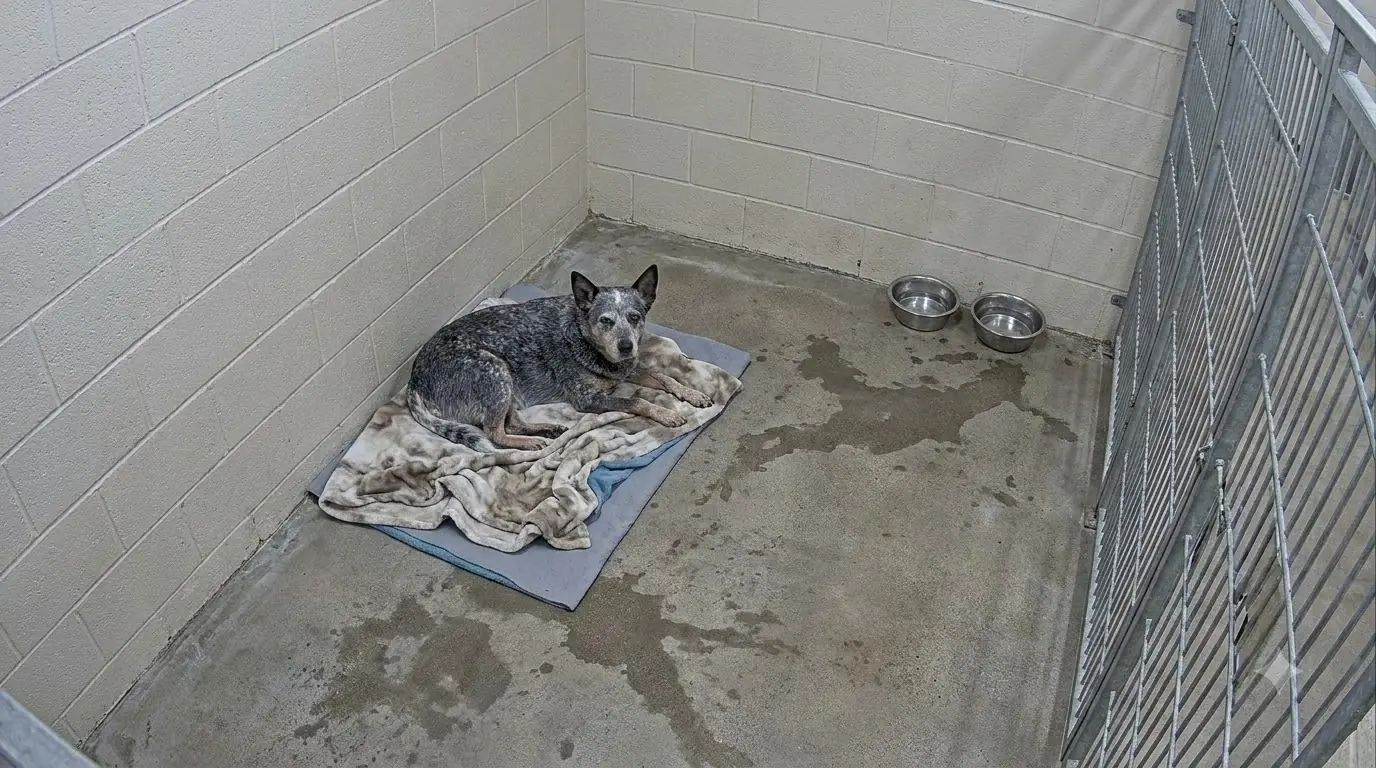
The sound itself was barely noticeable.
A metal latch clicked several kennels away.
A cart wheel rolled over a seam in the floor.
Someone spoke quietly at the far end of the hallway.
Most of the dogs in the medical row reacted in ordinary ways.
A head lifted.
A bark answered.
A body moved toward the front.
The senior Australian Cattle Dog reacted differently.
She had been lying on a fleece mat near the side wall, her body angled away from the kennel gate.
The noise reached her.
Her eyes opened.
Her head lifted.
Then she stopped.
For a moment, she seemed to be listening without knowing exactly where to look.
Her head turned one way.
Paused.
Then back again.
After several seconds, she began moving the rest of her body.
Her front paws shifted first.
Her shoulders followed.
Then her hips scooted slowly across the bedding.
She kept rotating until one side of her head faced the bars.
The ear on that side lifted.
The other barely moved.
Only when her remaining good ear was pointed toward the hallway did she lie down again.
Then she stayed perfectly still.
Waiting.
Not for a person specifically.
Not for food.
Not for the kennel door to open.
For the next sound.
One Ear Had Been Lost to Chronic Disease
The hearing problem had not started at the shelter.
The Cattle Dog had a long history of chronic ear disease before intake.
By the time she arrived, one ear had been affected severely enough that functional hearing on that side was gone.
Chronic otitis can become much more serious than occasional irritation.
Repeated inflammation may thicken tissue inside the canal.
The canal can narrow.
Bacteria or yeast may recur.
Pain may become persistent.
Deeper structures can eventually be affected.
When that happens, hearing loss may become permanent.
The veterinary team did not assume the dog was simply “going deaf because she was old.”
Her history and examination supported something more specific.
One side had suffered long-term disease.
The other still worked.
The First Goal Was Comfort
No one promised to restore the deaf ear.
That would not have been medically responsible.
Some hearing loss cannot be reversed.
Treatment focused instead on what could still be improved.
Was there active infection?
Inflammation?
Pain?
Discharge?
Skin irritation?
The affected ear was examined carefully.
Cytology or other testing could be used if signs suggested bacterial or yeast involvement.
The functioning ear was checked too.
That ear had become especially important.
Keeping it healthy mattered.
At First, Staff Thought She Was Ignoring Them
The misunderstanding did not last long.
A caregiver approached from the dog's deaf side.
Spoke softly.
No response.
Moved closer.
Still nothing.
Then the person stepped into the Cattle Dog's field of vision.
Her body tightened immediately.
Her head snapped around.
Eyes widened.
Within seconds, she recognized the person and relaxed.
The same caregiver tried approaching from the opposite side later.
Different response.
The remaining good ear moved before the person arrived.
The dog's head lifted.
She was already looking in the right direction.
That was when staff began understanding how differently she experienced the kennel.
Hearing From One Side Is Not the Same as Hearing Normally
She could hear.
That was important.
A food container opening down the hallway could wake her.
Footsteps could catch her attention.
Voices could make the good ear move.
But locating sounds was harder.
Two ears help animals compare timing and intensity to determine direction.
With one functional ear, that system becomes less precise.
The sound still exists.
Its location may not.
For the Cattle Dog, the solution seemed to be movement.
She would turn until the working ear had the best chance of identifying where the noise came from.
The Shelter Made That Harder
A kennel building is acoustically complicated.
Metal doors.
Concrete.
Block walls.
Water.
Barking.
Footsteps.
Equipment.
Sounds reflect.
Echo.
Overlap.
Even a fully hearing dog can find a busy shelter overwhelming.
For a senior dog relying on one ear, the same environment became much harder to interpret.
She could detect noise.
She could not always organize it.
That was why the slow turning became so frequent.
She Never Rushed Toward the Gate
That was one of the first things staff noticed.
A sudden hallway noise did not send her running forward.
Instead, she froze.
Listened.
Then repositioned.
Her behavior looked cautious rather than reactive.
That made sense.
If a dog cannot accurately locate something, moving quickly toward it could be risky.
So she gathered more information first.
The entire body became part of the listening process.
Her Age Made Every Turn More Expensive
She was senior.
Not immobile.
Not severely arthritic.
But slower.
Her movements lacked the effortless speed of a younger Cattle Dog.
When she rotated on the mat, the front end moved first.
The rear followed.
Sometimes she had to stand briefly to reposition.
Then lower herself again.
That meant a sound lasting one second could trigger several seconds of physical work.
The behavior was useful.
It was also tiring.
Staff Changed the Bed Before Trying to Change the Dog
The first environmental adjustment was simple.
They turned the bed.
Instead of placing it sideways to the kennel door, they positioned it so the dog could lie naturally with her good ear already facing the hallway.
The Cattle Dog inspected the new angle.
Turned once.
Lay down.
A cart rolled past.
Her good ear moved.
Her body stayed still.
That was exactly the outcome staff wanted.
The strange repeated turning had given them useful information.
Now they could reduce how often she needed to do it.
The Goal Was Never to Make Her Stop Listening
Listening helped her understand the environment.
The problem was the amount of work required.
If one bed placement allowed her to hear without constantly rotating, that was better care.
The rescue did not want to preserve an unusual behavior just because it made a compelling story.
They wanted to make it unnecessary.
People Changed How They Approached Her
Caregivers stopped calling repeatedly from the deaf side.
They stopped using her name as a test.
If they were approaching from behind, they tried to enter her visual field before touching.
If they came from the hearing side, a soft voice or ordinary footstep could give her warning.
When she was asleep, they were especially careful.
No sudden hand appearing on the deaf side.
No tapping her body without warning.
Predictability mattered.
Her Startle Response Was Not Aggression
This distinction became important for volunteers and visitors.
If someone surprised her from the deaf side, she might start sharply.
Head turn.
Body tense.
Eyes wide.
That did not automatically mean she was unsafe.
It meant she had received unexpected physical information without auditory warning.
The shelter treated that as an accessibility issue.
Not a character flaw.
She Became Easier to Handle Once People Respected the Hearing Loss
Ear exams were still difficult.
That history of chronic pain mattered.
The affected ear was not something staff could casually manipulate.
If a thorough examination would be painful, sedation could be medically appropriate.
Low-stress handling reduced unnecessary conflict.
Slow hands.
Treats when appropriate.
Short sessions.
No forcing the dog's head into position simply because she tolerated other handling.
The Good Ear Worked Almost Constantly
During the day, staff began noticing how expressive it was.
Footsteps.
Ear turns.
Voice.
Ear lifts.
Metal sound.
Ear flattens briefly.
Quiet.
Ear relaxes.
The deaf side remained comparatively still.
That visual contrast became one of the clearest ways to understand her sensory world.
The Dog Still Slept
At first, not deeply.
The medical kennel was unfamiliar.
She often rested with the good ear exposed toward the hallway.
One eye partly open.
A sound would wake her.
Then the head.
Then the body.
Then another full reorientation toward the gate.
As the bed position improved, the sequence shortened.
A noise happened.
Ear moved.
Maybe one eye opened.
Then sleep continued.