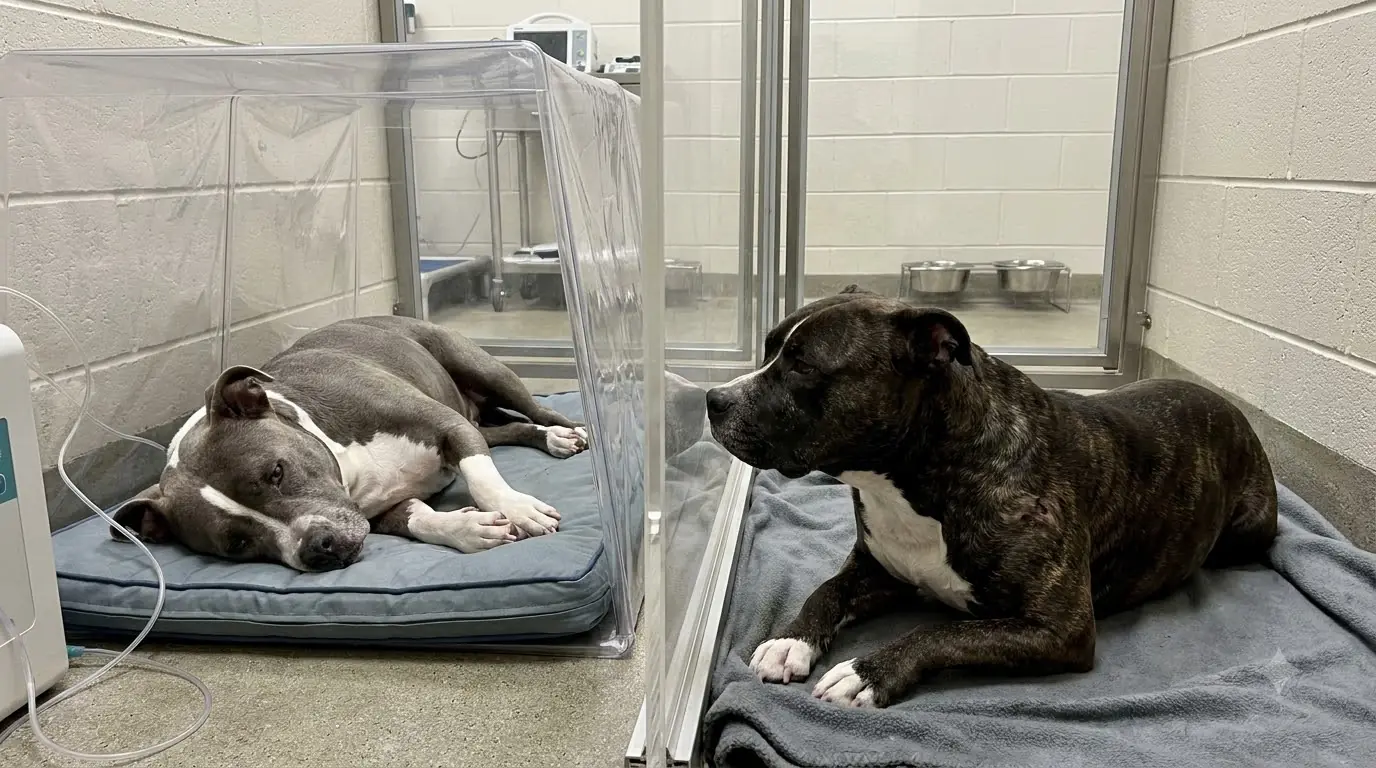
The male American Staffordshire Terrier had finally fallen asleep.
He was lying on his side beside the clear divider separating his recovery space from the kennel next to him. His coat still carried a few singed patches from the fire, and several shallow abrasions had already been cleaned and treated, but compared with the dog beside him, his injuries were minor.
The female dog was the one the veterinary team was watching most closely.
She lay on thick bedding inside the adjoining recovery kennel with supplemental oxygen supporting her while her irritated airways recovered from smoke exposure.
For several minutes, both dogs were quiet.
Then her breathing changed.
It was not dramatic.
No sudden collapse.
No frantic movement.
The rhythm simply became slightly different for several breaths.
The male dog's eyes opened immediately.
His head came up.
He remained still for a second, listening.
Then he moved closer to the divider.
His nose reached the narrow space near the barrier.
He sniffed toward her face.
The female remained lying down.
Her breathing settled into a steadier pattern again.
The male stayed there for several seconds.
Then, slowly, he lowered his head back onto the bedding.
Within minutes, his eyes were closed.
Later, it happened again.
And again.
Staff eventually realized he was barely getting through a full stretch of sleep.
Whenever her breathing sounded different, he woke.
Both Dogs Had Been Found in the Same Smoke-Filled House
The pair had lived together before the incident.
They were found after a small residential fire filled part of the home with smoke.
The shelter and veterinary team could confirm the circumstances surrounding their rescue.
They did not invent details about exactly where each dog had been standing during the fire or how long they had been exposed beyond what responders could reasonably document.
Both dogs had inhaled smoke.
But the female showed more concerning respiratory signs.
The male had visible superficial injuries.
Several areas of his coat had been lightly singed.
There were abrasions consistent with moving through a chaotic environment.
His breathing, however, remained comparatively stable.
The female was different.
She required more intensive monitoring almost immediately.
Smoke Exposure Can Look Worse After the Initial Rescue
One of the difficult things about inhalation injury is that the first appearance does not always tell the whole story.
A dog may be awake.
Standing.
Responsive.
Then airway irritation and pulmonary changes become more apparent over time.
That was why the veterinary team did not assume the female was safe simply because she had survived removal from the house.
Her respiratory rate mattered.
The effort behind each breath mattered.
The color of her gums mattered.
Her oxygenation mattered.
The condition of her eyes and face mattered.
The team listened to her lungs.
Monitored for coughing.
Watched for increased effort.
Used supplemental oxygen because her respiratory system needed support.
Further imaging or testing could be considered depending on how her examination evolved.
The goal was not to order every possible test automatically.
It was to respond to the clinical signs actually present.
She Was Kept Quiet for a Reason
A dog with respiratory injury does not need unnecessary excitement.
Every burst of activity increases oxygen demand.
So the female's recovery space was kept calm.
Minimal handling.
Low stimulation.
No visitors crowding the kennel.
No repeated attempts to make her stand for video.
No emotional reunions staged for attention.
She needed rest.
The male dog, however, complicated that plan in an unexpected way.
Not because he disturbed her.
Because he refused to put much distance between them.
Staff Initially Considered Housing Them Farther Apart
That would have been reasonable in many medical cases.
The female needed respiratory monitoring.
The male needed treatment for his own minor injuries.
Separate spaces make procedures easier.
They reduce the chance that one animal accidentally interferes with equipment.
They allow both dogs to rest.
But when the male was placed farther away, his behavior changed.
He stood more.
Looked repeatedly toward where she had been taken.
Had difficulty settling.
Once they were positioned in neighboring recovery spaces with a secure divider, he lay down almost immediately.
That did not prove a lifelong bonded relationship by itself.
But it was useful behavioral information.
Staff Chose Safe Proximity Instead of Full Separation
The dogs remained physically separated.
That was important.
The male could not climb onto her bedding.
He could not bump oxygen equipment.
He could not accidentally step on her.
The female could rest without another dog's weight beside her.
But they could see and smell one another.
They could lie near the same divider.
That arrangement seemed to reduce the male's restlessness without interfering with her medical care.
He Chose the Divider Every Time
There was plenty of space elsewhere in his kennel.
A comfortable bed.
Water.
Room to turn.
He still moved toward the shared barrier.
His chest nearly touched it when he lay down.
Sometimes his back faced the room.
Sometimes he curled.
But his head almost always ended up close to the side nearest her.
That was the position he chose for sleep.
Or tried to.
The First Night Was When Staff Noticed the Breathing Pattern
The medical team was already monitoring the female closely.
A technician sitting nearby heard her breathing change.
The male dog reacted at nearly the same time.
His eyes opened.
Head rose.
Nose toward divider.
Staff assumed the timing was coincidence.
Then it happened again later.
The female took several more audible breaths.
The male woke.
Sniffed toward her.
Waited.
Lowered his head.
By the third or fourth repetition, staff started documenting it.
He Did Not Bark or Paw Frantically
That distinction mattered.
He was not panicking every time she shifted.
He did not throw himself into the barrier.
He did not vocalize continuously.
The response was quieter.
Wake.
Lift head.
Move muzzle closer.
Sniff.
Watch.
Then settle.
That calm repetition made the behavior more striking.
Staff Could Not Know Exactly What He Was Detecting
It would be easy to say he understood that she was struggling to breathe.
That goes beyond what could be proven.
Dogs have extremely sensitive hearing and smell.
He may have noticed a change in respiratory sound.
A shift in airflow.
Movement.
Scent.
Body position.
Possibly several cues together.
The responsible statement was simpler.
Changes in her breathing were repeatedly followed by him waking and checking the divider near her face.
That was what staff saw.
The Female's Respiratory Injury Remained the Priority
The emotional behavior did not change medical decisions.
Her oxygen support was adjusted based on veterinary assessment.
Respiratory rate and effort were tracked.
If she coughed more.
If breathing became noisier.
If she appeared more anxious.
If oxygenation worsened.
Those were clinical signals.
The male dog's reaction was interesting.
It was not used as a replacement for monitoring equipment or examination.
He Had His Own Injuries to Recover From
The male's minor burns and abrasions still needed care.
Singed fur does not automatically mean deep burn injury.
The skin underneath had to be assessed.
Some areas only required cleaning and monitoring.
Any actual burn needed treatment based on depth and location.
His paws were checked.
Eyes evaluated if smoke or heat exposure had affected the face.
The abrasions were cleaned.
Pain was treated where necessary.
He was medically better off than the female.
He was not uninjured.
That Was Why Staff Wanted Him to Sleep
Rest mattered for him too.
His body had been through the same frightening environmental event.
He had minor injuries.
He had been transported.