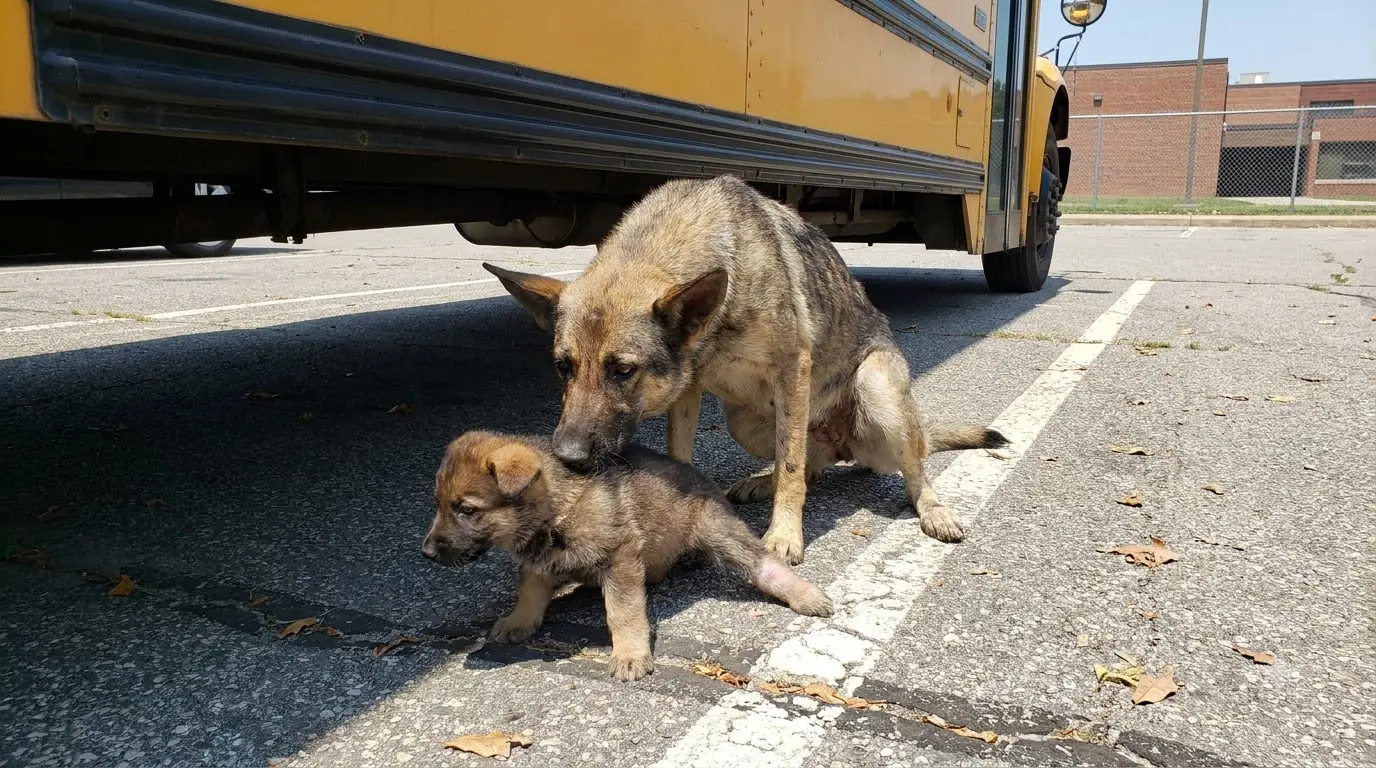
The school parking lot was almost empty.
Summer break had started weeks earlier. Most of the buildings were closed, the pavement sat exposed under the afternoon sun, and several yellow school buses had been parked in the same row long enough for dust to collect along their tires.
That was where someone first noticed the German Shepherd mix.
She was thin.
Her coat looked rough from outdoor living.
Her gait was uneven enough that one of the people checking the property thought she might be injured herself.
But the dog was not wandering the lot randomly.
She kept returning to the same bus.
More specifically, to the narrow strip of shade beneath it.
The first time a rescuer approached, the Shepherd disappeared under the vehicle.
Then a second shape moved behind her.
A puppy.
Small enough to fit easily beneath the bus frame.
Old enough to crawl and attempt short steps.
And visibly injured.
One hind leg was swollen.
The puppy tried to move forward anyway.
He dragged himself toward the edge of the shade.
The mother turned almost immediately.
She limped after him.
Reached his side.
Lowered her muzzle to his shoulder.
And gently pushed.
The puppy resisted for a moment.
Tried to crawl forward again.
The mother nudged him a second time.
He slid backward across the dusty pavement until he was beneath the bus again.
Then she positioned herself at the opening.
Her body between the puppy and the exposed parking lot.
The puppy lay down.
She remained there.
That was the behavior rescuers would see repeatedly before either dog was safely removed.
The Bus Had Become Their Shelter
The German Shepherd mix and her puppy had apparently been living around the closed school property for at least some period of time.
Exactly how long could not be confirmed.
No one had a reliable timeline showing when they first arrived.
There was no evidence that allowed rescuers to say someone had intentionally dumped them there.
The school was closed for the summer.
The lot had less human activity than usual.
A stray dog could move through it without being noticed immediately.
What rescuers could document was simple.
A thin adult female dog was repeatedly using the space beneath one parked school bus.
A puppy was staying with her.
And the puppy had a visibly abnormal hind leg.
The Mother Was Injured Too
Her limp was less dramatic than the puppy's.
That made it easy to overlook at first.
When she moved slowly beneath the bus, she could place all four feet.
When she had to follow the puppy quickly, the asymmetry became more obvious.
One side of her gait shortened.
She shifted weight away from one limb.
The veterinary team would later evaluate that separately.
At the parking lot, rescuers could only see that the mother was physically compromised and still moving whenever the puppy did.
That made every repeated trip from one side of the bus to the other costly.
The Puppy Kept Trying to Leave the Shade
That became the strongest pattern.
He would wake.
Shift.
Crawl.
Sometimes make it several feet.
The mother watched.
If he headed toward the open lot, she followed.
Not rushing.
She did not have the strength or mobility for that.
But she got there.
Placed her nose against his side.
Redirected him.
Then lay across or near the opening beneath the bus.
The behavior was striking because the puppy's movement was not inherently dangerous by itself.
He was simply trying to explore.
The problem was what waited outside the shadow.
Hot pavement.
Open space.
Vehicles that could eventually move.
No protection.
And a hind leg that already looked painful.
Rescuers Did Not Know Whether She Understood the Leg Was Injured
That would have been impossible to prove.
Dogs respond to many cues.
Movement.
Vocalization.
Scent.
Posture.
A puppy that struggles to walk behaves differently from one moving normally.
The mother's repeated response could have been influenced by any combination of those signals.
The responsible description was the observable one.
Whenever the injured puppy moved toward the open parking lot, she frequently followed, nudged him back toward the shaded area, and positioned herself near the edge.
No claim about human-like medical understanding was necessary.
The Heat Changed the Urgency
The pavement itself was part of the risk.
Summer asphalt can become dangerously hot.
A puppy with limited mobility cannot move away from heat as efficiently.
A thin adult dog may already be dehydrated.
The space under the bus offered shade, but it was not a safe long-term environment.
There was no reliable water source immediately visible beneath the vehicle.
No secure enclosure.
No protection from traffic once the property became active again.
Rescuers needed to remove both dogs.
The challenge was doing it without causing the mother to flee and leave the injured puppy behind.
They Started With Distance
A frightened stray mother may perceive direct approach as a threat.
Especially when a puppy is present.
So rescuers did not crawl under the bus immediately.
They stayed several yards away.
Placed water.
Then food.
Moved back.
The mother watched.
Her body remained low.
She did not approach while people stood near the bowls.
When they backed farther away, she came out.
Slowly.
She drank first.
That was useful information.
The dog was thirsty enough to risk leaving cover.
Then she ate.
Not frantically.
But quickly.
She repeatedly looked back toward the bus.
She Returned Before Finishing Everything
The puppy had moved.
His head and shoulders appeared beyond the shadow.
The mother stopped eating.
Turned.
Limped back.
Rescuers watched from a distance.
She reached him.
Nudged him beneath the bus.
Then stayed there.
The food could wait.
That sequence told the team that any capture plan needed to account for her repeated return to the puppy.
Trying to trap only the adult dog at the food station could separate them in a way that increased stress.
The Puppy Could Not Simply Be Chased Out
He was injured.
That ruled out many fast capture options.
No one wanted him scrambling across pavement on the swollen hind leg.
The safest approach was to reduce pressure.
Keep the area quiet.
Block unnecessary access by vehicles.
Gain enough of the mother's trust that both animals could be contained with minimal movement.
The school property manager helped keep the immediate section of the lot clear.
That created time.
The Mother Began Taking Food Closer to People
Not from hands.
That would have been too much too soon.
But the distance shortened.
Food placed farther from the bus initially caused hesitation.
Food placed near the shade line worked better.
The mother approached.
Ate.
Retreated.
Repeated.
Rescuers noticed that her body language was cautious but not explosively fearful.
She did not charge.
Did not bark continuously.
Did not try to defend the entire area aggressively.
Her priority seemed to be maintaining access to the puppy.
That made a low-stress capture more realistic.
The Puppy Vocalized When He Tried to Stand
That changed the plan again.
At one point, he pushed himself upright.
The healthy hind leg took weight.
The swollen leg barely did.
He took one awkward step.
Then lowered himself quickly.
A small vocalization followed.
The mother was beside him almost immediately.
That confirmed the leg needed veterinary attention without delay.
The puppy was not simply walking awkwardly because he was young.
The limb was painful enough to alter movement significantly.
Rescuers Used the Bus as Part of the Capture Strategy
The structure limited the dogs' escape routes.
That could help if used carefully.
It could also make them feel trapped.
So the team avoided surrounding both ends at once.
One side remained visually open.
Food was placed near a safe portable barrier setup.
The mother was given time to investigate.
The puppy remained in the shade.
No one crawled rapidly toward them.
No one tried to grab the mother by the legs.
The objective was controlled containment.
Not a dramatic chase.
The Puppy Was Secured First
Only once the mother was close enough and calm enough for rescuers to work.
A trained rescuer moved slowly into position.
The puppy could not retreat quickly because of the injured leg, but that did not mean he should be handled roughly.
A towel or blanket helped reduce visual stimulation.
His body was supported beneath the chest and pelvis.
The swollen hind limb was protected from dangling.
He was placed into a secure carrier with soft bedding.
The entire process took seconds once contact was made.
The preparation took much longer.
The Mother Stayed Close
She backed away when the rescuer reached under the bus.
Then moved forward again once the puppy was inside the carrier.
Her nose worked rapidly.
She circled.
The puppy made a sound.
The mother's attention focused on the carrier.
That was exactly what rescuers had hoped.
The carrier could now help guide her toward the rescue vehicle.
She Was Not Forced Into a Crate While Panicking
The team gave her another minute.
Food near the vehicle.
Carrier visible.
Puppy inside.
The mother approached.
Retreated.
Approached again.
A slip lead or humane containment method was used once she was in a safe position.
She resisted briefly.
Not with sustained aggression.
With uncertainty.
Rescuers kept pressure minimal.
No dragging by the neck.
Her own limp had to be respected too.
Eventually she was loaded into a secure space near the puppy.
The First Thing She Did Was Check the Carrier
Her nose went toward the openings.
The puppy shifted.
The mother remained standing for several seconds.
Then lowered herself.
That was the first time rescuers had seen her rest without the bus above her.
The vehicle door closed.
The school parking lot disappeared behind them.
Both Dogs Were Examined Separately
The puppy's swollen hind leg was the obvious priority.
But the mother was not treated as an accessory to his case.
She was thin.
She was limping.
She had likely been living outdoors.
She had her own nutritional and orthopedic needs.
The veterinary team examined both dogs individually.
That mattered.
Maternal behavior can easily distract from the mother's physical condition.
Rescue medicine should not.
The Puppy Needed Imaging
The swelling and reluctance to bear weight justified orthopedic evaluation.
The veterinarian examined the hip.
Knee.
Hock.
Paw.
Long bones.
Looked for wounds.
Assessed pain.
Then radiographs were used to determine whether the problem involved bone, joint, growth plate, or severe soft-tissue injury.
The team did not assume fracture from appearance alone.
The diagnosis came from imaging and examination.
Whatever the exact lesion proved to be, the puppy required stabilization and restricted activity.
Surgery Was Not Automatically the Answer
Some orthopedic injuries in young dogs need surgical repair.
Others can be managed conservatively depending on location, stability, displacement, and developmental stage.
The rescue followed the veterinary findings.
If surgery was indicated, it would be because the injury required it.
If splinting, rest, and close rechecks were more appropriate, those would be used instead.
The puppy's age made follow-up especially important.
Growing bones change quickly.
The Mother Had a Separate Leg Problem
Her limp was evaluated with gait observation and palpation.
There was no reason to assume she had the same injury.
She may have had a chronic soft-tissue problem.
Arthritis.
An older untreated injury.
Paw pain.
Or another cause entirely.
Radiographs were considered based on where pain localized.
The rescue avoided turning every limp into a fracture.
The mother was painful enough to need management.
Not necessarily surgery.
Her Body Condition Needed Attention Immediately
The German Shepherd mix was underweight.
Ribs were easier to feel than ideal.
Muscle mass had decreased.
Her coat looked dry.
That did not automatically prove prolonged starvation.
Outdoor living, lactation history if recent, disease, parasites, poor nutrition, or several factors could contribute.
The team approached it methodically.
Body-condition score.
Hydration.
Bloodwork where appropriate.
Fecal screening if indicated.
Food introduced in a controlled plan.
The goal was steady restoration.
The Puppy Was Weighed Daily
This was especially useful during the first phase.
Young dogs can change quickly.
Appetite.
Hydration.