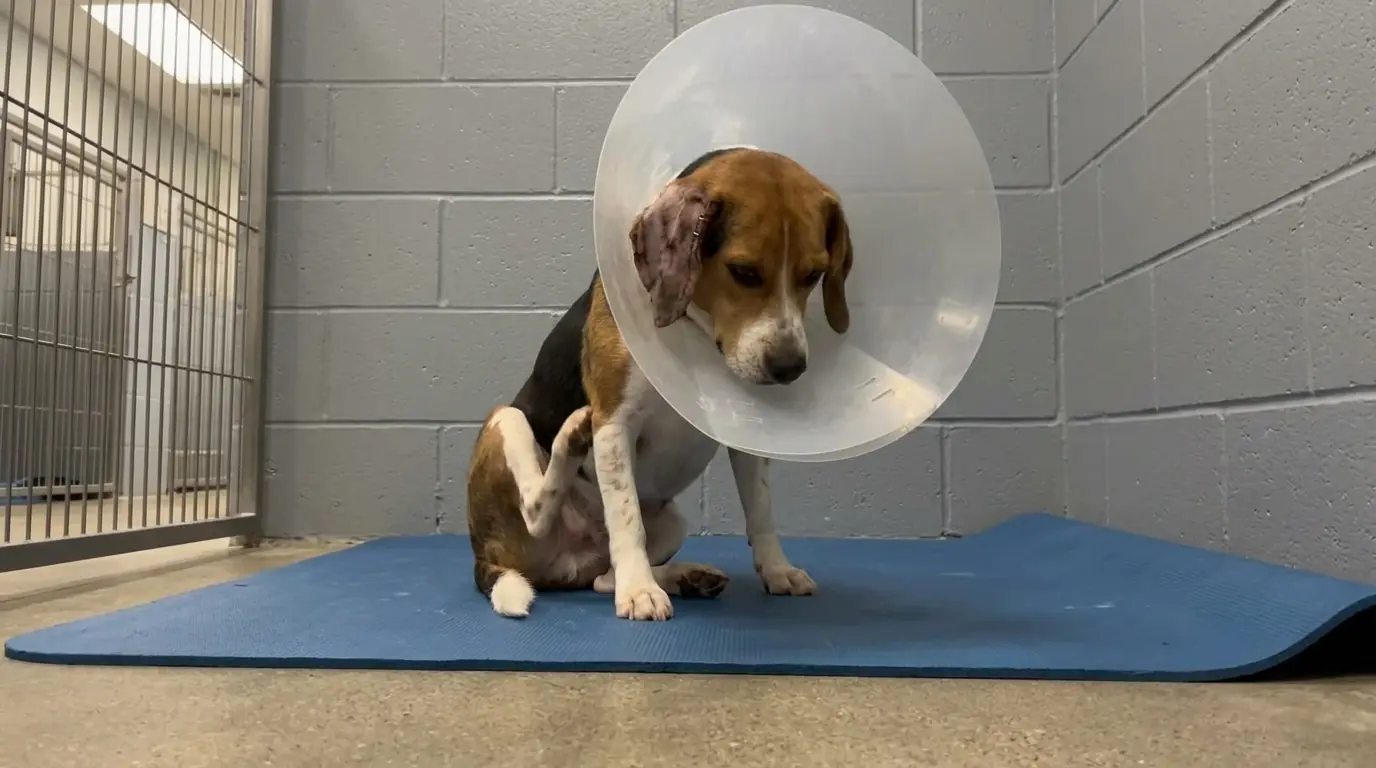
The Itch Was Small, but He Could Not Reach It
The Beagle mix would feel it before anyone else noticed.
His head would tilt slightly.
One ear shifted beneath the edge of the recovery cone.
Then his rear leg began to lift.
It moved slowly.
Not high enough.
He tried again.
The paw rose toward the side of his neck, stopped several inches short, and dropped back to the bedding.
A third attempt ended the same way.
The old injury in his hind leg had left the joint too stiff to flex far enough for a normal scratch.
So the Beagle sat down.
He lowered his head.
Then he pressed the outer rim of his plastic cone against the edge of the padded bed and began rubbing it back and forth.
Not hard.
Not frantically.
Just enough to create pressure against the itchy area he could not reach.
The sound was distinctive.
Plastic against fabric.
A slow scrape.
Pause.
Another scrape.
Staff began hearing it several times a day.
It was one of those small problems that would barely register in a healthy dog.
But for him, recovering from ear surgery while living with an older orthopedic injury, a simple itch had become something he could not solve on his own.
The Cone Had to Stay On
The Beagle was recovering from surgery on one ear.
Before the procedure, he had developed a painful chronic problem involving the ear flap that had not responded adequately to conservative treatment.
Repeated irritation and trauma had caused the tissue to remain swollen and uncomfortable.
The veterinary team had tried appropriate medical management first.
But when the damaged tissue continued causing problems, surgery became the reasonable next step.
The procedure addressed the diseased area and allowed the ear to begin healing properly.
Afterward, preventing self-trauma was critical.
Dogs use their hind feet with surprising force when scratching an itchy ear.
A few determined seconds can damage sutures, reopen tissue, or introduce bacteria.
So the Beagle needed an Elizabethan collar continuously during the vulnerable part of healing.
The cone was inconvenient.
But it was protecting the surgery.
His Back Leg Had Its Own History
The difficulty was that the ear was not his only problem.
The Beagle also had an old injury affecting one rear leg.
By the time he arrived in rescue care, the injury was already chronic.
There was no fresh fracture.
No open wound.
No evidence of a new emergency.
What staff saw instead was long-standing stiffness.
The affected joint had reduced range of motion.
The muscles around that leg were smaller than on the opposite side.
When he walked, he used it.
But his stride was shortened.
When he tried to sit, he sometimes angled the leg slightly outward rather than folding it normally beneath him.
And when he attempted to scratch his neck, the limitation became obvious.
His paw simply could not travel high enough.
Staff Had to Separate the Two Problems
It would have been easy to blame every unusual movement on the recent surgery.
The veterinary team did not.
The surgical ear needed postoperative monitoring.
The rear-leg stiffness needed its own orthopedic assessment.
Both could influence how he behaved.
The old injury was evaluated through gait observation, joint palpation, range-of-motion testing, and imaging where justified.
The findings supported chronic post-traumatic changes rather than a new acute injury.
There was no simple procedure likely to restore full flexibility.
That meant the leg would need long-term management.
The ear, meanwhile, was expected to heal over a much shorter timeline.
The awkward part was that the two conditions temporarily worked against each other.
The ear itched.
The leg could not reach it.
And the cone prevented him from finding another way.
Healing Tissue Often Itches
Several days after surgery, the Beagle became more interested in the area around his ear and neck.
That was not automatically a sign that something was wrong.
Healing tissue can itch.
Hair beginning to regrow can itch.
Skin beneath a cone can become warm or mildly irritated.
But increased scratching attempts after surgery always deserve attention because itch can also accompany inflammation, infection, moisture accumulation, or irritation from equipment.
So staff checked the incision carefully.
Was it redder?
Was there swelling?
Discharge?
Odor?
Heat?
Had any sutures shifted?
Was the cone rubbing the neck?
Was the dog showing increasing pain?
His postoperative examinations were reassuring.
The surgical site remained appropriately closed.
There was no significant discharge.
No rapidly worsening swelling.
The cone fit correctly.
The itch appeared consistent with the ordinary healing process rather than a new emergency.
That did not make it any less frustrating for him.
He Tried to Scratch Anyway
Dogs do not understand postoperative restrictions.
They feel an itch and respond.
The Beagle would lift his rear leg automatically.
The first attempt usually came quickly.
His hip shifted.
His knee flexed.
The paw rose.
Then stopped.
He looked almost surprised by the failure.
He lowered the foot.
Several seconds later, he tried again.
Sometimes his toes brushed the lower outside edge of the cone.
They never reached the itchy skin beneath it.
His third attempt was usually slower.
After that, he gave up.
Then came the rubbing.
The Bed Became His Substitute Scratcher
His padded bed had raised edges.
The Beagle discovered that if he tilted his head and pressed the cone into the side of the cushion, the plastic transferred some of that pressure toward his neck.
He began using the bed deliberately.
Sit.
Lean.
Rub.
Stop.
Reposition.
Rub again.
The behavior was slow enough that staff could interrupt it calmly if needed.
They did not punish him.
He was solving a physical problem with the tools available to him.
The challenge was allowing enough harmless self-soothing without letting repeated friction damage the cone, irritate the incision, or create pressure points on his neck.
Staff Started Checking the Cone More Often
Recovery cones are simple devices, but fit matters.
Too loose, and a dog may slip out.
Too tight, and the neck can become irritated.
Too short, and the dog may still reach the surgical area.
Too long, and eating, drinking, and moving can become unnecessarily difficult.
Staff checked that two fingers could fit appropriately around the neck area according to the device and veterinary guidance.
They inspected the skin beneath the collar attachment.
They wiped the cone when food or moisture collected on it.
They made sure the edge was smooth.
Because the Beagle repeatedly rubbed it against his bed, those checks became especially important.
The cone itself was part of the medical plan.
So maintaining it mattered.
They Did Not Remove It Just Because He Looked Miserable
There were moments when taking the cone off would have made him obviously more comfortable.
That did not mean it was safe.
Postoperative dogs often appear frustrated by protective equipment before the incision is ready to be left unprotected.
A dog can cause significant damage in the few seconds it takes a caregiver to reach across the room.
So staff followed the surgeon's timeline rather than the dog's impatience.
Short supervised breaks were considered only when medically appropriate and only if someone could prevent scratching immediately.
Otherwise, the cone remained on.
The Beagle was not being punished.
He was being protected from an instinct his body could not safely act on yet.
The Rear Leg Made Getting Comfortable Harder Too
The old injury affected more than scratching.
When he tried to settle, the stiff leg did not tuck cleanly beneath him.
He often circled once, then lowered his front half first.
His hindquarters followed at an angle.
The cone complicated that movement because its wide edge contacted bedding before his head did.
Staff changed the resting area.
His bed was firm enough to support him but padded enough for comfort.
A nonslip mat extended around it so the stiff rear leg would not slide while he stood or repositioned.
The bed's edge remained useful for the rubbing behavior, but staff monitored how forcefully he used it.
His Walks Were Short and Controlled
Postoperative care meant activity restrictions.
The old rear-leg injury also argued against strenuous movement.
So bathroom breaks were simple.
Leash on.
Short walk.
Plenty of time to sniff.
Then back inside.
The Beagle moved slowly but willingly.
His affected leg remained weight-bearing.
He was not dragging it.
He simply used a shortened range of motion.
When he turned too tightly, the stiffness became more obvious.
Handlers gave him wide arcs rather than pulling him through sharp pivots.
That reduced torque on the joint and made movement easier.
The Ear Required Daily Observation
The surgical site was checked every day.
Staff looked for changes rather than expecting it to look perfect immediately.
Some mild swelling after surgery can be expected.
Bruising can occur.
The tissue can appear different from one day to the next.
What mattered was the pattern.
Improving or stable.
Not progressively hotter, wetter, more painful, or more swollen.
The Beagle tolerated brief checks better when they were predictable.
A caregiver approached from where he could see.
A treat was offered.
The cone was handled gently.
The ear was inspected.
Then the interaction ended.
No unnecessary poking.
No repeated touching because someone was curious.
The Itch Became Stronger Before It Became Better
As healing progressed, the Beagle's attempts to scratch briefly increased.
That made sense.
Healing skin can become irritating during certain stages.
His rear leg lifted more often.
It still failed.
He began rubbing the cone against the bed several times during the day.
Staff considered whether additional comfort measures were appropriate based on the veterinary examination.
Any medication for itch or inflammation had to fit his overall treatment plan and not interfere with healing.
They did not simply sedate the behavior away.
The goal was to treat causes when possible and manage the rest safely.
His Frustration Showed in Small Ways
The Beagle did not become aggressive.
He did not destroy his kennel.
His frustration was quieter.
After an unsuccessful scratching attempt, he sometimes froze for a second.
Then he looked down.
He repositioned.