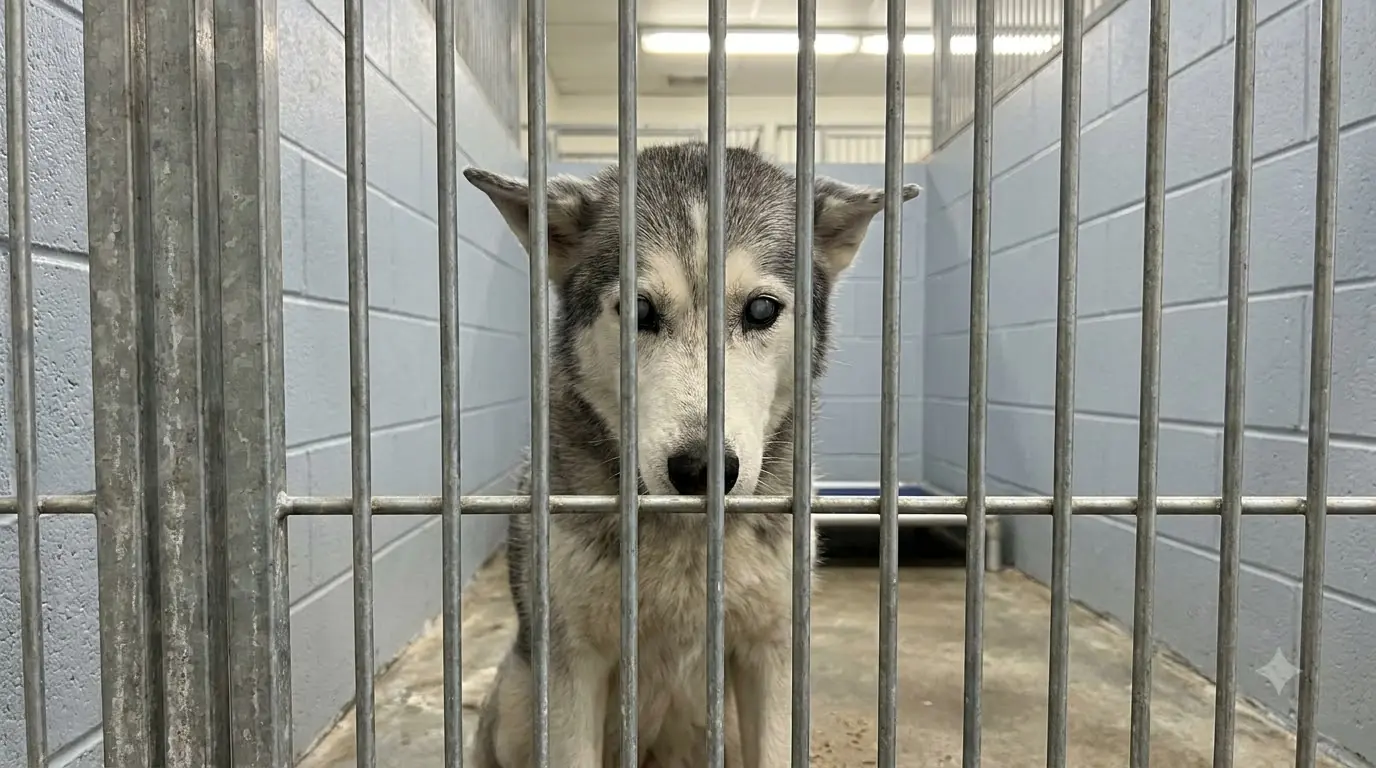
The water bowl was only a few feet away.
For most dogs, the trip from bed to water and back would not be worth noticing.
For the senior Siberian Husky, it had become a route he had to solve every single time.
He stood slowly from his bed and waited.
His eyes were open, but they no longer gave him a clear picture of the kennel around him.
Progressive eye disease had taken almost all of his functional vision. At this stage, veterinary examination suggested he could still detect changes in light and recognize some larger shapes, but fine detail was gone.
He could not reliably see the edge of the bed.
He could not judge small obstacles.
He could not simply look across the kennel and walk toward the water.
So he moved cautiously.
One front paw.
Pause.
Another.
His muzzle stayed slightly lowered.
He found the bowl.
Drank.
Then came the part staff had started watching.
The Husky did not turn directly toward the bed.
Instead, he searched for the wall.
His shoulder touched the cinderblock first.
The moment he made contact, his body seemed to settle into a more deliberate pattern.
He kept one side lightly against the wall.
Step.
Pause.
Step.
His muzzle moved ahead of him, sweeping just enough to check the space in front.
The wall became a line he could follow.
He walked beside it until his nose finally touched the edge of the bed.
Only then did he stop.
He sniffed.
Moved one front paw onto the mattress.
Then the other.
Turned slowly.
And lay down.
The entire route covered only a few feet.
But without that wall, he often stopped in the middle of the kennel as though the room had suddenly become too large.
His Vision Had Not Disappeared Overnight
The Husky's blindness was the result of progressive eye disease.
That mattered because his behavior had changed gradually too.
Staff could not identify the exact day when he stopped seeing individual objects clearly.
There probably had not been one.
His visual world had narrowed over time.
First, perhaps, smaller details became difficult.
Then low-light navigation.
Then depth and edges.
By the time he entered shelter care, he was functioning with very limited vision.
The veterinary team evaluated both eyes carefully.
The goal was not simply to label him blind.
They needed to know whether the eyes were painful.
Whether pressure was elevated.
Whether active inflammation was present.
Whether any remaining vision could reasonably be preserved.
And whether the condition was reversible.
In his case, meaningful normal vision was not expected to return.
That changed the plan completely.
The Goal Was Comfort, Not a Miracle
The rescue did not promise that treatment would make him see again.
Permanent retinal or other advanced ocular damage does not reverse because a dog enters a shelter.
If there were treatable components of the disease, those were addressed.
If medication was needed to keep the eyes comfortable, it became part of his care.
If follow-up examinations were required, they were scheduled.
But staff were realistic.
His remaining visual ability was limited to broad information.
Light.
Dark.
Large movement.
Possibly major shapes at close range.
That meant successful care had to focus on adaptation.
The First Few Days in the Kennel Were Difficult to Watch
The Husky was not panicked continuously.
That would have been an exaggeration.
But he moved as though every route required calculation.
When the kennel door opened, he lifted his head.
If someone approached too quickly, he could startle.
When he stood, he sometimes remained in place for several seconds before choosing a direction.
He used smell heavily.
His nose worked along the floor.
He listened.
He tested space with his muzzle before committing his body.
The kennel itself was unfamiliar.
Blindness becomes harder in an environment with no established map.
Staff Initially Made the Mistake of Moving Things
Not dramatically.
Normal shelter cleaning.
Water bowl shifted a little.
Bed straightened.
A blanket moved.
For a fully sighted dog, those changes are trivial.
For him, they mattered.
One morning, the water bowl had been placed slightly farther from the wall.
The Husky approached the location where it had been before.
His nose found nothing.
He stopped.
Turned.
Searched.
Eventually found the bowl.
After drinking, he tried to return to the bed but lost his usual line.
That was when staff realized consistency was not just convenient.
It was part of his mobility system.
The Kennel Became a Map
The bed stayed in one place.
The water stayed in one place.
Food was delivered predictably.
The wall remained the main route between them.
A textured mat helped mark the bed area.
Another surface change could signal the feeding zone.
Nothing needed to be elaborate.
Blind dogs often navigate extremely well when the environment stops changing underneath them.
The Husky began demonstrating that quickly.
The Wall Was His Most Reliable Landmark
Staff could see exactly why.
A wall does not move.
It does not depend on vision.
He could feel it through his shoulder.
If his body drifted away, he could find it again with the side of his muzzle.
Once contact was restored, the route became predictable.
That was what made the behavior so distinctive.
He was not simply leaning against the wall because he was tired.
He was using it.
After Drinking, He Always Looked for Contact
The sequence repeated.
Finish drinking.
Lift head.
Turn cautiously.
Search.
Shoulder against wall.
Then begin.
Sometimes he found the wall immediately.
Other times he made a partial circle before locating it.
Once there, his gait became more confident.
Still slow.
But straighter.
The wall told him where he was.
His Nose Did the Rest
The Husky used his muzzle like a soft probe.
Not ramming into objects.
Not constantly bumping.
He moved it ahead of his chest.
A gentle sweep.
A sniff.
Another step.
If the nose touched the bed edge, his whole posture changed.
He knew the route was finished.
That moment became one of the clearest signals staff learned to recognize.
He Would Not Lie Down Until He Found the Bed
That was another important detail.
If he lost the route and ended up in the middle of the kennel, he rarely simply lay down on the floor.
He remained standing.
Sometimes uncertain.
Sometimes turning slowly.
That suggested he did not trust the open space enough to settle there.
Again, staff did not say he was “afraid of the dark.”
They described what they saw.
He preferred to locate the familiar bed before lowering himself.
His Age Made Navigation Slower
The Husky was senior.
His legs were not failing severely, but they lacked the quickness and flexibility of a younger dog.
A blind young dog may compensate with fast learning and confident movement.
This dog was doing that work inside an older body.
Turning took longer.
Repositioning took longer.
If he bumped something, recovery was slower.
That made environmental consistency even more important.
Staff Stopped Calling Him From Across the Kennel
A voice might make him orient.
It did not always tell him exactly where to walk.
Sound localization remained useful, but the kennel acoustics could be confusing.
Instead of encouraging him to cross open space toward a person, caregivers approached him.
They spoke before touching.
Let him sniff.
Used predictable cues.
The idea was the same one staff eventually applied to his bed route.
Do not make a visually impaired dog solve a problem the environment can solve for him.
Touch Became a Language
A gentle touch on the shoulder after verbal warning.
A hand near the chest before guiding him.
A light contact from a leash.
The Husky responded best when physical information was predictable.
Sudden contact from an unexpected direction produced a startle.
That did not make him aggressive.
It made him a nearly blind dog receiving information late.
He Learned Familiar Staff by More Than Sight
Scent.
Voice.
Footstep pattern.
Routine.
When a familiar caregiver entered, his posture often changed before physical contact.
Head up.
Nose working.
Body slightly looser.
That was useful.
His vision had reduced.
Recognition had not disappeared.
The Shelter Had to Think About Lighting Differently
He could still detect some light and large shapes.
That meant dramatic changes in lighting could affect him.
A dark kennel suddenly flooded with bright light might be disorienting.
Likewise, low contrast made edges harder.
Staff kept lighting reasonably consistent.
They avoided placing unnecessary objects in routes.
If he could still use broad visual contrast, the environment should help rather than fight that.
The Bed Needed to Be Easy to Detect
A thick bed with a raised edge could be a useful tactile landmark.
But too high an edge could become a tripping hazard.
The shelter chose a low supportive bed with a clearly defined boundary.
The textured surface also helped.
When his paws touched it, the floor changed beneath him.
That tactile cue confirmed what his nose had already found.
The First Big Improvement Was Not Better Vision
It was fewer pauses.
Early on, the Husky would walk from the bowl to the wall.
Stop.
Walk.
Stop again.
Check with his muzzle.
Continue.
After several days with the same layout, the route became smoother.
Shoulder to wall.
Several steps.
Muzzle finds bed.
Lie down.
The vision had not changed.
The map had.
That Was the Kind of Progress Staff Wanted
Blindness does not have to disappear for confidence to improve.
The goal was not to teach him to ignore his disability.
It was to give him reliable information through the senses that remained.
Touch.
Smell.
Sound.
Light.
Texture.
Routine.
The Husky proved he could use all of them.
His Outdoor Walks Required a Different Strategy
A kennel wall is stable.
An outdoor environment is not.
So leash handling mattered.
The Husky walked slowly.
He used scent intensely.
The handler stayed close enough to prevent sudden collisions but did not drag him.
Curbs were approached carefully.
Uneven ground was announced through pace and leash guidance.
No retractable leash.
No long line around obstacles.
A blind senior dog needs enough freedom to explore without being allowed to discover hazards with his face.
He Still Enjoyed Sniffing
That was important.
Blindness had not removed curiosity.
Outside, his nose often became more active than his feet.
He stopped at grass.
Fence posts.
Air currents.
He could spend a full minute investigating one patch that a sighted dog might pass in seconds.
Staff allowed that.
Sensory enrichment does not have to be visual.
The Husky Was Not Helpless
This became a point the rescue emphasized.
He needed accommodation.
He did not need pity-based handling that removed every choice.
A blind dog can still navigate.
Choose a bed.
Ask for water.
Follow a scent.
Recognize people.
Learn routes.
The right environment turns disability into something manageable rather than all-consuming.