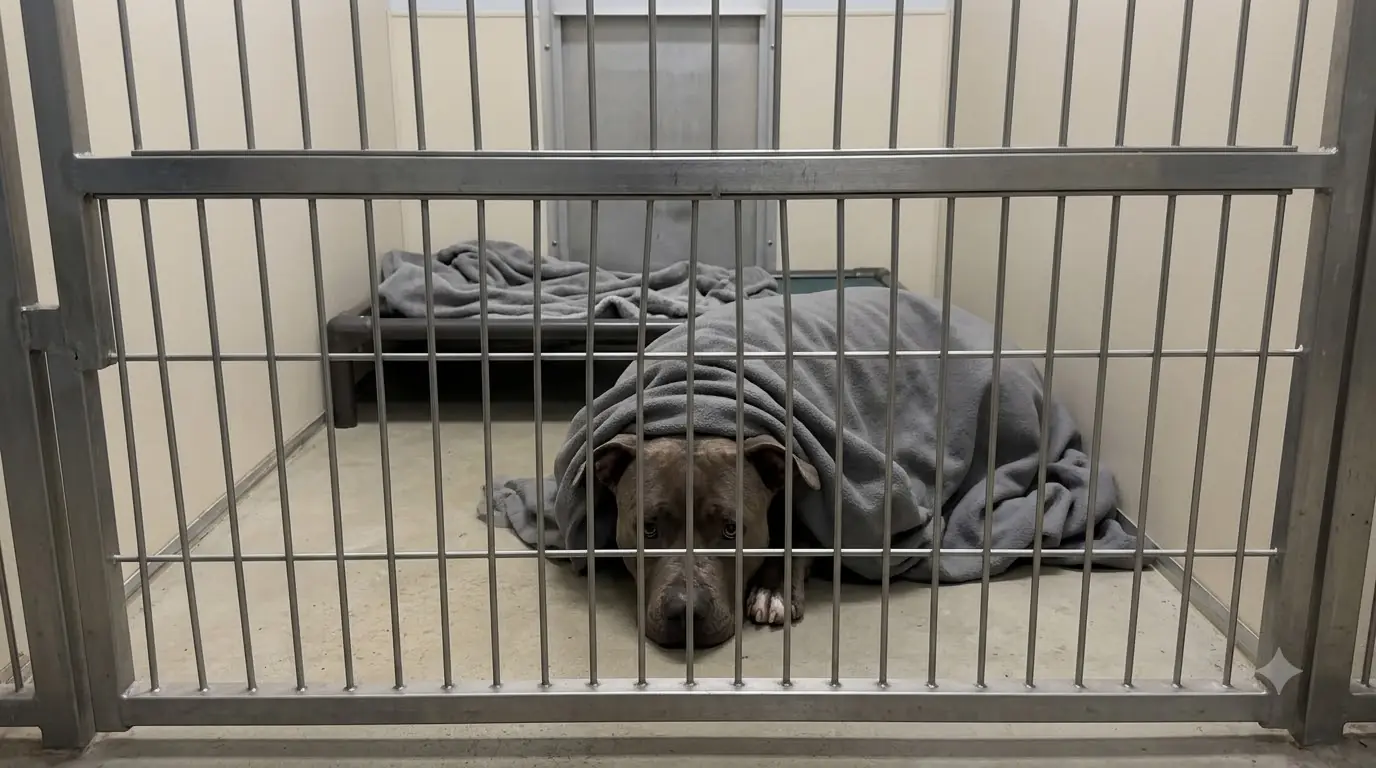
Tank is 6 years old, an American Pit Bull Terrier whose appearance and kennel behavior make many visitors keep their distance.
He is a large dog.
There are multiple old scars across his face, and one of his ears is visibly deformed.
When an unfamiliar person approaches his kennel, Tank often becomes extremely tense. His body stiffens, his eyes widen, and he barks forcefully toward the person outside the bars.
Most visitors do not stay long enough to see anything else.
But after the shelter hallway becomes quiet and the visitors are gone, the overnight camera has recorded a very different scene.
Tank takes his blanket into the corner.
Then he crawls almost completely underneath it.
And beneath that thin layer of fabric, the same dog people were afraid to approach can be seen trembling.
He stays there until morning.
During the Day, People See the Barking
Tank can make an intimidating first impression.
His large body and facial scars are immediately visible.
His damaged-looking ear adds to an appearance that some visitors may interpret as threatening before they know anything about him.
Then Tank starts barking.
His body becomes rigid.
His eyes are wide.
To someone standing in a shelter hallway with no knowledge of Tank's behavior, the safest and easiest decision may feel like simply moving on.
And that is what many people do.
They step away from his kennel and continue toward another dog.
Tank remains behind the bars.
What those visitors do not see is what happens hours later.
At Night, Tank Pulls His Blanket Into the Corner
The shelter changes when the building becomes quiet.
There are fewer footsteps.
Fewer unfamiliar faces appear outside Tank's gate.
The stimulation of the day fades.
That is when the overnight camera has captured Tank moving his blanket.
He pulls it toward the corner of the kennel.
Then he begins working his body underneath it.
Tank does not merely rest his head on the fleece.
He crawls so far beneath the blanket that almost his entire body disappears.
Then he stays there.
The blanket covers the large dog who had spent the day barking at strangers.
Underneath it, Tank trembles.
He remains hidden in the corner through the night.
By morning, the hallway will become active again.
And visitors will once again encounter the version of Tank standing stiffly behind the kennel bars.
The Trembling Matters
Tank's nighttime behavior does not automatically explain everything he does during the day.
His barking should not simply be dismissed.
A frightened dog can still behave defensively, and anyone working with Tank needs to take his signals seriously.
But the overnight footage provides important context.
Tank is showing behaviors consistent with significant fear and stress.
During the day, that distress can look intimidating: a rigid body, wide eyes, and forceful barking.
At night, it looks different.
There is nobody standing outside his kennel for him to bark at.
Instead, Tank retreats.
He covers himself.
He trembles.
That does not prove exactly what Tank is thinking or why he developed these responses.
It does show why judging him solely from a few seconds at the kennel gate may provide an incomplete picture.
His Scars Do Not Tell His History
Tank has multiple old scars on his face and a deformed ear.
Those physical features may naturally make people wonder what happened to him.
But no verified explanation for those injuries was provided.
It would be irresponsible to claim Tank was used for dogfighting, physically abused, attacked by another dog, or deliberately injured.
Old scars alone cannot tell that story.
There is also no information explaining how Tank entered the shelter or what his life was like before intake.
His history before the shelter is unknown.
Whatever caused the scars and ear damage should remain unknown unless veterinary records, animal-control documentation, or another reliable source establishes the facts.
Tank does not need an invented traumatic history to make his current behavior meaningful.
The dog in front of the camera is already showing what he is experiencing now.
Tank May Look Confident When He Is Anything But Relaxed
A common mistake is assuming that a dog barking forcefully at the kennel gate must feel confident.
Tank's complete body language deserves more attention.
His body becomes stiff.
His eyes open wide.
He reacts intensely when unfamiliar people approach.
Then, when the shelter becomes quiet, he retreats underneath a blanket and trembles.
Only qualified staff who have evaluated Tank directly can determine what those behaviors mean for handling and placement.
But visitors should not confuse an intimidating presentation with proof that Tank is comfortable or fearless.
His nighttime behavior suggests there is much more happening than the barking alone reveals.
The Blanket Covers Almost All of Him
That contrast becomes clearest on the overnight footage.
Tank is a large dog.
During visiting hours, his size is one of the first things people notice.
At night, he tries to fit nearly all of that body beneath a blanket.
He pulls the fleece into the corner.
He lowers himself.
He works his head underneath.
Then his shoulders disappear.
Most of his body follows.
Eventually, there is little more to see than the shape of Tank beneath the fabric.
The blanket moves slightly as he trembles underneath.
There is no visitor at the gate now.
No barking is needed.
Tank simply remains covered until morning.
Tank Needs a Real Behavioral Assessment, Not Assumptions
The nighttime footage should not be used to make the opposite mistake and declare Tank harmless based solely on sympathy.
His intense kennel response needs to be taken seriously and professionally evaluated.
Anyone considering Tank should request the shelter's complete behavioral observations.
Important questions include how Tank behaves outside the kennel, whether his reactions change in quieter environments, how he responds to familiar staff, whether he can be safely leashed and handled, and what triggers have been identified.
Potential adopters, fosters, or rescues should also ask whether Tank has been evaluated around other dogs and what is known about his behavior around cats, children, and unfamiliar adults.
None of those details were provided.
They should never be assumed from his breed, scars, barking, or nighttime trembling.
The goal should be to understand the individual dog in front of them.
His Exact Shelter Risk Is Not Provided
Tank is clearly struggling inside the shelter environment, and visitors repeatedly avoiding his kennel could make placement more difficult.
However, no explicit euthanasia-list status or deadline was provided with Tank's description.
It would therefore be inaccurate to claim that he has only hours or days remaining.
No shelter name, city, state, or Animal ID was supplied either.
Anyone interested in Tank should contact the shelter directly to determine his current placement status and whether any deadline applies.
If he is at risk, the shelter should provide the most current information.
People See One Tank — The Camera Sees Another
During visiting hours, someone approaches Tank's kennel.
Tank sees the stranger.
His muscles tighten.
His eyes widen.
Then the barking begins.
The visitor looks at his scarred face, damaged ear, and large body.
They move away.
Tank is left behind.
Hours later, the building becomes quiet.
The overnight camera continues recording.
Tank finds his blanket.
He pulls it across the kennel floor and into the corner.
Then the large Pit Bull begins disappearing underneath it.
His face vanishes.
His scarred head disappears.
His body follows until almost all of him is covered.
Then Tank lies there trembling beneath the blanket.
By morning, the blanket will come off.
People will return.
And the next stranger may once again see only the dog barking behind the bars.
They may never know that the night before, Tank spent hours hiding underneath a blanket.
DOG INFORMATION
Name: Tank
Breed: American Pit Bull Terrier
Age: 6 years old
Physical features: Multiple old facial scars; one deformed ear; large build
Observed daytime behavior: Becomes rigid, opens his eyes wide, and barks forcefully when unfamiliar people approach his kennel
Observed nighttime behavior: Pulls his blanket into a corner, crawls almost completely underneath it, and lies trembling beneath it until morning
Deadline: No euthanasia deadline provided
Current status: Shelter dog frequently avoided by visitors; exact placement and risk status should be confirmed directly with the shelter
HOW TO HELP
Anyone interested in Tank should contact the shelter directly and request his current status and complete behavioral assessment.
Because Tank displays intense reactions toward unfamiliar people in the kennel, potential adopters, fosters, or rescues should ask how he behaves outside that environment, how he responds to familiar handlers, what triggers staff have identified, and what type of placement and handling plan professionals recommend.
His old scars and deformed ear should not be used to invent a history for him. Any known medical information about those injuries should come directly from the shelter.
Sharing Tank's case may also help people see what a brief encounter at the kennel door can miss: the large, scarred dog barking behind the bars is also the dog who waits for the building to become quiet, crawls beneath his blanket, and trembles there until morning.
Please contact the shelter directly for the most current information about Tank's availability, behavioral requirements, and risk status.