A month ago, the adult female Bald Eagle later given the temporary rehabilitation name Willow was lying beneath a large tree in western Wisconsin, too weak to remain upright for long.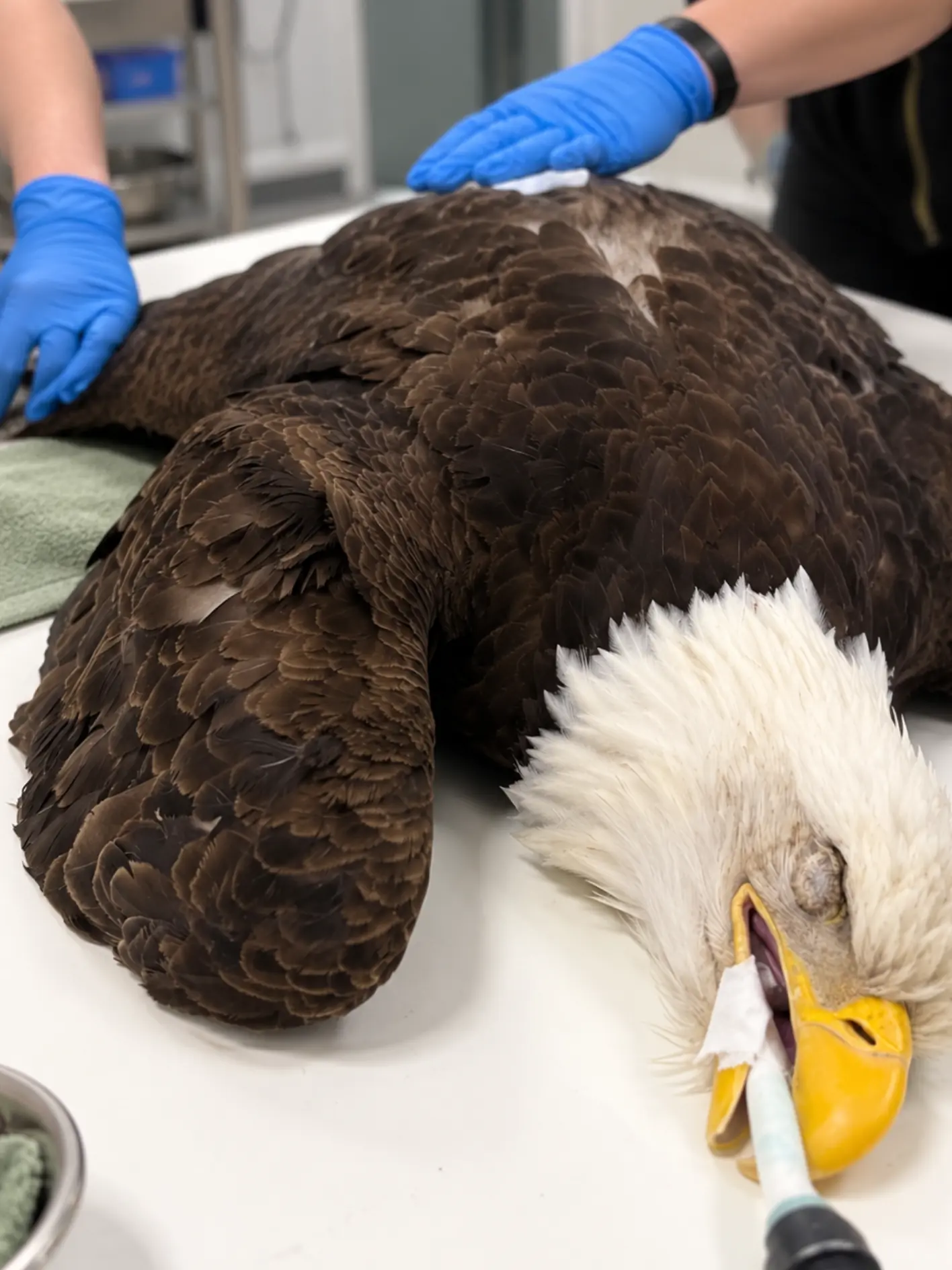
By the time she reached the fictional Great Lakes Wildlife Rehabilitation Center, staff could immediately see several injuries.
Her upper beak was fractured.
A small wound was present on one foot.
She was dehydrated and unusually quiet for a wild adult eagle.
But the most dangerous problem was not the one people could see.
Bloodwork showed that Willow was severely anemic.
Her red blood cell level had fallen far enough that veterinarians were concerned her body could no longer transport oxygen efficiently enough to support normal organ function and recovery.
The medical team moved quickly.
Willow received supportive care, treatment for her visible injuries, and ultimately a blood transfusion.
For a time, the response was encouraging.
Her blood values improved.
She began standing more strongly.
The fractured beak stabilized.
She started eating independently.
The small wound on her foot appeared to heal.
Eventually, Willow began flying again.
It looked as though the most dangerous phase of rehabilitation might be behind her.
Then the foot began to swell.
What had looked like one of the least serious injuries at admission had developed into something far more complicated.
Repeat evaluation showed evidence consistent with osteomyelitis — an infection involving bone.
Release had to be postponed.
Willow returned to treatment.
Veterinarians began antimicrobial therapy and monitored the injured foot closely while trying to prevent the infection from compromising her ability to grip, perch, hunt, and land.
Weeks later, the swelling had resolved.
Her grip was strong again.
Her blood values remained stable.
Her beak functioned normally.
And repeated flight testing showed that the eagle could meet the physical demands required for life in the wild.
After one of the most complicated recoveries the rehabilitation team had managed that season, Willow was released.
The Eagle Was Found Beneath a Tree
Willow’s case began when a resident near La Crosse, Wisconsin, reported an adult Bald Eagle on the ground beneath a large tree.
The circumstances of the fall were not completely clear.
The finder said the bird appeared to have come down abruptly from the canopy, but no one had observed the entire event closely enough to determine whether she had fallen because of trauma, weakness, or another underlying problem.
When wildlife responders arrived, the eagle was alive and responsive.
But her condition was concerning.
She remained low to the ground.
Her posture was weak.
There was visible damage around the upper beak.
One foot had a small wound.
Most importantly, she did not attempt a normal escape flight.
Healthy adult Bald Eagles generally create distance from people quickly when they are able.
Willow did not.
She was safely contained and transported to Great Lakes Wildlife Rehabilitation Center for emergency evaluation.
At that point, the rescue team knew the eagle was injured.
They did not yet know how medically unstable she was.
The Most Serious Problem Was Discovered in the Bloodwork
At admission, fictional wildlife veterinarian Dr. Amanda Pierce began a complete examination.
Willow was dehydrated.
She was markedly subdued.
The eagle could respond to handling, but her strength was far below what would be expected from an adult female Bald Eagle.
The visible injuries initially demanded attention.
The upper beak contained a fracture.
The foot wound appeared small but required cleaning and evaluation.
Neither finding, however, fully explained the severity of Willow’s weakness.
Blood was collected.
The results changed the urgency of the case.
Willow was profoundly anemic.
Anemia occurs when the number of circulating red blood cells, or the amount of functional oxygen-carrying capacity they provide, becomes too low.
Red blood cells transport oxygen throughout the body.
When their numbers fall substantially, tissues receive less oxygen.
A severely anemic animal may appear weak, lethargic, intolerant of exercise, and unable to maintain normal activity.
In a bird already attempting to recover from trauma, severe anemia can place additional strain on nearly every system involved in healing.
“The fractured beak was the injury we could see immediately,” Pierce said. “The anemia was the problem that concerned us most in those first hours.”
Willow Needed a Blood Transfusion
The veterinary team repeated and reviewed the blood values while assessing Willow’s overall condition.
The combination of clinical weakness and severely reduced red blood cell parameters led them to conclude that supportive care alone might not be sufficient.
A blood transfusion was planned.
Transfusion medicine in wildlife patients requires careful preparation and close monitoring.
The goal is not simply to increase a laboratory number.
It is to restore enough circulating red blood cell mass to improve oxygen delivery while the patient’s own body begins recovering.
During the procedure, Willow was closely monitored for changes in heart rate, respiration, temperature, and any evidence of an adverse reaction.
A photograph taken during one of her early procedures shows the eagle anesthetized on an examination table while staff wearing protective gloves monitor her.
An airway tube is positioned at the beak, allowing the veterinary team to control and observe breathing during anesthesia.
The image documents the intensity of the medical care required during the first stage of Willow’s hospitalization.
It does not, by itself, reveal the anemia or explain why transfusion was necessary.
Those conclusions came from the clinical examination and blood testing.
The Broken Beak Created a Second Major Concern
Once Willow was medically stabilized, the veterinary team could focus more closely on the upper-beak injury.
For a Bald Eagle, the beak is essential to survival.
The bird uses it to tear food, manipulate prey, preen feathers, and perform defensive behaviors.
Even a fracture that does not threaten life immediately may prevent successful release if it heals in a position that interferes with feeding.
The beak was examined for stability and alignment.
The surrounding tissues were checked for contamination, swelling, and deeper injury.
The fracture did not appear to have completely destabilized the upper beak.
That was encouraging.
The team elected to manage the injury while repeatedly monitoring whether Willow could close the beak normally and eventually tear food without assistance.
During the early phase of recovery, the bird was given food appropriate to her condition so that unnecessary stress on the healing beak could be minimized.
The Foot Wound Initially Looked Minor
Compared with the anemia and fractured beak, the wound on Willow’s foot appeared much less dramatic.
It was small.
There was no large open fracture.
The foot retained circulation.
The toes could move.
The wound was cleaned, treated, and monitored.
At first, swelling decreased.
The surface began to close.
Nothing about the early appearance suggested that this injury would ultimately become one of the longest parts of Willow’s recovery.
That is one of the challenges of wildlife trauma.
The smallest external wound is not always the least important.
A puncture can carry bacteria deep into tissue.
A small opening may close at the skin while infection remains underneath.
If bacteria reach bone, treatment becomes much more complicated.
Willow had not reached that stage yet.
For the moment, the team remained cautiously optimistic.
Her Blood Values Began to Improve
The first major evidence of progress came from repeat bloodwork.
Willow’s red blood cell parameters improved after transfusion and supportive care.
Clinically, the difference became noticeable as well.
She began holding her body more upright.
Her responses to people became stronger.
She spent less time lying down.
Her grip improved.
Her eyes remained alert.
Appetite gradually returned.
For rehabilitation staff, increased defensiveness was one of the most encouraging behavioral changes.
A healthy wild Bald Eagle should not welcome close human contact.
As Willow regained strength, she increasingly resisted handling and watched staff from a distance.
That made routine treatment more difficult.
It also suggested that her normal wild behavior was returning.
“The bloodwork was improving, but we also started seeing the change in the bird herself,” Pierce said. “She was stronger, more reactive, and much less tolerant of us being near her. That was exactly what we wanted.”
Eating Independently Tested the Beak
The fractured upper beak remained an important concern.
Once Willow was stable enough, staff observed her feeding behavior closely.
Could she grip food normally?
Could she close the beak without abnormal movement?
Could she tear tissue?
Could she swallow efficiently?
The answers gradually became encouraging.
Willow began feeding independently.
She used both feet to secure food.
The upper and lower beak met appropriately.
She could tear food without obvious instability.
Later, she began preening normally.
That mattered because preening requires delicate beak control and repetitive movement.
Each of these behaviors demonstrated something that an X-ray alone could not:
the beak was not merely healing anatomically.
It was functioning.
The Foot Wound Also Appeared to Improve
During the same period, the foot wound looked better externally.
Inflammation decreased.
The surface tissues began closing.
There was no obvious heavy drainage.
Willow placed weight on the foot.
Grip remained functional.
The team continued treatment and observation.
At that stage, nothing suggested that the foot would delay rehabilitation significantly.
Attention shifted increasingly toward overall strength and flight readiness.
Willow Returned to a Perch
Once she was strong enough to maintain balance safely, Willow was given access to a low perch.
The eagle stepped onto it.
Both feet closed around the surface.
She adjusted her position naturally.
Grip on the previously injured foot remained adequate.
The perch provided the team with another functional assessment.
A Bald Eagle must be able to bear weight through both feet.
It must be able to lock its toes around branches.
It must maintain balance while sleeping, feeding, and responding to wind.
Willow managed the low perch well.
As confidence increased, higher perch options were introduced.
Her strength continued improving.
Flight Returned Gradually
When the medical team believed the beak and general condition were stable enough, Willow was moved to a larger rehabilitation enclosure.
She was not forced into the air.
The eagle was allowed to move on her own.
At first, she remained perched.
Then she launched.
The initial flights were short.
Her movements lacked the power and endurance of a fully conditioned wild eagle.
That was expected.
Willow had spent time severely anemic, medically unstable, and restricted during treatment.
Even when an injury heals, muscle conditioning must be rebuilt.
Over subsequent sessions, her flights improved.
She traveled farther between perches.
She gained more altitude.
Landings became more controlled.
The team began thinking seriously about the later stages of rehabilitation.
Then staff noticed a change in the foot.
The Foot Began to Swell Again
The swelling was subtle at first.
One of Willow’s feet appeared slightly larger around the previously injured area.
Staff also noticed that she occasionally shifted her weight differently while perched.
Her grip was still present.
But something had changed.
The foot was examined again.
There was localized swelling and concern for deeper inflammation.
The rehabilitation team immediately slowed progression toward release.
A Bald Eagle that can fly but cannot use both feet normally is not ready for the wild.
The feet are essential for hunting, carrying food, landing, defending territory, and maintaining a secure perch.
Release could not be considered until the cause of the swelling was understood.
Repeat Imaging Revealed a More Serious Problem
Additional diagnostic imaging was performed.
The findings raised concern for osteomyelitis involving the injured area.
Osteomyelitis is an infection of bone.
It can develop when bacteria reach bone through an open wound, penetrating injury, bloodstream infection, or nearby infected tissue.
Bone infections are particularly concerning because they can be difficult to eliminate.
Blood supply within affected bone may be compromised.
Inflamed tissue can become painful.
The infection may persist even after the skin appears healed.
In a Bald Eagle, osteomyelitis involving the foot can threaten release even if every other part of the bird is healthy.
The smallest visible injury from Willow’s initial examination had become one of the most significant obstacles to her return to the wild.
The Medical Team Started Antibiotic Therapy
The treatment plan changed again.
Where clinically appropriate, samples from the wound or affected tissues can be used to help determine which bacteria are present and which antimicrobial drugs are most likely to be effective.
Willow was placed on antibiotic therapy targeted to the infection.
The foot continued to be monitored for swelling, heat, discharge, pain, and changes in grip strength.
Activity was adjusted so that the healing tissue would not be subjected to unnecessary stress.
Pain management was used as appropriate.
The team knew that osteomyelitis could require a longer course of therapy than a superficial wound.
They also knew that visual improvement alone would not be enough.
The infection had to resolve sufficiently for the foot to function normally and for the underlying bone to remain stable.
Release Was Postponed
Only a short time earlier, Willow had seemed to be approaching the final stages of rehabilitation.
Her anemia had improved.
The beak was functioning.
Flight was returning.
Now the process had to slow again.
For a rehabilitation center, postponing release can be frustrating.
For the patient, it is necessary.
A wild animal is not released because it has survived hospitalization.
It is released only when it can meet the functional demands of the environment.
Willow needed both feet.
A weakened or painful foot could prevent her from gripping prey.
It could affect landing.
It could reduce her ability to perch securely.
It could place excessive load on the opposite foot and create another problem.
“Flight alone wasn’t enough,” Pierce said. “If she couldn’t grip normally, she couldn’t be considered ready.”
The Infection Began Responding
Over the following days, the swelling gradually decreased.