Finn Is Recovering, but One Side of His Face Still Doesn’t Look Right — And His Eye Still Won’t Fully Open
Finn is finally strong enough to move around his recovery enclosure again, but his face still makes people stop when they see him for the first time.
One side looks almost normal.
The other doesn't.
A large healing abrasion runs from the upper cheek toward the side of his muzzle, leaving the skin and surrounding tissue visibly uneven. The fur hasn't grown back properly yet, and the injured side of his face still looks slightly distorted compared with the other.
Most noticeable is his eye.
Finn can open it now, but not completely.
Even when he is fully awake and watching movement around his enclosure, that eye remains narrowed to a small opening while the other is wide and alert.
What makes the sight especially difficult is knowing that this is Finn after he began recovering.
The swelling has already gone down.
The wounds are cleaner.
He is eating again.
He can sit upright.
And when a caregiver enters the room, Finn now has enough energy to move away.
None of those things were true when he arrived.
Finn was found early one morning behind a suburban home after the homeowner noticed repeated noises near a wooden privacy fence.
At first, they thought an adult raccoon might have been getting into the trash overnight.
Instead, they discovered a juvenile raccoon wedged into a narrow sheltered area between the fence and a storage shed.
He was alive, but barely moving.
His head was resting directly on the ground.
One side of his face was so badly swollen that the eye had disappeared beneath the surrounding tissue. The fur across his cheek and muzzle was dirty and matted, and several areas appeared scraped and damaged.
The shape of his face looked wrong.
When he attempted to lift his head, he managed only a few seconds.
Then his chin dropped back onto the ground.
There was no mother nearby and no other young raccoons were visible.
More importantly, this wasn't simply a healthy juvenile temporarily separated from his family.
Something had happened to him.
Because an injured raccoon should not be approached or handled casually, the homeowner kept people and pets away and contacted wildlife professionals.
By the time Finn reached appropriate care, his condition was even more concerning than it had appeared from several feet away.
The swelling involved much of one side of his muzzle and cheek.
His affected eye could not be properly seen through the swollen tissue at first. The surface injuries extended farther than expected once the dirty, matted fur around them could be assessed.
There were abrasions around the cheek and muzzle, and the underlying tissue was inflamed.
Finn was also dehydrated and profoundly weak.
Normally, a frightened juvenile raccoon doesn't make an examination easy.
Finn barely resisted.
That told us almost as much as the visible injuries did.
The immediate temptation when looking at a face like his was to ask one question:
What attacked him?
But we didn't know that Finn had been attacked.
No one had witnessed the event.
Trauma was clearly a concern, but several circumstances could potentially produce facial injuries. A young raccoon can fall, become caught in fencing or another structure, be struck or crushed, encounter another animal, or develop significant inflammation after an initial wound.
The pattern of damage could help guide veterinary assessment, but it couldn't give us a reliable eyewitness account.
So we resisted turning uncertainty into certainty.
Our first job wasn't to reconstruct Finn's night.
It was to stabilize the animal who had survived it.
He was placed in a quiet, controlled environment while his condition was evaluated. Because the injuries involved his face, special attention had to be given to the eye, mouth, nose, and surrounding tissues.
The eye was one of our greatest concerns.
Severe swelling can make it difficult to determine immediately what is happening underneath. The fact that Finn couldn't open it didn't automatically tell us whether the eye itself had been seriously damaged or whether surrounding inflammation was preventing the eyelids from functioning normally.
That distinction mattered enormously.
The damaged areas of his face were addressed as part of his veterinary care, and his hydration and overall condition required support as well.
Feeding couldn't simply be rushed because he was young.
His ability to swallow, the condition of his mouth and muzzle, his hydration, his body temperature, and his overall responsiveness all had to be considered.
Finn spent much of that first day lying down.
We provided him with a protected place to rest, but he initially made almost no attempt to use it.
He simply remained on the fleece where he had settled.
Every so often, his nose twitched.
Sometimes his uninjured eye opened.
Then it closed again.
Hours passed without any dramatic transformation.
The swelling remained severe.
His injured eye remained hidden.
But by that evening, there was one small change.
When a caregiver entered for a necessary check, Finn raised his head.
He held it there.
Then he slowly pulled his front paws underneath his chest.
For the first time since arriving, he managed to remain upright without immediately collapsing onto his side.
Only briefly.
But it was enough to show us that there was still some strength underneath all that exhaustion.
That first night was mostly about watching.
His breathing.
His responsiveness.
His posture.
Changes in the facial swelling.
Any discharge or other changes around the injured area.
Whether he could reposition himself.
Whether he was becoming brighter or fading.
By morning, Finn was still there.
And he was angry.
Not very angry.
Not yet.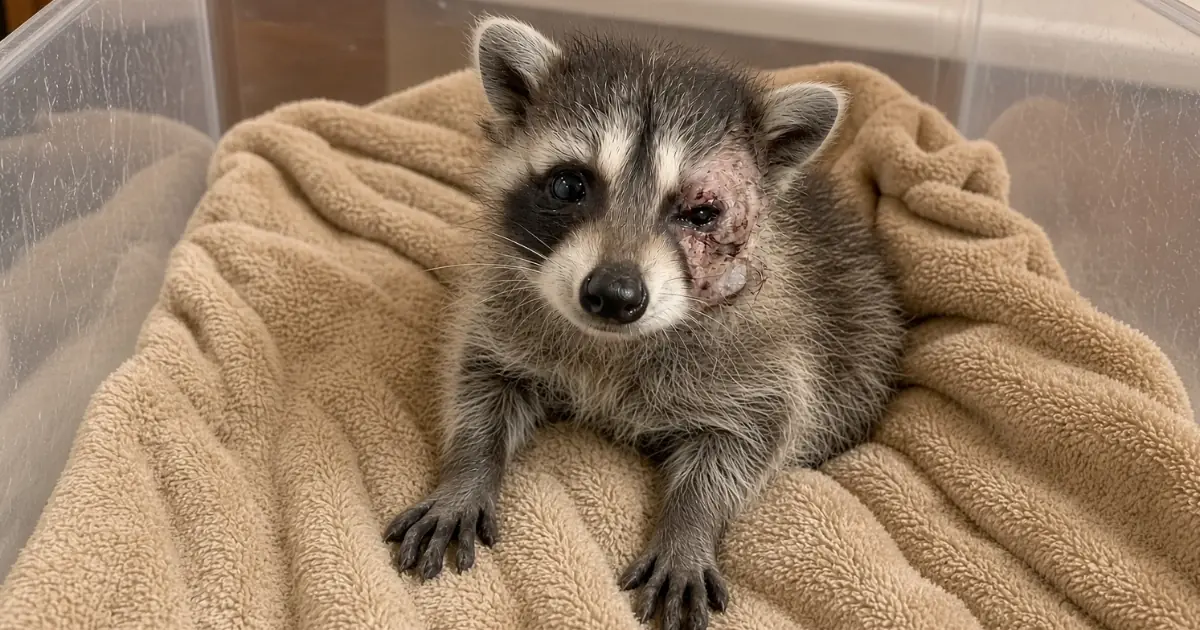
But when a caregiver approached, he pulled his head away and made a weak attempt to retreat.
It was one of the most encouraging things he had done.
A wild raccoon trying to avoid us was far preferable to a wild raccoon too sick to care that we were there.
The next few days produced the first visible changes in his face.
The swelling began to decrease.
At first, the difference was subtle enough that we had to compare photographs from consecutive days.
The contour of his muzzle became slightly easier to recognize.
Then the area around the injured eye began changing.
A narrow opening appeared between the eyelids.
For the first time, we could see the eye that had been completely obscured when Finn arrived.
That didn't answer every question.
Opening the eye was only one milestone. Its condition and function still needed continued assessment as the surrounding injury healed.
But seeing it at all felt significant.
Finn's behavior was changing just as quickly.
He started sitting upright for longer periods.
His appetite improved.
Instead of remaining wherever he had been placed, he began choosing where he wanted to sleep.
Then his paws started working.
For a young raccoon, that was when his personality seemed to return.
Finn began touching the fleece.