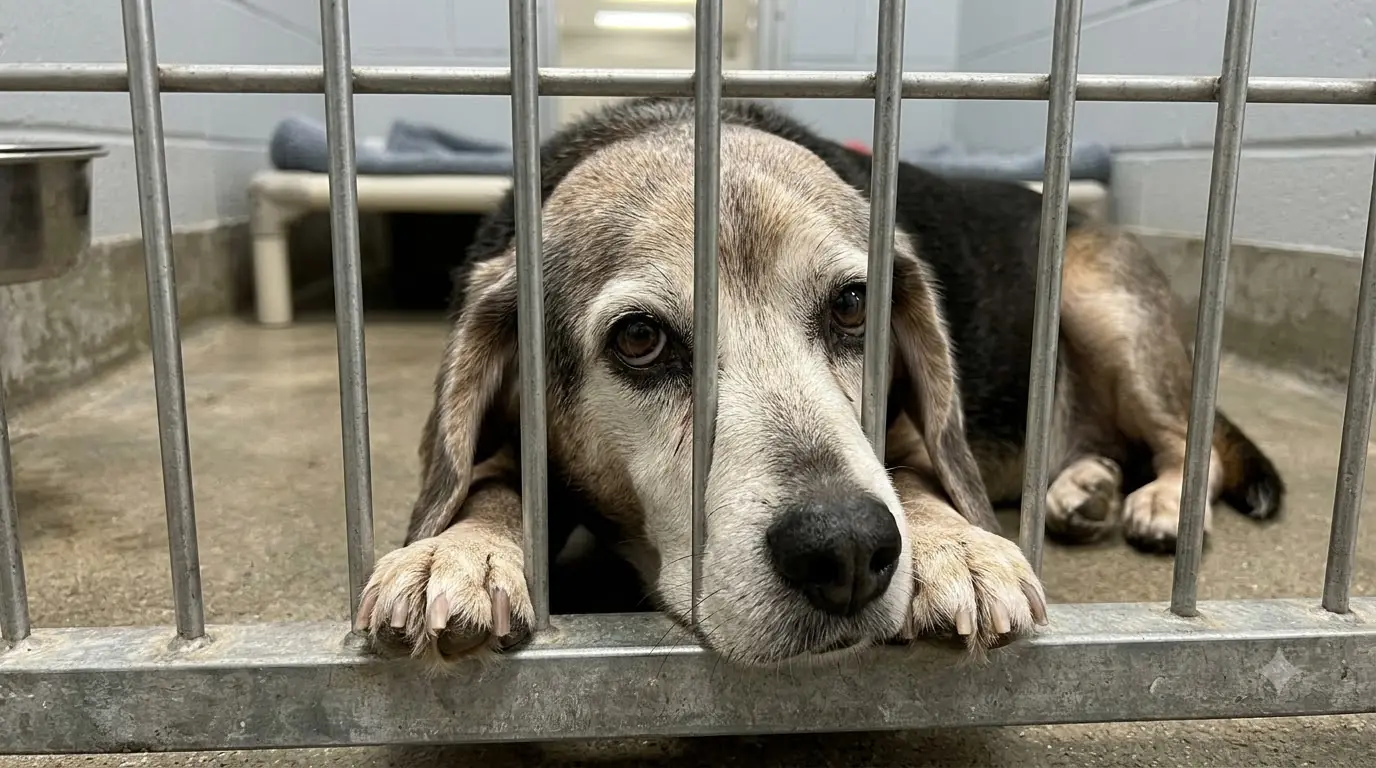
The bed was only a few feet behind him.
It was soft.
Clean.
Large enough for him to curl up without touching the kennel walls.
Staff had placed a folded blanket over one side because senior dogs often appreciate the extra cushioning.
The Beagle mix barely used it.
Instead, every morning, caregivers found him in the same place.
At the front of the kennel.
His body curled against the metal gate.
His graying muzzle rested between his front paws.
His back stayed close enough to the bars that anyone walking down the hallway could see him immediately.
Most of the time, he did not bark.
He did not paw at the gate.
He did not jump up when people passed.
He simply watched.
And whenever someone stopped in front of his kennel, his eyes lifted.
That was often the only part of him that moved.
A person might stand there for a few seconds.
The Beagle would raise his head slightly.
His cloudy senior eyes would follow them.
Sometimes his ears shifted forward.
Then the person moved on.
The dog's head returned to his paws.
By the time the shelter had been watching this routine for several weeks, staff stopped asking why he would not use the bed in the back.
A different question had become harder to ignore.
Why did an old dog who seemed interested in so little still insist on sleeping where he could see every person who passed?
He Had Not Been Abandoned in the Way People Might Assume
The Beagle mix had been surrendered after his owner moved into assisted living.
That part of his history was known.
The rescue did not describe it as someone suddenly deciding an elderly dog was inconvenient.
The circumstances were more complicated.
The person who had cared for him could no longer maintain the same living arrangement, and the transition into assisted living meant the dog needed somewhere else to go.
There was no dramatic owner confession.
No cruelty investigation.
No evidence that he had been discarded because he became old.
Sometimes animals enter shelters because human lives change in ways nobody wanted.
That distinction mattered.
But it did not make the transition easier for the dog.
He had gone from a familiar home and familiar person to a kennel with unfamiliar smells, new handlers, barking dogs, cleaning routines, doors opening and closing, and people constantly passing without staying.
For a younger dog, that kind of change can be difficult.
For a senior who had likely spent years in a much smaller, more predictable world, it was enormous.
His Age Showed Before He Took a Single Step
The Beagle's muzzle had faded to silver.
His face still carried the familiar rounded softness of the breed, but age had changed the way he held himself.
His movements were slow.
He took time to rise.
He did not spring forward when the kennel door opened.
His first few steps after rest were often shorter than the ones that followed.
His nails needed careful maintenance because traction mattered more now.
His body was not severely wasted, but he had lost some of the muscle definition younger dogs carry through the hindquarters.
The shelter's veterinary team treated those signs as reasons to examine him, not as permission to dismiss everything as old age.
Senior dogs deserve the same medical curiosity as young ones.
Staff Checked More Than His Joints
His intake evaluation included the basics.
Body condition.
Hydration.
Heart and lungs.
Teeth and gums.
Eyes.
Ears.
Skin.
Abdomen.
Gait.
Joint comfort.
Because he was a senior undergoing a major life transition, baseline bloodwork was considered appropriate.
Age-related changes could influence behavior.
Pain could reduce interest in toys.
Dental disease could affect appetite.
Vision or hearing loss could make a new environment more confusing.
Arthritis could make certain resting surfaces harder to use.
Cognitive decline could alter sleep and engagement.
The medical team looked for actual evidence rather than building a story from assumptions.
What they found was consistent with an older dog who needed senior management, not an animal in immediate crisis.
His mobility was reduced.
His joints showed age-related stiffness.
His senses were not as sharp as they once had been.
But none of that fully explained why he ignored the comfortable bed and kept returning to the gate.
The Toys Barely Mattered to Him
Staff tried simple enrichment.
A soft toy.
A food puzzle.
A scent-based activity.
A stuffed item appropriate to his diet.
Some senior dogs immediately become more animated when given something novel.
The Beagle mix showed limited interest.
He sniffed.
Sometimes he ate the food.
Sometimes he investigated for a minute.
Then he went back to the front.
The lack of toy interest was not treated as proof of depression.
Older dogs vary widely in play style.
A dog who has spent years in a quiet home may not care about squeaky toys.
A Beagle may value scent more than plush objects.
Arthritis can make certain play movements uncomfortable.
A dog in a shelter may simply not be ready to engage.
Still, the contrast was striking.
New toy in the kennel.
Minimal reaction.
Footsteps in the hallway.
Eyes up.
The Front of the Kennel Gave Him Information
That was one possible explanation for his choice.
From the back of the kennel, his world was limited.
From the front, he could see more.
He could smell the hallway.
He could notice people before they disappeared.
He could track which direction staff went.
He could watch another dog being walked.
He could see food carts arrive.
For an animal whose familiar routine had vanished, the front of the kennel may simply have been where the most useful information existed.
No one could prove that was why he slept there.
But the pattern made sense behaviorally.
The gate was where things happened.
So he stayed near it.
At First, Staff Moved Him Back to the Bed
Not physically.
They encouraged him.
Treats were tossed onto the bedding.
A familiar blanket was placed there.
Caregivers sometimes sat near the bed instead of near the gate.
He would follow.
He might lie down for a while.
Then, later, he was back at the front.
By morning, his body was curled against the bars again.
Eventually, staff stopped treating the location like a problem that needed correcting.
If the front was where he felt most comfortable, they could make the front more comfortable too.
They Brought the Bed Forward
The bed was repositioned closer to the gate.
Staff thought that might solve both issues.
He could remain near the hallway while resting on cushioning.
The Beagle sniffed the moved bed.
He stepped onto it.
Circled once.
Then stepped off.
He lay directly beside it.
Muzzle between his paws.
Eyes toward the hallway.
The next morning, his hip was pressed against the mattress.
The rest of him was still on the floor.
That told staff something useful.
The exact sleeping surface might not be the main issue.
The exact position was.
Hard Flooring Was Not a Good Long-Term Plan
An older dog should not spend every night on a hard kennel floor if staff can help it.
Pressure over elbows and hips can become uncomfortable.
Arthritic joints benefit from support.
So the care team changed the setup again.
Instead of expecting him to choose a raised or bulky bed, they placed a thinner orthopedic mat directly at the gate.
It provided cushioning without creating a boundary he had to step over.
A fleece layer went on top.
This time, he used it.
Not perfectly.
Sometimes one shoulder remained on the floor.
Sometimes his paws extended past the mat.
But the basic position stayed the same.
Near the bars.
Face forward.
His Eyes Became the Part Visitors Remembered
The Beagle did not make himself impossible to ignore.
That was part of the problem.
Shelter hallways are full of dogs who communicate loudly.
Some bark.
Some leap.
Some spin.
Some press their bodies against the gate.
Some carry toys.
Some whine when a person walks away.
The senior Beagle mostly stayed down.
A visitor could pass him in seconds.
But the people who stopped often noticed the same thing.
The eyes.
When someone stood at the gate, his gaze lifted immediately.
The rest of his body might remain curled.
The head came up only slightly.
But he watched.
People Sometimes Mistook Stillness for Lack of Interest
Staff had to explain that.
A senior dog may not greet someone with the physical intensity of a young dog.
Pain or stiffness can make getting up expensive.
Age can change hearing and vision.
A dog may prefer to evaluate quietly before moving.
The Beagle's behavior outside the kennel helped clarify that.
When the gate opened and a familiar caregiver invited him out, he did stand.
Slowly.
He walked.
Slowly.
Then his nose began working.
Outside the Kennel, He Became More Like a Beagle
The difference was subtle but consistent.
He did not transform into an energetic puppy.
But outdoors, scent mattered.
He lowered his nose.
He investigated the edge of a walkway.
He paused at patches of grass.
He followed odor trails for a few feet, then stopped.
Staff gave him time.
The walks were not long.
His joints did not need distance.
What they needed was comfortable movement.
And his brain seemed to benefit from having something to investigate that was not a kennel hallway.
He Still Turned Back Toward People
During those short outings, he sometimes stopped when someone passed.
His head lifted.
He watched.
If the person approached slowly, he allowed them closer.
He was not indiscriminately social.
Sometimes he preferred sniffing.
Sometimes he moved away.
But he was clearly capable of engaging.
That made the hours at the kennel gate easier to understand.
The dog who appeared emotionally shut down was not entirely disconnected.
He was selective.
Slow.
And very observant.
Staff Began Sitting With Him at the Gate
They did not force him onto the bed in the rear anymore.
Instead, caregivers sat in the hallway outside his kennel for short periods.
The Beagle often remained lying down.
Sometimes he sniffed their fingers through the bars.
Sometimes he simply rested near them.
When the person stood to leave, his eyes followed.
Then his head lowered again.
These quiet visits became more useful than repeatedly offering toys he did not seem to value.
The Shelter Tried to Recreate Familiarity, Not Excitement
Senior dogs coming from homes often benefit from predictability more than stimulation for stimulation's sake.
His feeding schedule became consistent.
Walks happened at similar times.
The same caregivers handled him when possible.
His bed remained in the same location.
Water did not move around unnecessarily.
The kennel setup stopped changing every day.
That stability seemed to help.
He rested more deeply.
He ate reliably.
His posture loosened.
But he still preferred the front.
The Rescue Did Not Tell People He Was "Waiting for His Owner"
That would have been emotionally powerful.
It also would have crossed the line between observation and invention.
The Beagle had lived with a person who was no longer present.
He had undergone a major separation.
He chose to sleep near the gate.
He watched people pass.
Those facts were true.
What he believed about any individual person walking down the hallway was unknowable.
Maybe he expected someone familiar.
Maybe he simply preferred social proximity.
Maybe the front of the kennel was the easiest place to monitor a confusing environment.
The rescue did not need to claim more.
The sight of him was already enough.
His Former Life Was Probably Quieter Than This
That assumption was reasonable only in broad terms.
Most private homes have less concentrated dog noise than an animal shelter.
For a senior Beagle accustomed to one household, the kennel environment likely required significant adjustment.
That became obvious during louder periods.
When barking increased, his ears shifted.
Sometimes he lifted his head.
Sometimes he moved even closer to the gate.
Other times he turned around and faced the rear wall.
The behavior was not perfectly consistent.
Stress rarely is.
Staff responded by giving him quieter breaks when possible.
A Quiet Room Changed Him
On one occasion, he spent time in a smaller office-like room away from the main kennel row.
There was a low bed.
A rug.
A person working nearby.
The Beagle sniffed the room.
Then settled.
He did not lie against the door immediately.
For nearly an hour, he slept several feet away from it.
That observation mattered.
It suggested that the kennel-gate behavior was at least partly connected to the shelter environment.
In a quieter space with a human nearby, he did not seem to need the doorway as much.
That Made Foster Care an Important Possibility
The shelter began looking for an appropriate foster placement.
Not because the Beagle was deteriorating dramatically.
Because a home environment could reveal more about him than a kennel ever would.
Could he sleep away from a door?
Would he engage more with people?
Would his interest in food, scents, or toys change?
How would his mobility look on rugs rather than sealed shelter flooring?
Would he rest more deeply?
For senior dogs, temporary foster care can be as much an assessment tool as a comfort measure.
The First Foster Night Did Not Produce an Instant Transformation
He entered cautiously.
Sniffed the entryway.
Followed the wall.
Investigated the water bowl.
His foster caregiver gave him space.
The home had been prepared with nonslip rugs and a low orthopedic bed.
No stairs were required.
The Beagle explored slowly.
Then he chose a place to lie down.
Near the front door.
Of course he did.
The Pattern Had Followed Him
His body curled along the edge of the entry rug.
His muzzle rested between his paws.
The orthopedic bed sat several feet away.
The foster caregiver did not move him.
The similarity to the shelter was obvious.
Different building.
Different door.
Same basic location.
That made staff rethink the behavior again.
Perhaps thresholds themselves were familiar.
Perhaps he had a long history of resting where he could monitor entrances.
Perhaps after losing his known home, doors had become especially important.
There was no way to know for certain.
But now the pattern existed outside the kennel too.
The Difference Was What Happened When the Foster Sat Nearby
The caregiver sat on the floor several feet away.
The Beagle lifted his head.
Watched.
Then stood.
It took effort.
He walked over.
Sniffed.
And lowered himself beside the person's leg.
That was something he could rarely do in the shelter hallway.
There, the bars kept him separated.
Here, he could close the distance.
His Bed Moved Closer to the Door
Again, the humans adapted.
Instead of insisting the dog sleep where they had planned, the orthopedic bed was moved near his chosen location.
The Beagle sniffed it.
Stepped on.
Turned.
Lay down.
That night, he slept on the bed.
Still beside the door.
The goal was never to eliminate the location.
It was to make the location physically easier on an old body.
His Behavior Began Expanding
Over the next several days, the Beagle started using more of the home.
He followed the foster into the kitchen.
He sniffed under a chair.
He discovered a sunny patch near a window.
He slept there one afternoon.
That was new.
For a dog who had spent weeks at the front of a kennel, choosing to sleep somewhere unrelated to a doorway was significant.
Not dramatic.
Significant.
He Still Did Not Care Much About Toys
The foster tried a few.
A soft squeaker got a sniff.
A plush animal was ignored.
A ball rolled several feet and remained exactly where it stopped.
Nobody worried about it.
The Beagle did not need to become playful in a stereotypical way to prove he was improving.
His enrichment preferences were simply different.
Food scents worked better.
Slow walks worked better.
Being near someone worked better.
He Started Following the Foster From Room to Room
Not constantly.
That would have raised different concerns.
But enough that his daily pattern began changing.
The front door was no longer the only place where he waited.
If the foster moved to the living room, he sometimes followed and settled nearby.
If someone worked at a table, he might lie under it.
At night, he still preferred the entryway.
During the day, his world widened.
His Medical Care Continued in Parallel
Foster comfort did not replace veterinary management.
His senior stiffness still required attention.
Pain management was adjusted as needed.
His weight was kept lean enough to protect aging joints.
His nails were trimmed for traction.
His exercise remained low-impact.
If he appeared unusually tired or reluctant to rise, that change was taken seriously.
The point of foster care was not to pretend age disappeared outside the shelter.
It was to make aging easier.
The Silver Muzzle Stayed Between His Paws
That posture remained one of his signatures.
When resting, he often stretched both front legs forward.
Then he placed his muzzle between them.
His face looked older in that position.
The gray around his nose and eyes was impossible to miss.
In the shelter, people had seen that face through bars.
In foster care, they could sit beside it.
That simple absence of a gate changed the interaction more than any toy had.
He Became More Interested in Touch
At first, the foster let him initiate.
No hugging.
No leaning over him.
No pulling his face upward.
The Beagle approached.
Sniffed.
Accepted a scratch beneath the chin.
Later, he leaned slightly into a hand on his shoulder.
Eventually, he began lying close enough that casual contact happened without invitation.
Those changes took time.
A dog can have years of social history and still need days or weeks to understand a new person.
The Front Door Remained His Nighttime Spot
Even after he became comfortable in other rooms, nighttime pulled him back.
The house quieted.
The lights dimmed.
The Beagle walked toward the front.
He settled on the orthopedic bed positioned there.
Muzzle down.
Eyes toward the doorway.
The foster did not try to relocate him.
There was no reason.
He was safe.
He was comfortable.
And now, unlike the shelter, he was not separated from every person by metal bars.
Sometimes He Fell Asleep Before the Household Did
That was another change.
At the shelter, the hallway itself seemed to hold his attention.
Every movement mattered.
In foster care, normal household sounds became predictable.
A cabinet closing.
Footsteps.
A television.
Someone moving in another room.
He stopped lifting his head for every single sound.
He slept.
Deeply.
The door remained nearby.
But he no longer appeared to need to monitor every moment.
Staff Began Thinking About Placement Differently
The Beagle was not a dog who needed a highly active home.
He did not need someone expecting long hikes.
He did not need a basket of toys.
He needed traction.
A comfortable bed.
Predictable routines.
Gentle exercise.
Senior veterinary care.
And people who understood that his version of companionship might often mean simply lying nearby and watching them move through the room.
That made him a better fit for some homes than his shelter presentation suggested.
He Was Easy to Overlook in the Kennel
That remained one of the saddest parts.
The Beagle did not advertise himself.
Visitors often respond first to movement.
A dog standing at the gate gets noticed.
A dog bouncing gets noticed.
A dog carrying a toy gets noticed.
This senior often stayed curled down.
Someone might see only a sleeping old dog and continue walking.
But if they stopped long enough, the eyes came up.
That was his greeting.
Staff Began Explaining Him Before Visitors Passed
When possible, they would say something simple.
He is awake.
He sees you.
Give him a second.
Often, that was enough.
A person paused.
The Beagle lifted his head.
Sometimes he stood.
Sometimes he did not.
If the interaction remained quiet, he might approach the gate.
His nose came between the bars.
A hand offered from the outside could be sniffed.
The dog who had seemed unavailable suddenly became part of the hallway again.
Foster Care Showed He Was Not "Shut Down"
That label can be overused.
The Beagle was not emotionally absent.
He was an old dog undergoing a major transition.
His behavior was low-energy.
His interests were narrow.
His movements were slow.
But he could still engage.
He could still seek proximity.
He could still learn a new routine.
He could still choose where to sleep.
And most importantly, he could still begin attaching ordinary comfort to new people.
He Did Not Stop Looking at Doors
Even in foster care, thresholds remained important.
If someone left, he often watched the door.
If a car pulled up outside, his ears shifted.
If the front door opened, he looked.
That behavior might remain for the rest of his life.
Nobody needed to eliminate it.
The goal was not to make him stop noticing who came and went.
The goal was to make sure his entire day was not controlled by waiting at an entrance.
He Began Choosing the Living Room in the Afternoon
The first time the foster sent a photo, shelter staff immediately noticed the difference.
The Beagle was asleep on a rug.
No gate.
No front door.
No muzzle pointed toward an exit.
He was lying on his side.
One hind leg stretched behind him.
His mouth was relaxed.
A dog who had spent weeks sleeping with his face toward the shelter hallway had chosen to sleep in the middle of ordinary household life.
That did not erase the kennel behavior.
It helped explain it.
The Shelter Had Never Been the Place He Could Truly Settle
He could rest there.
He could eat there.
He could receive medical care there.
He could be safe there.
But safety and familiarity are not identical.
At the shelter gate, he could monitor movement while remaining separated from it.
In the foster home, he could become part of the movement.
He could follow.
Settle nearby.
Sleep while someone remained in the room.
That difference mattered more than the physical type of bed.
He Still Has Slow Days
Age did not disappear because the environment improved.
Some mornings, his first steps remain stiff.
Rainy weather seems to coincide with more hesitation.
Long outings are not appropriate.
After a more active day, he sleeps longer.
His medical plan continues.
His senior needs remain.
Nobody describes him as rejuvenated.
He is still an old Beagle.
The goal is not youth.
It is comfort.
His Story Is Not About Making Him Play Again
That was never his strongest sign of progress.
He may never care much about toys.
He may never become animated in the way adopters expect from younger dogs.
What changed was more basic.
He started sleeping away from barriers.
He started following people.
He started choosing rooms because someone was in them, not simply because a door was there.
He started resting without needing to watch every movement.
The Gate Behavior Still Returns
Whenever he spends time back at the shelter for a check or transition, staff notice how quickly the old pattern can reappear.
He enters a kennel.
Sniffs.
Walks to the front.
Lowers himself.
Muzzle between paws.
Eyes toward the hallway.
It has become a familiar response to that environment.
But now staff know something they did not know during those first weeks.
It is not the only version of him.
Behind the Gate, He Looked Like He Was Waiting
In a home, he looks more like he is staying close.
That distinction may seem small.
For him, it changes everything.
At the kennel door, every person who stops is separated from him.
They arrive.
He looks up.
They leave.
At home, someone walking away can be followed.
Someone sitting down can be joined.
A door opening does not always mean the relationship is over.
One Recent Evening Looked Almost Like the Shelter Again
The foster home was quiet.
The Beagle walked toward the front door.
His orthopedic bed was positioned nearby.
He circled.
Lowered himself.
His silver muzzle came down between his front paws.
For a moment, the image looked almost identical.
An old dog.
A doorway.
Eyes facing forward.
Then the foster caregiver walked past.
The Beagle lifted his eyes.
The person stopped.
In the shelter, there would have been bars between them.
This time there were none.
The caregiver sat down beside him.
The Beagle lifted his head.
He shifted closer.
Then rested the side of his face against the person's leg.
A few minutes later, both were still there.
He May Always Choose the Door Sometimes
That is okay.
Nobody needs to turn every habit into a symptom.
Perhaps he spent years resting near entrances.
Perhaps watching doors has always been part of him.
Perhaps losing his familiar home made that habit stronger.
There may never be a way to know.
What matters is that it is no longer the only place he can settle.
For Weeks, the Shelter Saw the Same Face at the Bars
Morning.
Afternoon.
Evening.
An old Beagle curled at the kennel door.
Bed behind him.
Toys mostly untouched.
Silver muzzle between the paws.
Eyes lifting whenever someone stopped.
Then dropping again when they continued down the row.
That was the behavior people saw.
It was real.
But it was not the entire dog.
Now There Are Days When He Sleeps Through Footsteps
In the foster home, someone can walk across the room without his head coming up.
A door can close somewhere else.
He keeps sleeping.
The bed beneath him supports aging joints.
His body is loose.
He knows where the water is.
He knows when meals arrive.
He recognizes the footsteps of the person caring for him.
Predictability has replaced some of the vigilance.
Not all of it.
Enough.
And He Still Looks Up When Someone Stops
That part has never disappeared.
If someone pauses near him, his eyes rise.
Sometimes his head follows.
Sometimes he stands.
Sometimes he remains where he is and waits for the person to come closer.
The difference is what happens next.
At the shelter, most people eventually moved on.
In foster care, someone often stays.
For an old dog who spent weeks sleeping against a kennel door because it was the closest he could get to every person passing outside, that may be the most meaningful change of all.
He still chooses the doorway some nights.
He still puts his silver muzzle between his paws.
He still watches.
But now, when he looks up and finds someone standing there, they do not always disappear down the hallway.
Sometimes they sit beside him.
And he finally lets his eyes close again.