The police sergeant grabbed the Black woman’s upper arm before she had even removed her second glove.
“Step away from the motorcycle.”
She looked at his hand.
Then at his face.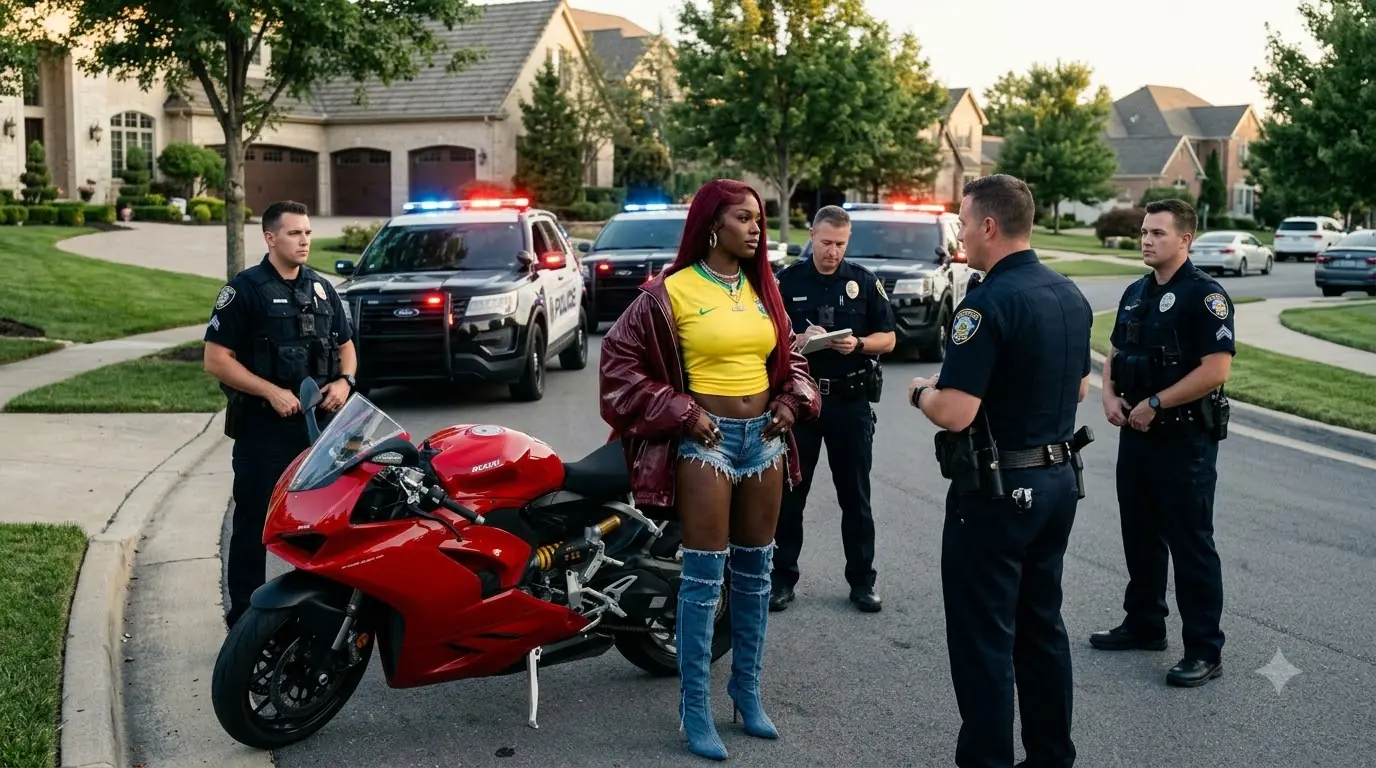
“Take your hand off me.”
It was 4:58 on a clear Thursday afternoon in an expensive neighborhood outside Charlotte, North Carolina.
Children were riding bicycles two streets over.
A landscaping crew was packing equipment into a trailer.
Someone’s sprinklers clicked rhythmically across a manicured lawn.
Nothing about the afternoon looked like the beginning of a federal operation collapsing in public.
The woman stood beside a glossy red superbike that looked far too aggressive for the quiet suburban street.
She was twenty-seven, Black, with deep brown skin, sharp almond-shaped eyes, and extremely long straight burgundy-red hair falling nearly to her waist.
Her clothing was deliberately memorable.
A fitted yellow cropped soccer-style jersey with green trim.
Distressed denim shorts.
Tall denim-style boots.
A glossy burgundy jacket hanging open over layered silver jewelry.
Large hoop earrings.
Bracelets.
Rings.
A sparkling cross necklace.
She looked more like someone arriving at a celebrity after-party than a federal agent working an interstate vehicle-theft case.
That was the point.
For the past eleven weeks, she had been building a cover identity around exactly that image.
Young.
Stylish.
Money visible.
Motorcycle obsessed.
Careless enough to move expensive machines without asking difficult questions.
The men she was investigating did not recruit people who looked like government auditors.
They recruited people they believed cared more about cash than paperwork.
Her appearance had gotten her through three controlled meetings.
Two warehouse entrances.
One private motorcycle gathering.
And a back room where a man had casually offered her twelve thousand dollars to move a motorcycle across state lines without asking why the VIN plate looked newly installed.
Now her cover might die because four local police officers had decided she looked suspicious beside the wrong motorcycle.
The sergeant tightened his grip.
“I said step away.”
“I heard you.”
“Then move.”
“I’m not moving until you tell me why I’m being detained.”
That irritated him.
She could see it immediately.
The sergeant was a broad white man in his forties, short brown hair, square jaw, black patrol uniform stretched tightly across his shoulders.
He had arrived first.
A second patrol SUV arrived less than thirty seconds later.
Then a third.
Now four officers surrounded the motorcycle.
One stood behind her.
Another near the front wheel.
A younger officer remained several feet back, phone in one hand, radio clipped high on his vest.
That younger officer mattered.
She did not know why yet.