When a four-year-old bald eagle later named River arrived at Prairie Raptor Rehabilitation Hospital from Clay County, Minnesota, the injury visible on radiographs was only part of the problem.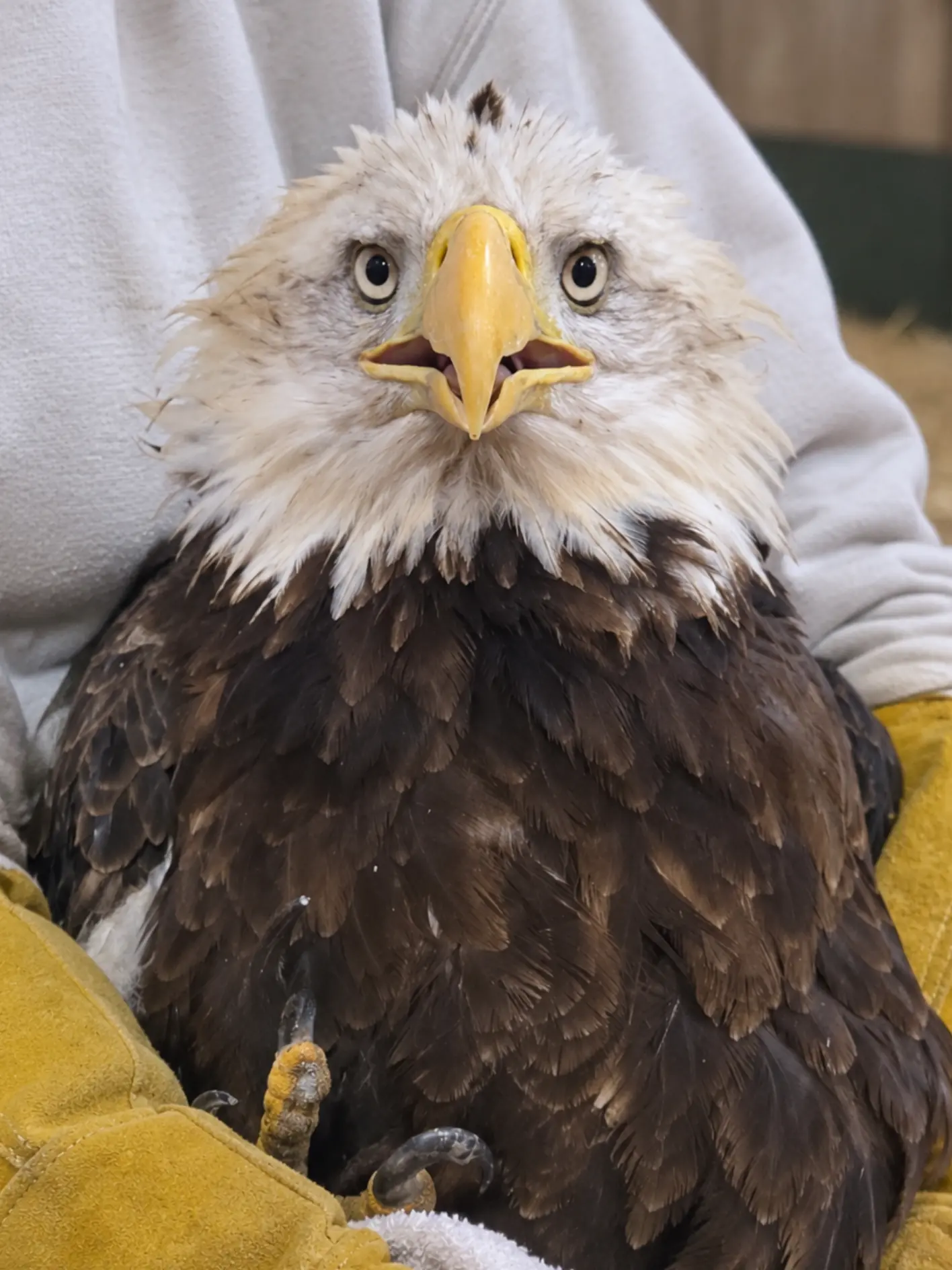
Yes, the bird had a serious wing injury. Imaging would later confirm a fractured ulna and findings consistent with gunshot trauma. But by the time River reached care, the consequences had gone far beyond the original wound. The eagle was severely underweight, dehydrated, too weak to fly, and no longer capable of hunting or scavenging effectively in the wild.
For a species that depends on strength, balance, and flight to survive, that combination can quickly become life-threatening.
River’s story could have ended in a field.
Instead, it became the kind of case wildlife rehabilitators know all too well: a traumatic injury that was visible on the outside, paired with a quieter but equally dangerous collapse in body condition. The fracture had damaged the wing, but the days that followed had taken a toll on the rest of the bird. Unable to fly, River had also become unable to feed normally, and each day on the ground appears to have pushed the eagle deeper into crisis.
Now, because someone noticed the bird, because trained responders got it to professional care, and because specialized rehabilitation resources were available, River has a real chance to recover.
Found grounded and unable to escape
According to the intake history provided to the rehabilitation team, River was found in Clay County after local residents noticed an adult bald eagle lingering on the ground and failing to take off normally. Witnesses reported that the bird appeared alert but was unable to gain lift. When approached, the eagle did not show the kind of strong, immediate escape behavior rehabilitators would expect from a healthy adult.
That alone raised concern.
A grounded bald eagle is almost always an emergency. Even when external injuries are not obvious, the inability to fly may indicate serious trauma, intoxication, severe weakness, neurologic compromise, or systemic disease. In River’s case, the bird’s overall appearance strongly suggested that something had been wrong for more than a few hours.
By the time trained responders safely contained the eagle for transport, another problem had already become apparent: River felt unusually light.
Under a full coat of feathers, eagles can sometimes hide just how poor their body condition has become. But experienced handlers learn to recognize the difference quickly. A healthy adult bald eagle should feel substantial and muscular. River did not. The bird was thin, weak, and noticeably compromised even before formal examination began.
The eagle was transported promptly to Prairie Raptor Rehabilitation Hospital, where veterinary staff prepared for a full intake evaluation.
A critical condition beneath the feathers
On admission, River remained alert, but the physical examination confirmed that the bird was in serious condition.
Veterinary staff noted marked weight loss, dehydration, and generalized weakness. The eagle’s pectoral muscles were significantly reduced, a classic sign of prolonged inadequate nutrition in birds. Rather than the rounded muscle mass expected in a strong flying raptor, River’s body condition reflected sustained calorie deficit and declining physical reserves.
That finding mattered.
For a bald eagle, flight is not just movement. It is access to food, safety, territory, and survival. A bird that cannot fly cannot hunt fish effectively, cannot move efficiently between feeding areas, and may struggle to compete for carrion. Even if some food is available on the ground, a debilitated eagle is at a tremendous disadvantage. Over time, traumatic injury and malnutrition begin to reinforce one another.
River’s intake exam suggested exactly that pattern.
The bird showed pain associated with one wing, but the eagle’s critical state could not be explained by the fracture alone. The team recognized that River would need treatment for both trauma and systemic decline. Stabilization would have to come first.
Before any definitive decisions about the wing could be made, the eagle required supportive care: quiet housing, thermal support, fluids, pain management, and careful nutritional planning.
Imaging reveals a fractured ulna
Once River was stable enough to proceed, the medical team obtained radiographs.
The imaging study revealed a fracture of the ulna, one of the two long bones in the forearm portion of the wing. The fracture pattern, combined with additional findings, was consistent with a gunshot injury. Metallic fragments associated with projectile trauma were also identified.
That discovery helped explain both the bird’s inability to fly and the severity of the decline that followed.
In birds of prey, wing fractures can be devastating. Even when a fracture is not open or grossly displaced externally, it can still disrupt normal wing loading, extension, and control. The ulna plays an important role in wing structure and function, and a fracture in that region can make stable, powered flight impossible. A bald eagle may still be able to flap or attempt short movement, but true hunting and sustained flight become unrealistic.
For River, that loss of function appears to have set off the downward spiral seen at intake.
Unable to use the wing normally, the eagle likely spent days or longer grounded, expending energy without being able to replace it. What arrived at the hospital was not only a bird with a fracture. It was a bird suffering the physiological consequences of having been stranded in the wild with no way to live normally.
The hidden damage caused by being grounded
Cases like River’s illustrate a reality that is not always obvious to the public: wildlife trauma is rarely only about the initial injury.
A fracture may be what starts the emergency, but dehydration, starvation, exposure, and stress often determine whether the animal survives long enough to receive care. In River’s case, the radiographs told one story. The bird’s body told another.
The fracture was the acute injury.
The severe weight loss was evidence of what happened next.
For a large raptor, the decline can happen fast once normal feeding stops. Without adequate food intake, muscle mass begins to drop. As weakness progresses, the animal becomes even less able to move effectively or escape danger. Dehydration compounds the problem, affecting circulation, digestion, and recovery capacity. By the time the bird reaches a rehabilitation center, clinicians may be treating not only trauma, but also the consequences of prolonged metabolic stress.
That was the challenge facing River’s care team.
If the hospital focused only on the broken wing and ignored the bird’s nutritional instability, the outcome could still be poor. So the first stage of treatment centered on stabilizing the whole patient.
Stabilization before repair
River was placed in a quiet, low-stress enclosure and started on supportive care tailored to a debilitated raptor. The team addressed hydration deficits, monitored pain, and began a controlled nutritional rehabilitation plan.
That last step was especially important.
In severely underweight wildlife patients, simply offering large meals immediately is not always appropriate. A careful refeeding approach helps reduce complications and allows the medical team to monitor whether the digestive system is tolerating treatment. In River’s case, the goal was not only to restore calories, but to rebuild strength gradually and safely.
Staff also monitored the eagle’s posture, mentation, appetite, grip strength, and droppings—small but important indicators of how the body was responding. Daily weights were used to track progress objectively.
While these supportive measures were underway, the wing injury remained under close observation. Fractures in birds must be approached with the long-term goal in mind: return to full, functional flight. A wing that heals but does not restore aerodynamic function may still leave a bird non-releasable.
That meant every treatment decision for River had to balance short-term survival with long-term flight potential.
Early progress in the first days of care
The first days after admission are often the most uncertain in cases like this.
Wild raptors under severe physiologic stress can decline suddenly, even after reaching professional care. But River began to show the kind of small, guarded improvements that rehabilitation teams hope to see. The eagle remained quiet but became more responsive. Hydration status improved. Appetite began to return. River was increasingly able to hold the head upright for longer periods and showed stronger interest in the surroundings.
Those changes may sound modest. In critical wildlife care, they are not.
For a bird that arrived weak, underweight, and unable to function normally in the wild, the return of appetite can mark a major turning point. Eating voluntarily is not only a nutritional milestone; it is also a sign that pain control, systemic support, and stabilization are beginning to work.
River’s body condition did not improve overnight, but the trend moved in the right direction.
The bird that first arrived exhausted and depleted was now beginning to respond like a patient with a fighting chance.
Managing the fracture
As River stabilized, the rehabilitation team was able to focus more directly on the wing injury itself.
The ulna fracture required careful management, including ongoing assessment of alignment, surrounding tissue health, and the bird’s comfort and use of the wing. Depending on fracture configuration and soft-tissue involvement, treatment in cases like this may include external support, wound care, restricted activity, follow-up imaging, and close rehabilitation monitoring. The overarching objective remains the same: preserve or restore the structural integrity needed for eventual flight.
In River’s case, the care team monitored for complications including infection, poor healing, and functional asymmetry. Follow-up evaluations were planned to determine how well the fracture was progressing and whether the wing would be capable of supporting the bird through the demanding final stages of rehabilitation.
Because the initial injury appeared consistent with gunshot trauma, the team also remained mindful that damage from projectiles can extend beyond the fracture itself. Soft-tissue trauma, localized inflammation, and secondary tissue compromise can all affect recovery.
For that reason, River’s treatment plan was never just about immobilizing a broken bone. It was about managing a complex injury in a species that must eventually fly with precision, power, and endurance if release is to be possible.
Weight gain becomes a sign of hope
One of the most encouraging developments in River’s recovery came not from the wing, but from the scale.
As days passed, the eagle began to gain weight steadily.
That mattered tremendously. A bird can show normal alertness and still be far from physically ready for the next stage of care. Weight restoration, along with visible improvement in pectoral muscle mass and hydration, gives clinicians evidence that the patient is no longer merely surviving but actually rebuilding.
River’s increasing body weight suggested that the nutritional plan was working. The bird was consuming food more consistently, metabolizing it appropriately, and beginning to reverse the severe deficits present at intake.
With better body condition came stronger posture, more stable standing, and a more typical defensive response to handling. In rehabilitation medicine, those changes are often welcome signs. A stronger eagle is usually a less cooperative eagle—and that is exactly what the team wants.
Wildness is a good sign in a wild patient.
River still had a long way to go, but the eagle was no longer presenting only as a critically thin, exhausted trauma victim. The bird was beginning to look and behave more like a recovering raptor.
Rebuilding for release, not just survival
A key principle in wildlife rehabilitation is that discharge criteria must reflect the realities of life in the wild.
For a bald eagle, “doing better” is not enough. The bird must be able to fly strongly, perch normally, land accurately, feed independently, and tolerate the physical demands of a free-ranging life. That means recovery is measured not just by healing tissue, but by functional capacity.
River’s care plan was built with that standard in mind.
Once the fracture showed sufficient progress and the eagle’s overall condition improved, the next phase would involve gradual physical rebuilding. Birds recovering from wing trauma often need time to regain not only healed bone integrity, but also muscle, coordination, and stamina. A period of restricted rest may protect healing, but it also contributes to deconditioning. Carefully staged activity becomes essential.
For River, that process would include monitored movement, perch use, and eventually transfer to larger rehabilitation space when medically appropriate. The purpose is not to rush. It is to make sure that each stage of progress truly supports the next one.
A bird that can stand is not necessarily ready to perch well. A bird that can perch is not necessarily ready to fly. A bird that can fly short distances is not automatically releasable.
Each step matters.
Why this eagle had a chance
River’s story is about one bird, but it also reflects a larger truth about wildlife care: many animals survive only because several things go right in succession.
Someone has to notice that the animal is in trouble.
Someone has to make the right call instead of walking away.
A trained responder has to intervene safely.
A rehabilitation facility has to be equipped to receive the patient.
Veterinary staff have to provide species-specific care.
And behind all of that, there must be resources—medical supplies, imaging equipment, food, housing, skilled staff, and time.
River had a chance because those pieces came together.
If the eagle had gone unseen, the outcome would likely have been very different. If the bird had not been transported promptly, dehydration and emaciation may have worsened beyond recovery. If no center had been able to take the case, the opportunity to stabilize and treat the fracture would have been lost.
And if specialized wildlife hospitals did not have community support, many of these cases could not be managed at all.
Trauma care, radiographs, wound management, nutritional rehabilitation, and long-term conditioning are resource-intensive. They depend on people who believe that native wildlife is worth the effort required to save it.
That is why cases like River’s matter beyond the individual patient.
A reminder about preventable injuries
Although River’s immediate priority is recovery, the circumstances of the case also raise broader concerns for eagle conservation and public responsibility.
Radiographic findings consistent with gunshot trauma serve as a stark reminder that human-caused injuries remain a significant threat to raptors. Whether such injuries result from intentional shooting, reckless behavior, or unlawful activity, the impact on wildlife can be severe and prolonged. Even when an animal survives the original event, the downstream effects—immobility, hunger, weakness, infection, and exposure—can be devastating.
The public can help protect bald eagles and other raptors in practical ways:
- Report injured or grounded birds promptly to wildlife authorities or licensed rehabilitators.
- Never attempt to treat or keep an eagle without proper permits and training.
- Support wildlife hospitals and rehabilitation centers that provide specialized care.
- Encourage responsible outdoor practices that reduce preventable harm to scavenging and predatory birds.
- Share information about the importance of protecting native raptors and the consequences of human-caused trauma.
Every one of those actions can make a difference.
River’s next chapter
River is not at the end of the journey yet.
The eagle still requires continued monitoring, ongoing fracture management, nutritional rehabilitation, and careful assessment of long-term flight potential. The prognosis in wing-fracture cases always depends on healing quality, function, and the bird’s ability to return to the demanding standards of life in the wild.
But River now has something that was missing in Clay County: time, treatment, and a path forward.
The bird that arrived thin, dehydrated, and unable to fly is stronger than it was on day one. The body condition is improving. The eagle is eating. The fracture has been identified and managed. And most importantly, River is receiving exactly the kind of specialized, evidence-based care that wild raptors need when trauma and debilitation collide.
That opportunity did not happen by chance.
It happened because someone found River.
It happened because River was brought to care.
And it happened because people who support wildlife rehabilitation make this level of treatment possible.
For now, the goal remains clear: not simply to keep an injured eagle alive, but to restore a strong, fully functional bald eagle to the sky where it belongs.
If River eventually leaves rehabilitation and returns to the wild, that release will represent far more than the healing of one broken wing. It will represent the combined value of public awareness, timely rescue, veterinary expertise, and community-backed conservation care.
And for one eagle from Clay County, that combination may prove to be the reason the story continues.