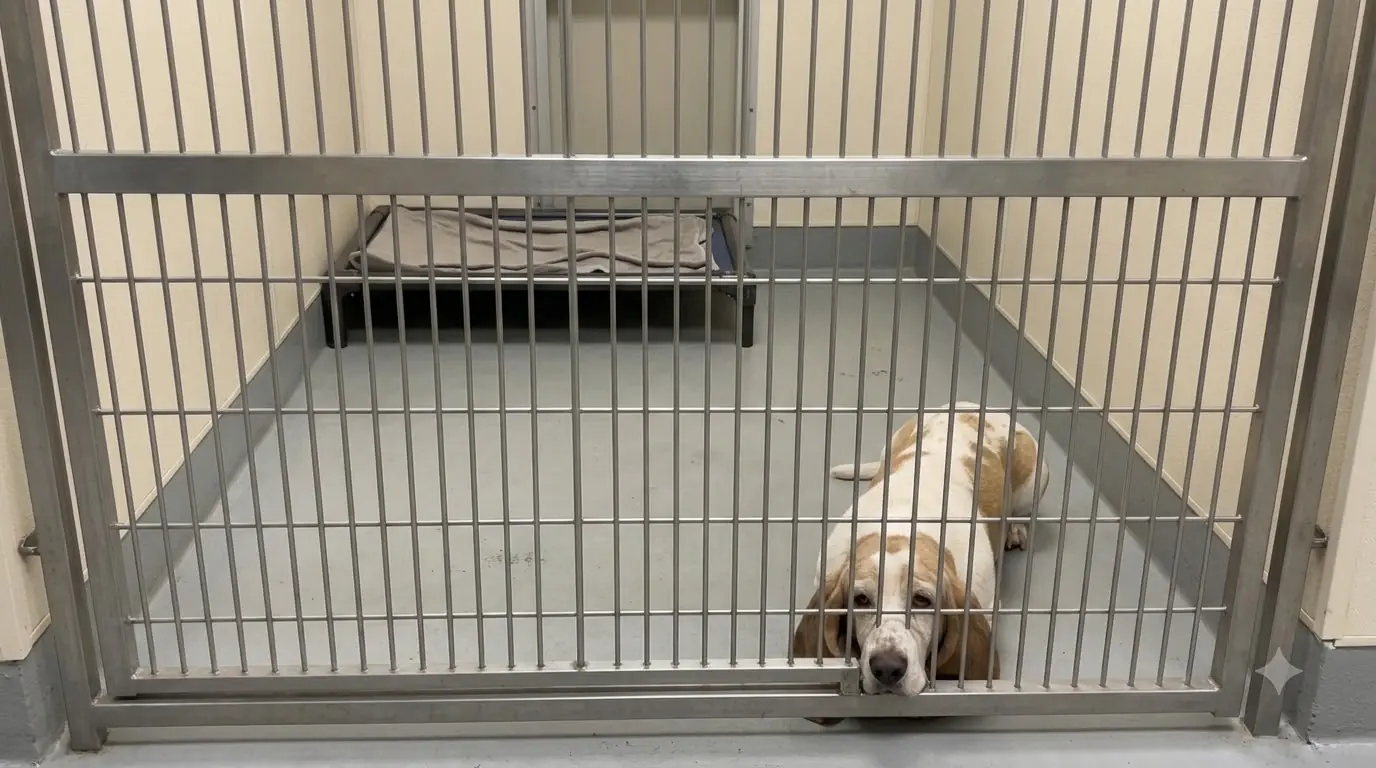
Franklin is 11 years old, a senior Basset Hound with spinal degeneration and significant weakness in both hind legs.
Most of the time, he rests on an orthopedic bed at the back of his kennel because simply getting up takes him a long time.
That creates a heartbreaking problem when visitors stop to look at him.
Franklin notices them.
He immediately plants his front paws and begins struggling to lift himself from the bed.
But his body cannot move quickly anymore.
By the time Franklin manages to drag himself several steps toward the kennel bars, the person who stopped has often already walked away.
Franklin keeps going anyway.
Eventually, he reaches the gate.
Then he lies down exactly where the visitor had been standing, pushes his nose between two bars, and stays there.
Franklin Starts Moving the Moment Someone Stops
Franklin does not ignore visitors.
He just cannot reach them quickly.
When someone appears outside his kennel, Franklin begins trying to get up almost immediately.
His front legs brace against the bed.
He pushes.
His weakened hindquarters are much slower to follow.
For an 11-year-old dog with spinal degeneration and hind-leg weakness, something as ordinary as rising from a bed has become a process.
The visitor may wait for a moment.
From the hallway, Franklin still appears to be lying toward the back.
Then they continue walking.
Inside the kennel, Franklin is only getting started.
He finally gets himself forward.
One difficult movement becomes another.
He slowly drags himself several steps closer to the gate.
But when he arrives, the space outside is often empty.
He Still Goes All the Way to the Door
Franklin could stop once the person disappears.
He does not.
He continues toward the place where they had been standing.
His front legs do much of the work as his weakened rear legs struggle behind him.
Eventually, Franklin reaches the bars.
Then his body lowers back to the floor.
He lies at the kennel door.
His nose slides between two of the metal bars.
And he stays there.
There is no responsible way to say Franklin believes the person will return or understands that he was too slow.
Those would be human interpretations.
The observable scene is enough.
Someone stops.
Franklin immediately tries to get to them.
His disability makes him slow.
The person leaves before he arrives.
Franklin finishes the journey anyway.
His Body Moves on a Different Schedule Now
Franklin has spinal degeneration and weakness affecting both hind legs.
No additional veterinary details were provided.
The exact spinal diagnosis, severity, diagnostic imaging, medications, pain-management plan, and prognosis are unknown.
It is also unclear how much independent mobility Franklin currently retains or whether his condition is expected to continue progressing.
What is already obvious is the functional effect.
Franklin cannot simply spring from his bed when someone approaches.
Standing requires time.
Moving forward requires effort.
Getting from the back of the kennel to the front can take longer than a visitor is willing to wait.
That means his physical disability is influencing how people perceive him.
Someone may think Franklin has chosen not to come over.
In reality, they may simply leave before he physically can.
Visitors Often Never See Franklin Reach Them
Shelter interactions can be extremely brief.
Someone walks down the hallway.
They stop at one kennel.
They look at the dog.
If nothing happens immediately, they move to the next.
For Franklin, those few seconds matter.
A younger, mobile dog may already be standing against the gate.
Franklin is still trying to lift himself from his orthopedic bed.
By the time he gets moving, the opportunity has passed.
The person may never know that Franklin responded to their presence at all.
They do not see the effort happening behind them.
They do not see him continue across the kennel.
And they do not see where Franklin eventually chooses to lie down.
Right at the gate.
Right where they had been.
Franklin's Nose Ends Up Between the Bars
The most emotional part of Franklin's routine happens after the visitor is already gone.
Franklin finally reaches the front.
His tired body lowers onto the floor.
Then he positions his muzzle against the gate.
His nose rests between two metal bars.
The hallway beyond them is empty.
Franklin stays there.
The orthopedic bed he started from remains at the other end of the kennel.
Getting back to it would require another difficult trip.
So after spending his limited strength reaching the front, Franklin simply rests where the visitor had stopped.
For the next person walking down the hallway, Franklin may finally be visible at the gate.
But the person he originally tried to reach never sees him arrive.
Franklin Needs More Than a Few Seconds
Franklin's behavior is an important reminder that a dog's reaction during a brief kennel visit does not always tell the whole story.
His mobility limitations change the timing of every interaction.
If Franklin remains on his bed when someone appears, that does not necessarily mean he has no interest in approaching.
His body needs time.
Staff who understand his condition can help visitors see what happens when Franklin is given that time.
They can also explain how he moves and what assistance he may need.
There is no information provided about Franklin's behavior around other dogs, cats, children, or in a home environment.
Those things should not be assumed simply because he tries to approach visitors.
A complete behavioral assessment still matters.
His Spinal Condition Could Require Significant Care
Anyone considering helping Franklin should request his current veterinary records.
Spinal degeneration combined with hind-leg weakness can create substantial mobility and supportive-care needs.
Potential adopters, fosters, or rescues should ask how independently Franklin can stand and walk, whether he drags his hind feet, whether he falls, and whether staff currently use a support harness or other mobility assistance.
They should also ask about pain management, medications, bladder and bowel function, skin care, exercise restrictions, and whether veterinary staff recommend rehabilitation or mobility equipment.
Franklin's ability to use stairs and safely tolerate transportation should also be discussed.
None of those details were provided here.
His diagnosis should not be expanded beyond the known spinal degeneration and hind-leg weakness without veterinary documentation.
Franklin's History Before the Shelter Is Unknown
No information was provided explaining how Franklin entered the shelter.
It is unknown whether he arrived as a stray, was surrendered, transferred from another organization, or entered under another circumstance.
His history before intake is unknown.
There is also no information establishing when his spinal problems began or how quickly his mobility has declined.
Nothing provided establishes neglect, abuse, abandonment, or another cause.
Those details should not be invented.
What matters now is what Franklin is physically experiencing inside the kennel.
He wants to move toward the gate when someone stops.
His body simply cannot accomplish it quickly.
His Exact Risk Status Has Not Been Provided
No explicit euthanasia-list status or deadline was included with Franklin's information.
It would therefore be inaccurate to claim that he has only hours or days remaining.
The shelter name, city, state, and Animal ID were also not provided.
Franklin is a medically vulnerable senior dog whose mobility limitations appear to be making it harder for visitors to notice his response to them.
But his exact placement status needs to be confirmed directly with the shelter.
If Franklin is at risk of euthanasia, the shelter should provide the current deadline and requirements for helping him.
No deadline should be invented simply to make his story more urgent.
The Person Leaves — Franklin Keeps Coming
The scene at Franklin's kennel can happen in only a few minutes.
Someone stops outside.
Franklin sees them from his orthopedic bed.
His front paws immediately press down.
He tries to lift himself.
His chest rises first.
His weakened hindquarters struggle behind him.
The visitor waits briefly.
Then they walk away.
Franklin finally gets moving.
He drags himself several slow steps toward the gate.
There is nobody there anymore.
But Franklin does not turn back.
He keeps going until he reaches the exact place where that person had stood.
Then the old Basset Hound lowers himself onto the floor.
His body becomes still.
His muzzle reaches the gate.
And Franklin places his nose between two bars, facing an empty hallway.
The person who stopped may believe Franklin never came to greet them.
They simply did not stay long enough to see him arrive.
DOG INFORMATION
Name: Franklin
Breed: Basset Hound
Age: 11 years old
Current condition: Spinal degeneration with significant weakness in both hind legs and severely limited mobility
Observed kennel behavior: Immediately attempts to rise when visitors stop, slowly makes his way toward the gate, and often reaches it only after they have left
Deadline: No euthanasia deadline provided
Current status: Senior shelter dog with significant mobility limitations; exact placement and risk status should be confirmed directly with the shelter
HOW TO HELP
Anyone interested in Franklin should contact the shelter directly to confirm his current availability, placement options, medical condition, and whether any deadline applies.
Because Franklin has spinal degeneration and hind-leg weakness, potential adopters, fosters, or rescues should request his veterinary records and ask about mobility assistance, pain management, medications, bladder and bowel function, transportation needs, and his ability to safely navigate a home.
Visitors interested in meeting Franklin should also ask shelter staff how to interact with him and give him enough time to respond. A few seconds at the kennel door may end before Franklin can physically get there.
Sharing Franklin's case may help people understand the scene most visitors miss: the old Basset Hound on the bed is already trying to come toward them. His body just needs more time than they realize.
Please contact the shelter directly for the most current information about Franklin's availability, medical needs, placement requirements, and risk status.