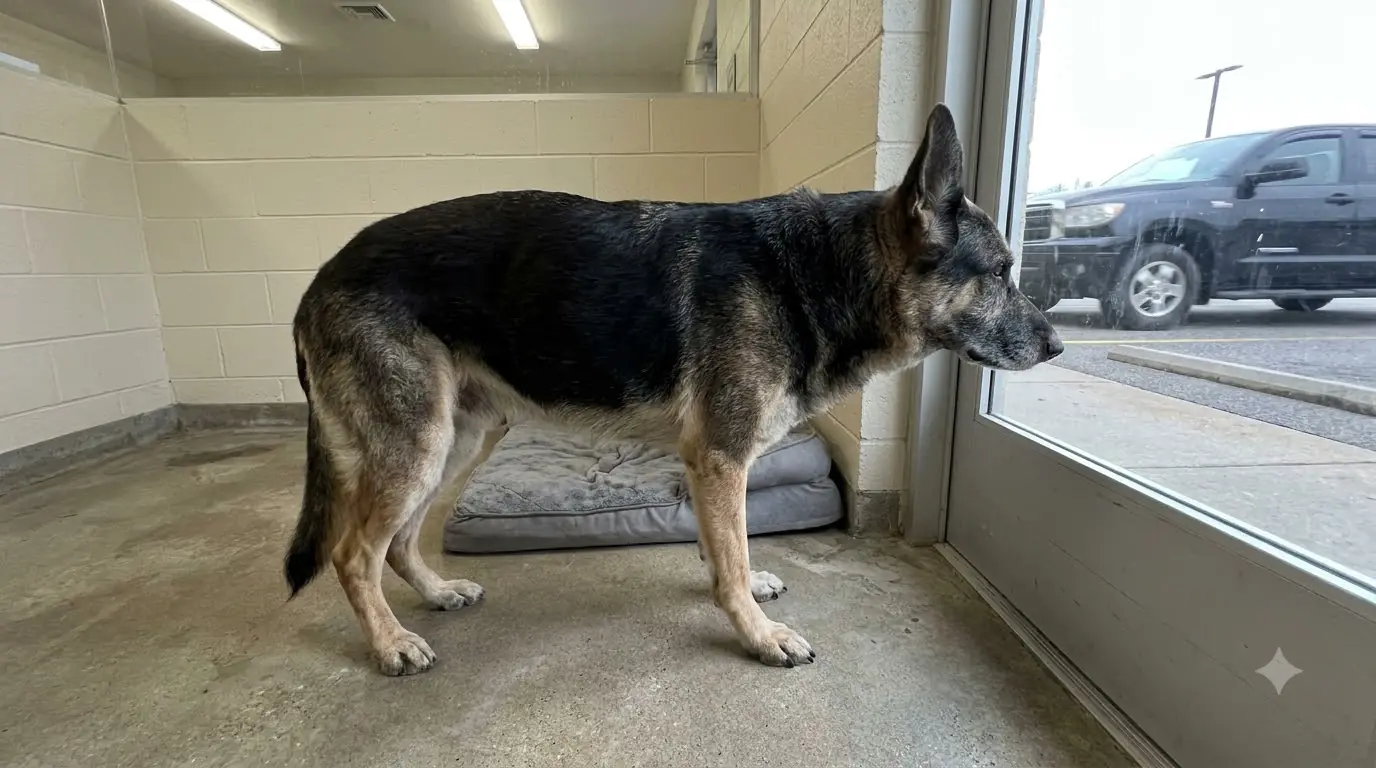
Most of the day, Hank does not move very quickly.
The 10-year-old German Shepherd spends long stretches resting in the indoor adoption room at the humane society. Arthritis has made getting up harder, and staff have learned not to expect the senior dog to rise every time someone passes.
But there is one sound that changes him almost immediately.
A pickup truck entering the parking lot.
Hank's head comes up.
His ears stand.
Then he pushes himself off the floor.
The first few steps are stiff, but once he is moving, he heads directly toward the large window overlooking the parking lot.
He stands as close to the glass as he can and watches.
People get out.
Doors close.
Sometimes the truck remains there for several minutes.
Hank stays at the window.
Then the vehicle pulls away.
Only after it disappears does he eventually turn back toward his bed.
Staff initially noticed the behavior because of how unusual the sudden burst of movement was for a dog who otherwise spent so much of his day resting.
Then they learned why pickup trucks might be different for Hank.
It Kept Happening With the Same Kind of Sound
Not every vehicle brought Hank to the window.
Ordinary parking lot activity often barely disturbed him.
A car door might close and one ear would move.
People could walk past the glass without convincing him to stand.
But the deeper engine sound of certain pickup trucks produced a much stronger response.
His head would rise before staff had even looked outside.
Then came the difficult part.
Getting his aging body upright.
Hank would bring his front paws underneath himself first. His hindquarters followed more slowly.
Sometimes he paused after standing as though he needed a moment before asking his joints to do anything else.
Then he headed for the glass.
It happened often enough that staff stopped treating it as coincidence.
There was a pattern.
What they did not initially understand was what had happened before Hank entered the humane society.
Hank Had Not Lost His Home Because Someone Stopped Wanting Him
Before arriving at the shelter, Hank had belonged to an owner.
Then his owner died.
There was no family member able to take over Hank's long-term care, leaving the senior German Shepherd facing an enormous change late in life.
The home and routine he knew were gone.
So was the person around whom much of that routine had likely been built.
Hank could not explain what parts of his old life he recognized or remembered.
Staff were careful not to claim they knew exactly what he was thinking each time an engine entered the parking lot.
But one detail from his previous life made his behavior at the window much harder to ignore.
His owner had driven a pickup truck.
Suddenly, the rush toward the glass had context.
Staff Began Watching What Hank Did After the Truck Stopped
He did not simply investigate the noise and immediately return to bed.
Hank watched.
His ears remained upright as people moved around the vehicle.
If someone stepped out, his attention followed them.
Sometimes his body leaned slightly toward the glass.
He stayed there even though standing for long periods was harder on his arthritic joints than lying on his bed.
And then the truck would leave.
Hank watched it move through the parking lot until it disappeared from view.
There was no dramatic barking.
No frantic scratching at the window.
Most of the time, he simply stood there.
Eventually his ears relaxed.
He turned around.
And the walk back was usually much slower than the walk that had brought him there.
That was the detail that concerned staff.
Whatever was motivating Hank to reach the window, his body was paying for it.
His Arthritis Didn't Disappear When He Heard an Engine
Hank's sudden movement could make him look temporarily more energetic than he really was.
But staff saw what happened afterward.
The stiffness was still there.
After standing at the glass, he sometimes lowered himself carefully onto his bedding and remained there for a long time.
His caregivers began paying closer attention to his mobility and comfort.
A senior German Shepherd with arthritis did not need to repeatedly struggle across a room simply because something outside had caught his attention.
His pain and mobility needs had to remain part of his care even on the days when excitement temporarily made him move faster.
So the humane society adjusted the environment around him.
They Gave Hank a Comfortable Place Closer to the Window
Instead of trying to stop him from looking outside, staff made it easier for him to do so.
A comfortable resting area could be positioned where Hank did not need to cross as much floor whenever something in the parking lot caught his attention.
His routine also became increasingly predictable.
Meals.
Bathroom breaks.
Quiet periods.
Staff visits.
Gentle interaction appropriate for a senior dog.
The goal was not to make Hank forget the window.
Nobody could know whether that was possible or even necessary.
The goal was to give him more reasons to engage with what was happening inside the room.
For a while, the pickup trucks still won almost every time.
Then something began to change.
Hank Started Looking at Staff Before Getting Up
A truck would enter.
His ears would rise.
But occasionally, instead of immediately forcing himself to his feet, Hank would look toward a familiar caregiver first.
Sometimes he still stood and went to the window.
Other times he remained on his bedding and listened.
It was a subtle difference.
The truck still mattered.
But it no longer produced exactly the same response every single time.
Hank was also becoming more familiar with the people caring for him.
He began showing more interest when certain staff entered.
He settled more easily after his routine outings.
He could rest while ordinary activity continued around him.
None of that erased what happened when the right engine sound came through the glass.
One Afternoon, He Didn't Get Up
A pickup truck pulled into the parking lot.
Hank's head lifted immediately.
Both ears pointed toward the window.
Staff expected the familiar sequence.
Front paws forward.
Slow push upward.
Quick walk to the glass.
Instead, Hank remained lying down.
He listened.
His eyes stayed on the window.
But his body stayed on the bed.
A caregiver sitting nearby did not call him or try to distract him.
The truck remained outside for a short while.
Then it left.
Hank watched from where he was.
Afterward, he lowered his head again.
It was only one afternoon.
The next similar truck might still bring him to his feet.
But staff remembered it because it was the first time Hank seemed able to let the sound pass without making his painful joints carry him to the glass.
The Habit Has Not Completely Gone Away
And nobody at the humane society expects it to disappear on a schedule.
Hank experienced a major disruption at an age when his routines had already been established for years.
He is also dealing with a body that needs more rest and comfort than it once did.
Staff continue supporting both sides of that adjustment.
His arthritis needs appropriate management.
His activity needs to match what he can comfortably tolerate.
And his days need enough predictable, positive experiences that the adoption room becomes more than simply the place where he waits between sounds from the parking lot.
There are signs that is happening.
Hank rests more comfortably.
He responds to familiar caregivers.
He does not investigate every sound.
Sometimes he hears a pickup and stays where he is.
But sometimes the old pattern returns in full.
Hank Still Goes to the Window
The engine reaches the room.
His ears shoot upright.
He gathers his legs underneath his aging body and stands.
Then the senior German Shepherd moves toward the glass with a speed staff rarely see at any other time.
He watches the truck.
He watches the people around it.
And he stays until it leaves.
Staff cannot say Hank believes his owner is inside.
They cannot know exactly what the engine means to him.
They only know that pickup trucks were once part of the life Hank shared with the person he lost, and that certain sounds still produce a response nothing else in the parking lot seems to match.
But there is one difference now.
When the truck disappears, Hank has somewhere else to turn.
A familiar bed.
A predictable routine.
And people he has begun recognizing as part of his day.
Sometimes he still stands at that window until the last second.
Other times, he only lifts his head and listens.
For Hank, that small hesitation may be the first sign that not every familiar engine requires him to get up and look for the life that existed before he came here.