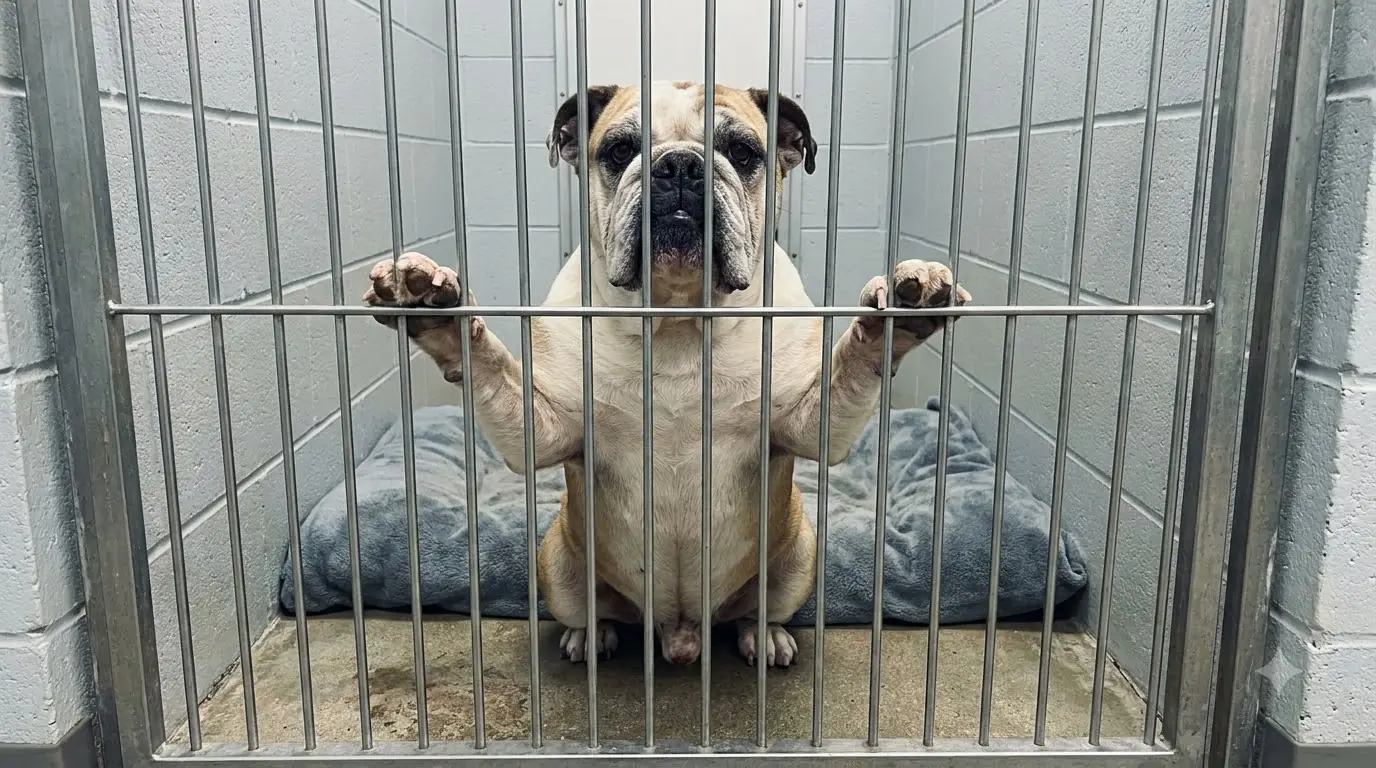
The senior English Bulldog does not come to the kennel door anymore.
Not because he does not notice people.
Not because he has stopped reacting to them.
His body simply cannot make that trip.
Most of the day, he lies on a low orthopedic bed inside the medical kennel with his hindquarters supported on thick padding. His back legs are weak from an old spinal injury, and the tail that should lift and move freely behind him has almost no normal motion left.
When the hallway is quiet, he sleeps.
When someone walks past, his eyes may open.
But when someone actually stops at his kennel, something else happens.
First, his head lifts.
Slowly.
His broad Bulldog muzzle comes off the blanket.
His neck stiffens as he works to hold it there.
Then, behind him, the tail moves.
Barely.
A small twitch against the mattress.
Pause.
Another.
Sometimes two or three tiny movements are all he can manage.
The rest of his body stays exactly where it is.
No attempt to stand.
No walk toward the bars.
No full-body wag.
Just a gray-faced senior dog looking toward the person outside while a tail that has almost stopped working tries to move anyway.
Staff Almost Missed It at First
The movement was so small that it did not look like a wag from across the room.
A caregiver would stop.
The Bulldog's head would rise.
Something near his hindquarters would shift.
At first, staff assumed he was repositioning his pelvis.
Then someone stood close enough to see the pattern.
Person arrives.
Head up.
Tail moves.
Person leaves.
Tail stops.
It happened again with another familiar caregiver.
Then again when a volunteer crouched outside the bars.
That was when staff understood that the tiny motion was not random.
The dog was trying to move a body part that his old spinal injury had made difficult to control.
His Tail Was Not the Main Medical Problem
The spinal damage was.
The weak tail was only one visible consequence.
The Bulldog had a history consistent with chronic spinal injury that had left both hind legs significantly impaired.
By the time he entered medical care, he could still produce some voluntary movement behind, but strength, coordination, and endurance were poor.
Standing independently was unreliable.
Walking without support was not safe.
The veterinary team evaluated more than the obvious weakness.
They watched his gait when he was assisted.
Checked paw placement.
Assessed reflexes and muscle tone.
Palpated the spine for pain.
Looked for asymmetry.
Asked whether bladder and bowel function remained normal.
Those details mattered because “weak hind legs” can mean very different things depending on where the neurologic problem is located and how severe it has become.
The Injury Was Old
There was no evidence that this had happened the day before shelter intake.
The weakness had been present long enough for muscle loss to develop.
The hindquarters were narrower than the front.
The back legs lacked the power expected in a compact, heavy-bodied English Bulldog.
The tail did not lift normally.
There was no responsible way to reconstruct exactly how the original spinal injury had occurred unless records supported it.
A fall.
A disc problem.
Trauma.
Degenerative disease.
More than one cause can leave similar long-term deficits.
The rescue did not invent the missing history.
They treated the dog in front of them.
His Body Type Made the Weakness Harder
English Bulldogs are compact, broad, and front-heavy.
Even healthy individuals can carry substantial weight over relatively short limbs.
For a senior Bulldog with compromised hindquarters, that body shape creates an additional challenge.
The front legs may remain strong enough to lift the chest.
The rear cannot always follow.
That meant he could sometimes look as though he was about to stand.
Front paws brace.
Shoulders rise.
Head comes up.
Then the hips stay down.
Staff learned not to let that become repeated struggling.
He Had Tried in the Beginning
During the first days, when a person entered the kennel, the Bulldog sometimes attempted to get up.
The sequence was always the same.
Front legs under chest.
Push.
Shoulders rise.
Hind feet search for traction.
Then the rear end slips or fails to lift.
He would settle back down.
Sometimes he tried twice.
Staff stopped allowing that.
There was no benefit in letting a neurologically weak senior dog exhaust himself just to greet someone.
If he wanted contact, people could cover the distance.
The Orthopedic Bed Became Essential
He spent most of his time lying down.
That makes bedding medical equipment.
Not decoration.
The mattress had to support his weight without swallowing his body so deeply that repositioning became impossible.
It needed enough cushioning to protect elbows, hips, hocks, and the chest.
The surface needed to stay dry.
Blankets had to be checked frequently because a dog who cannot move easily cannot simply get away from damp bedding.
Pressure points were monitored closely.
This mattered even more because Bulldogs can be prone to skin irritation in folds and areas where moisture accumulates.
Staff Helped Him Change Position
A dog lying in one posture for hours can develop discomfort and skin problems.
The Bulldog could make small adjustments with his front half.
The hindquarters often needed help.
Caregivers moved slowly.
One person could stabilize the chest while another supported the rear.
No sudden twisting of the spine.
No dragging the back legs across the mattress.
If the dog resisted or showed pain, handling was reassessed.
The goal was comfort.
Not perfect symmetry.
His Tail Made Repositioning More Complicated Than It Looked
Because the tail had limited motion, staff had to make sure it did not remain trapped beneath his body.
Pressure on a poorly mobile tail can create skin problems quickly.
Every bedding change included a check.
Tail position.
Skin underneath.
Any redness.
Any moisture.
Any swelling.
The tail could not reliably move itself out of trouble.
Humans had to notice.
The Tiny Wag Became One of the Best Ways to Read Him
Not as a complete measure of happiness.
Tail movement alone never tells the whole emotional story.
A wagging dog can be excited, uncertain, socially engaged, or stressed.
Context matters.
For this Bulldog, the movement was useful because it appeared most consistently in calm social interactions.
A familiar caregiver stopped.
His eyes focused.
Head lifted.
The tail gave several small movements.
His body otherwise stayed loose.
That combination suggested social interest.
Strangers Got Less Movement
That was useful too.
With unfamiliar people, he sometimes only watched.
No tail.
No attempt to raise the chest.
That did not mean he disliked them.
He needed time.
The medical kennel was not a place where strangers should pressure a recumbent dog into interaction.
People were asked to crouch.
Speak quietly.
Let him sniff.
If he wanted more contact, he showed it in small ways.
Familiar People Got the Full Version
Which was still tiny.
Head up.
Eyes more alert.
The end of the tail twitching against the orthopedic bed.
Sometimes his front paws shifted as though he wanted to pull himself closer.
Staff prevented unnecessary crawling.
They came to him instead.
That became his preferred type of greeting.
He Liked Contact Around the Chest and Neck
Handlers learned this through observation.
Not every Bulldog enjoys the same touch.
This dog seemed more comfortable with gentle scratching along the chest, neck, and shoulder than handling near the hindquarters.
That made sense.
The back half was neurologically compromised and sometimes sensitive during care.
People did not need to touch the weak area to interact with him.
His Hind Legs Still Had Some Function
That was important.
They were weak, not completely absent.
During supported standing, he could sometimes place the feet.
On stronger days, he bore partial weight for a few seconds.
The veterinary team did not promise full recovery.
Chronic spinal injuries can leave permanent deficits.
But preserving whatever useful function remained was worthwhile.
Rehabilitation Started With Seconds
A support sling beneath the rear.
Front feet positioned on a nonslip surface.
Encourage a controlled stand.
Hold briefly.
Then down.
The first goal was not walking.
It was safe weight-bearing.
Could he activate the hindquarters at all?
Could the feet remain correctly placed?
Did the legs cross?
Did the paws knuckle?
Did his body show pain?
The session ended before fatigue became collapse.
The Tail Sometimes Moved During Rehabilitation
That was another clue that some neural connection remained.
Not enough to restore normal tail function.
But enough for small voluntary movement.
The rehabilitation team documented it.
They did not turn it into proof that the spine was “healing.”
Chronic neurologic recovery is more complicated.
A tiny tail twitch is not a prognosis by itself.
Bathroom Care Required Planning
Mobility-impaired dogs often need more help with elimination than people expect.
The Bulldog could not simply walk outside on his own.
A rear-support harness helped.
The route had to be short.
Flooring needed traction.
If he fatigued, staff supported more of his weight.
Urination and stool were monitored because changes could indicate neurologic or medical problems.
If he could not posture normally, caregivers adapted.
Dignity in rescue often looks like very practical help.
His Appetite Stayed Good
That gave everyone something easier to manage.
Meals interested him.
Food was placed where he could reach without standing.
Because of his build, bowl height mattered.
His neck should not strain.
The chest should remain supported.
Staff watched that he could swallow comfortably.
The dog did not need to prove strength by standing over food.
He Gained Some Condition
Not much.
Enough to move toward a healthier senior body condition.
Extra weight would have made mobility harder.
Bulldogs are often kept heavier than is ideal, and for a dog with spinal weakness, unnecessary pounds are especially costly.
The veterinary team aimed for lean.
Enough nutrition to maintain muscle and healing.
Not enough to increase the work required from every supported stand.
The Strong Front Half Could Create False Confidence
This happened with visitors.
They saw him lift his chest.
“He looks like he could walk.”
Staff explained.
The front legs were not the problem.
A dog can have impressive strength in the shoulders and still be unable to support the rear.
Allowing him to drag himself because the front half could pull would create friction, fatigue, and injury risk.
So his movement stayed assisted.
Crawling Was Not Used as Exercise
That was a deliberate choice.
Dragging the back legs across the floor can cause skin damage.
It can also encourage inefficient movement patterns.
The rehabilitation plan focused on supported posture and controlled steps when appropriate.
If the Bulldog needed to move through the kennel, caregivers helped.
No “let him figure it out.”
He had already lost enough mobility.
The Medical Team Watched for Pain Separately From Weakness
Neurologic deficits can exist with or without significant spinal pain.
The dog could also have ordinary senior arthritis on top of the old injury.
Staff watched carefully.
Did he tense when the spine was touched?
Did he cry out when repositioned?
Did he resist one direction?
Did appetite fall?
Did breathing change with handling?
Pain control was adjusted based on the whole picture.
Weakness alone was not automatically pain.
Pain alone was not assumed from weakness.
He Began Sleeping More Comfortably
At intake, he woke frequently when his hindquarters shifted.
Once the bed, positioning routine, and pain plan were optimized, he stayed asleep longer.
That mattered.
A recumbent dog spends enough time resting that poor-quality sleep can affect everything.
Appetite.
Patience.
Rehabilitation.
Social interaction.
Deep sleep was part of recovery.
The Tail Moved More on Rested Days
Staff noticed this over time.
After a good night, familiar people sometimes got three or four tiny movements.
After a tiring rehabilitation session, perhaps one.
Again, that did not become a formal medical test.
It became another small observation about his energy.
The dog had very limited ways to express excitement physically.
This was one of them.
A Volunteer Started Sitting Beside Him Every Morning
No dramatic interaction.
The person entered.
Sat on the floor.
The Bulldog lifted his head.
Tail moved.
Then he settled.
Sometimes they remained together without touching.
That was useful because the dog did not have to spend energy maintaining attention.
The volunteer stayed long enough for him to relax.
He Did Not Need to Come to the Door Anymore
Staff moved his bed closer to the front.
Not directly against the bars, where drafts and cleaning could become a problem.
Close enough that visitors could crouch and be within his field of view.
That reduced the urge to pull himself forward.
Now the greeting could happen from the bed.
The First Time He Stopped Trying to Rise Was Actually Progress
A familiar caregiver appeared.
The Bulldog's head lifted.
Front paws moved.
Then stopped.
The person crouched immediately.
The dog remained down.
Tail twitch.
Head still up.
No failed stand.
No slide backward.
That was exactly what staff had been teaching through the environment.
Social contact does not require locomotion.
His Neurologic Deficits Remained
Weeks of care did not restore normal rear-leg function.
That was expected.
He gained some strength.
Could participate more during assisted standing.
But no one described him as recovered.
The old spinal injury had left permanent consequences.
Management was the realistic path.
Foster Placement Needed a Specific Kind of Home
A standard foster could not necessarily handle him safely.
He needed someone prepared for mobility care.
One-level living.
Nonslip surfaces.
Frequent bedding checks.
Ability to support a heavy Bulldog.
Comfort with cleaning.
Medication.
Rehabilitation.
Monitoring urine and stool.
Veterinary follow-up.
Potential future decline.
That narrowed the options.
A Medical Foster Eventually Stepped Forward
They had cared for neurologically impaired dogs before.
The home was arranged before transfer.
Runners over smooth flooring.
Low orthopedic bed.
Water nearby.
Short route outside.
Rear-support sling ready.
No stairs required for daily life.
That was exactly the type of environment he needed.
The First Foster Greeting Looked Familiar
The Bulldog was carried or supported into the living area.
Settled onto the bed.
The foster sat down several feet away.
His head lifted.
The tail moved twice.
The foster came closer.
The dog remained down.
No need to go anywhere.
That became the household rule from the first hour.
The Bed Was Put Where People Actually Lived
Near the couch.
Not in a back room.
This mattered because he was socially interested.
If his resting place had been isolated, he might have spent more time trying to move toward activity.
Instead, ordinary life happened around him.
Someone watched television.
Someone read.
Someone walked through.
The Bulldog could participate without standing.
His Tail Became Easier to See at Home
There was less distraction.
No kennel bars.
No constant movement behind him.
When the foster entered, the tail would sometimes flick clearly against the blanket.
Tiny motion.
Very obvious once people knew to look.
Visitors were told what it meant in context.
Do not ask him to get up.
Come down to his level.
He Still Tried Once
A person he knew walked toward the front door.
The Bulldog braced on his front legs.
Chest rose.
He appeared to want to follow.
The foster returned immediately.
Sat beside him.
The dog relaxed back onto the bed.
Tail moved.
That became another reminder.
His social motivation could exceed his physical ability.
Humans needed to manage the gap.
Rehabilitation Continued at Home
Short sessions.
Supported standing.
Gentle weight shifts.
A few assisted steps if cleared.
Rest.
No aggressive strengthening.
No forcing the hind legs through movement they could not control.
The objective remained maintenance and whatever modest improvement was neurologically possible.
One Paw Began Placing More Reliably
That was a meaningful small gain.
During supported standing, one rear foot stayed correctly positioned longer.
The other remained weaker.
The foster documented the change for the rehabilitation team.
No one turned it into a prediction of walking independently.
Small neurologic improvements can matter without becoming miracles.
His Tail Never Returned to Normal
That remained true.
It did not lift high.
It did not swing broadly.
Sometimes the movement was barely visible.
Other times nothing happened.
Permanent deficits remained permanent.
That honesty was important.
The Dog Developed Other Ways to Greet People
His face did more.
Eyes widened slightly.
Head lifted faster.
Nose moved toward a hand.
Sometimes he made a soft sound.
The tiny tail wag was no longer the only sign people noticed.
The more they knew him, the less they needed one obvious behavior to interpret the interaction.
He Could Choose to End Contact Too
That mattered.
If tired, he lowered his head.
Turned slightly away.
Closed his eyes.
Visitors were told to respect that.
A mobility-impaired dog can become trapped socially if people assume lying still means unlimited consent to touch.
The Bulldog's ability to move away was limited.
Humans had to pay closer attention to subtle signals.
His Skin Stayed Healthy
That was a real success.
No pressure sores.
No moisture-related breakdown.
No tail injury from being trapped underneath him.
Those outcomes required constant routine.
Clean.
Dry.
Reposition.
Check.
Repeat.
It was not glamorous.
It preserved comfort.
The Foster Learned His Strong and Weak Times
Morning after rest.
Better head control.
More active front legs.
More tail movement.
Late evening.
Tired.
Less response.
Harder repositioning.
The daily rhythm helped schedule rehabilitation and bathroom support when he had the most reserve.
He Still Enjoyed Being Outside
With help.
A support harness.
Short trips.
Grass beneath the front paws.
The Bulldog would stand for several seconds and sniff.
Sometimes his rear legs contributed.
Sometimes the foster carried more of the load.
No long walks.
The goal was sensory experience and function.
Not distance.
The Tail Occasionally Moved Outside Too
A familiar person approached.
Small twitch.
Sunlight.
Grass.
Different smells.
The dog had a larger life than the medical bed.
Mobility support made that possible.
The Rescue Was Careful About Quality of Life
Chronic disability does not automatically mean poor quality of life.
Neither does social interest automatically mean life should continue regardless of suffering.
The team looked at the full picture.
Pain.
Appetite.
Sleep.
Skin.
Elimination.
Ability to rest.
Interest in people.
Ability to enjoy outside time.
Tolerance of care.
Those factors mattered together.
He Had More Good Days Than Bad
At this stage, that remained true.
He ate.
Slept.
Engaged.
Participated in assisted outings.
Did not show persistent uncontrolled pain.
That supported continued care.
If those things changed, the plan would change too.
The rescue did not promise endless intervention.
The Foster Stopped Thinking of the Tail as Sad
That took time.
At first, every tiny wag looked like a reminder of what he had lost.
Later, it simply became his wag.
Small.
Limited.
His.
There was no need to compare it to a healthy dog's broad tail movement every time.
Adaptation includes accepting the body that remains.
Visitors Learned to Watch Closely
A person enters.
Head up.
Tail twitches.
That is his greeting.
They crouch.
The Bulldog sniffs.
Maybe accepts a chest scratch.
Then relaxes.
No one waits for a bigger response.
That reduced pressure on everyone.
One Child Met Him in Foster Care
The interaction was carefully supervised.
The child was told that the dog could not walk over.
So the child sat several feet away.
The Bulldog watched.
Head up.
Tail moved once.
The adult helped the child come closer.
No crawling over the bed.
No touching the back legs.
The dog sniffed the child's hand.
Then rested.
That was enough.
His Disability Did Not Need to Become a Lesson for Children
The rescue avoided that framing too.
He was not there to teach gratitude or resilience.
He was a dog receiving care.
Children could learn respectful behavior by being around him.
But his body did not exist as an inspirational object.
That boundary mattered.
Over Time, He Got Better at Assisted Standing
Not dramatically.
A few seconds longer.
Less collapse through one rear leg.
More stable front posture.
The tail sometimes moved during these sessions.
But independent walking remained unlikely.
That was acceptable.
The goal was function within his limits.
The Orthopedic Bed Stayed Central
He had several eventually.
One in the living room.
One near the bedroom.
The dog did not have to be transferred across the house just to remain near people.
The environment came to him.
That was one of the biggest differences between shelter and foster care.
He Started Sleeping Through Footsteps
At the shelter, someone stopping usually woke him.
At home, familiar household movement became ordinary.
A person crossed the room.
He stayed asleep.
Door opened.
Maybe an ear moved.
No need to lift the head for every possibility.
That reduced the amount of energy he spent monitoring people.
But Certain Footsteps Still Wake Him
The foster returning home.
A familiar volunteer visiting.
The person who usually brings food.
Those patterns produce more obvious attention.
Head up.
Eyes forward.
Sometimes three tiny tail movements.
Everyone smiles.
No one asks for more.
His Old Spinal Injury Is Still Visible Every Day
The weak rear legs.
The limited tail.
The need for assistance.
That has not changed.
The difference is that those deficits no longer define every interaction.
He has routines.
Preferences.
People.
A comfortable bed.
A way to communicate.
Staff Still Remember the Medical Kennel
The Bulldog lying almost motionless.
Someone stops.
Head rises.
And then, if you looked carefully enough, the tail moved.
Barely.
Against the blanket.
A tiny effort from a part of his body that no longer worked the way it once had.
That was why the behavior stayed with them.
They Also Remember What He Could Not Do
He could not stand.
Could not walk forward.
Could not press against the bars.
Could not offer the big physical greeting people expect from dogs.
So his response became smaller.
That did not make it meaningless.
It made humans pay closer attention.
The Best Care Made the Greeting Easier
Move the bed closer.
Come inside.
Crouch.
Sit.
Let the dog stay down.
Do not make him spend his strongest muscles compensating for the ones that failed.
That principle followed him from shelter to foster.
Recently, the Foster Came Home After Being Gone for Several Hours
The Bulldog was asleep on his orthopedic bed.
The door opened.
He did not stand.
He could not.
His eyes opened.
Then the head came up.
The foster walked toward him.
Before they reached the bed, the tail moved.
One small twitch.
Then another.
Then a third.
The foster sat beside him.
The Bulldog's head stayed up just long enough to sniff their hand.
Then it lowered.
The tail stopped.
He rested again.
Nothing About the Moment Was Dramatic
That is what made it right.
No struggling rise.
No rear legs slipping.
No dragging toward a doorway.
The person covered the distance.
The dog used only the strength he had available.
His Tail Will Probably Never Wag Normally Again
That belongs in the ending.
The old spinal injury remains.
The hind legs remain weak.
The tail still has very limited movement.
There is no reason to pretend rehabilitation will erase all of that.
But It Does Not Need To
He can still respond.
Still choose contact.
Still eat.
Sleep.
Sniff outside.
Recognize familiar people.
Participate in the world from a body that works differently now.
That is enough to build a meaningful life around.
And People Know What to Look For Now
Not the dog running to the door.
Not a full-body wiggle.
Not a broad tail sweeping side to side.
They watch the bed.
The head lifting.
The eyes focusing.
Then the smallest movement behind him.
A tail shifting against fleece.
Once.
Twice.
Maybe three times.
That Tiny Wag Is No Longer a Sign That He Needs to Try Harder
It is a signal for humans to come closer.
That is the change.
At the shelter, he could see someone beyond the bars and had no way to reach them.
Now, when his tail starts moving, nobody waits for him to get up.
They walk over.
Sit down.
Let him stay exactly where his spine and tired hind legs need him to be.
He Still Tries to Wag the Tail He Can Barely Move
That part of the story has not changed.
What has changed is what happens next.
He no longer has to make the rest of his body follow.
The person comes to the bed.
A hand arrives near his muzzle.
His head can lower when it gets tired.
The tail can stop whenever it needs to.
And the senior Bulldog who once had only a few tiny movements left to greet people with has finally learned, through the way humans respond to him, that those few movements are enough.