San Marino, California.
May 1994.
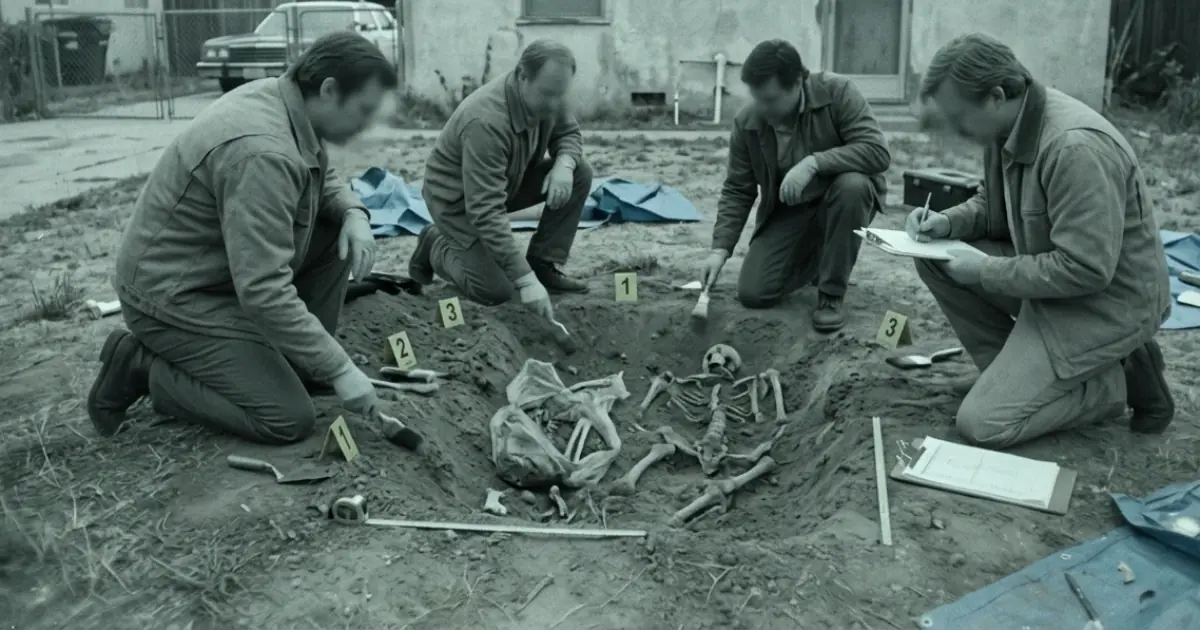
A construction crew was digging a swimming pool behind an expensive home on Lorain Road when the machinery struck something that did not belong in the ground.
At first, it looked like debris.
Plastic.
Fragments.
Then bone.
The workers stopped.
Police were called.
What investigators eventually uncovered was not an old animal burial or forgotten household waste.
It was human.
The remains had been hidden in the backyard for years, only a few yards from a guesthouse that had once been occupied by a strange young tenant who claimed to come from British aristocracy.
Parts of the skeleton were badly deteriorated.
The skull showed massive trauma.
At trial years later, forensic testimony would conclude that the man had suffered several extremely forceful blows to the head, injuries severe enough to be fatal. Other evidence suggested additional sharp-force injuries.
But the most curious objects were not bones.
They were plastic bags.
Two bags associated with the victim's skull carried names of universities.
One was connected to the University of Southern California.
The other was from the University of Wisconsin-Milwaukee.
Investigators would eventually realize that a man who had once lived only feet away from the grave had connections to both schools.
At the time, however, police had a more immediate problem.
Whose body was this?
The family who had owned the property before the current residents had experienced a strange disappearance nearly a decade earlier.
In February 1985, a young married couple named John and Linda Sohus had vanished.
Neither had ever returned.
And not long after they disappeared, the eccentric tenant in the backyard guesthouse vanished too.
His name, according to the people of San Marino, was Christopher Chichester.
Except it was not.
He had another name.
Then another.
Then another.
For more than twenty years, he would repeatedly erase himself and reappear as someone new.
A British aristocrat.
A Hollywood insider.
A Wall Street financier.
A descendant of nobility.
Eventually, he would adopt his most audacious identity of all.
Clark Rockefeller.
He would enter wealthy East Coast social circles under that name, marry a highly successful woman, raise a daughter and convince intelligent, educated people that he belonged to one of the most famous families in America.
The disguise lasted until 2008.
Then a custody dispute led to an extraordinary kidnapping.
The fake Rockefeller was arrested.
His photograph appeared across national television.
And people who had known completely different men decades earlier began calling investigators.
One said:
I knew him as Christopher Chichester.
Another:
I knew him as Christopher Crowe.
Another remembered him from California.
Another remembered him from Connecticut.
Suddenly the man arrested for abducting his own daughter seemed connected to a murder mystery that had been sitting in a California police file since 1985.
The skeleton under the swimming pool.
The vanished couple.
The truck that somehow crossed the country.
The mysterious postcards from France.
The guesthouse bloodstains.
The borrowed chainsaw.
The foul black smoke from a chimney.
And the young tenant whose entire life seemed to disappear at exactly the same time John and Linda Sohus did.
His real name was Christian Karl Gerhartsreiter.
In 2013, a Los Angeles jury convicted him of murdering John Sohus.
But that verdict answered only one part of the mystery.
Because Linda Sohus was never found.
As of 2026, she remains officially missing.
And one question still sits at the center of the case:
What happened to Linda?
Before the Grave
To understand the mystery, detectives had to return to San Marino in the early 1980s.
San Marino sits northeast of downtown Los Angeles.
It is affluent.
Quiet.
Filled with large homes, manicured lawns and streets where violent mystery feels out of place.
The property at 1920 Lorain Road belonged to Ruth "Didi" Sohus.
Her adult son was Jonathan Sohus, usually called John.
John was interested in computers.
His wife, Linda, loved science fiction and fantasy.
She worked at a bookstore associated with that world and created fantasy artwork.
Friends described the couple as financially stretched but happy together.
They had married only a short time before their disappearance.
Because money was tight, John and Linda lived in the main house with John's mother.
There was also a guesthouse.
But John and Linda did not use it.
Someone else lived there.
Linda once explained the arrangement to a close friend in language that would sound far more significant after she vanished.
The guesthouse tenant, she said, was "kind of creepy."
They did not really interact with him.
The tenant called himself Christopher Chichester.
That name sounded elegant.
British.
Old-world.
Exactly the image he wanted.
He gave people the impression that he had aristocratic connections.
At various points he suggested he was related to the famous British sailor Sir Francis Chichester.
He moved comfortably through church groups and wealthy social environments.
He talked about film.
He attended or hovered around USC film classes.
Some believed he taught there.
Others thought he was a student.
He told different stories to different people.
This became one of the defining characteristics of Christian Gerhartsreiter.
He did not simply tell one lie.
He constructed entire identities.
And he tailored each identity to the audience.
Christian Gerhartsreiter
Gerhartsreiter was born in West Germany in 1961.
He came to the United States in 1978, when he was seventeen.
Almost immediately, the reinvention began.
Over the next three decades, he would move through the United States using names that included Christopher Chichester, Christopher Crowe, Christopher Mountbatten and finally Clark Rockefeller.
His claimed professions and accomplishments changed just as dramatically.
Film insider.
Producer.
Financial expert.
Physicist.
Art collector.
Ship captain.
Wall Street professional.
British aristocrat.
Rockefeller heir.
Some claims were so audacious that they seem impossible to believe now.
Yet people did believe them.
The reason may have been less about perfect documentation than confidence.
Gerhartsreiter learned how elite environments operate.
He understood names.
Clubs.
Schools.
Art.
Finance.
The kinds of details that signal status.
If someone speaks confidently enough and appears to belong, people often assume someone else has already verified him.
That social assumption became one of his greatest tools.
In San Marino, the identity was Christopher Chichester.
And in early 1985, Christopher Chichester was living only a short distance behind John and Linda Sohus.
Then the couple announced they were leaving town.
The Secret Government Job
Friends remembered something unusual about John and Linda's supposed plans.
Linda said John had received an opportunity connected to the government.
Some versions involved computers.
Others involved satellites.
The work was described as secret.
The couple were supposedly going to New York.
They would be away briefly.
Linda told one close friend they would be back in time for a science-fiction convention in Phoenix.
That detail mattered later.
It meant the trip did not sound permanent.
She expected to return.
Her employer also expected her back.
Their life had not been packed up.
Their relationships had not been severed.
They had recently acquired a Nissan pickup truck and were apparently proud they had managed to afford it.
Then, in February 1985, John and Linda disappeared.
No confirmed sighting ever placed them alive together again.
The Cats
Small details often make disappearance cases disturbing.
For Linda, one of those details was her cats.
Friends knew she cared deeply about them.