For twenty-three days, the white American cowboy told himself that anger was easier than missing her.
Anger gave him something to do.
He could saddle a horse angry.
Repair fence angry.
Dig out a clogged irrigation channel angry.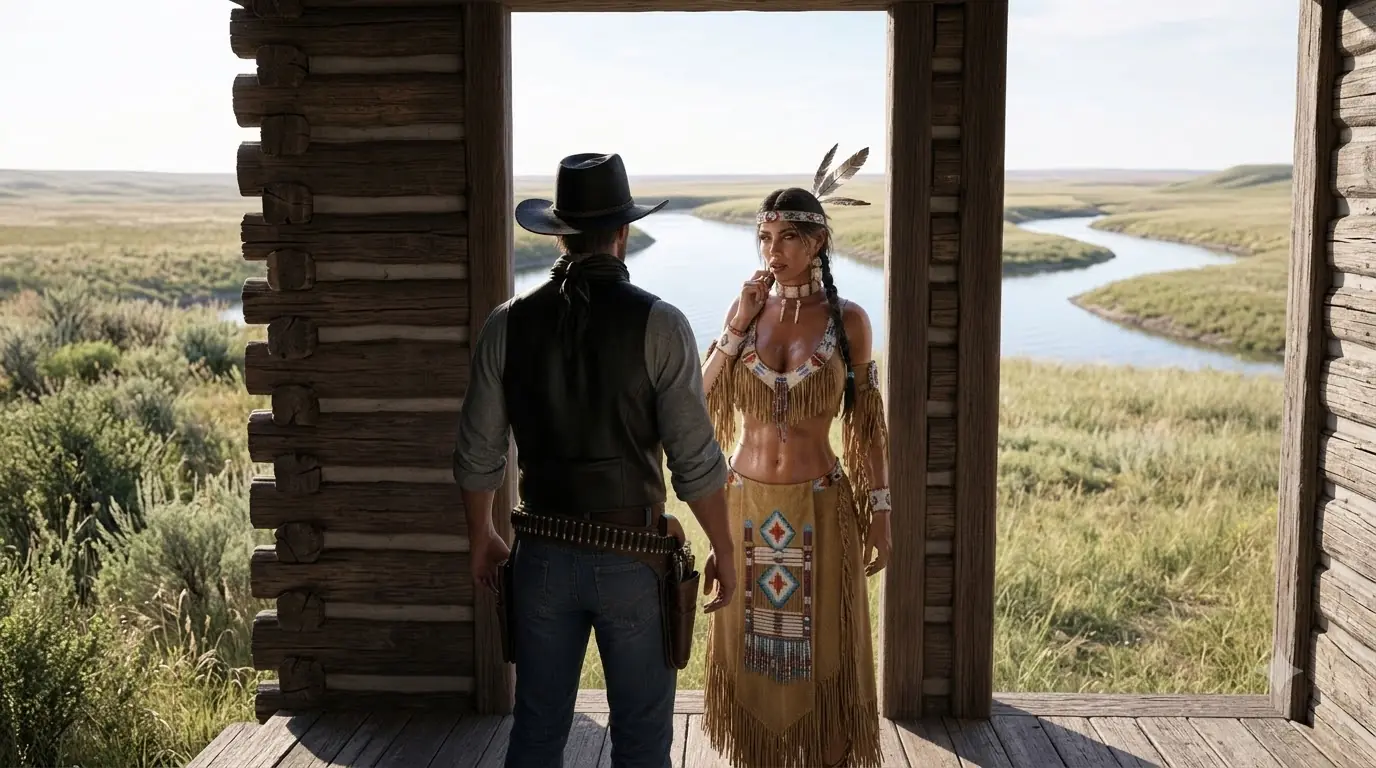
Break ice from a trough angry.
Ride the northern boundary angry.
Sit alone at his kitchen table after midnight staring at the empty chair across from him angry.
Missing her was different.
Missing her required admitting that an Apache woman he had known for less than a season had somehow entered the quiet spaces of his ranch so completely that the silence after she disappeared felt altered.
Not emptier exactly.
Sharper.
He had lived alone before she came.
He knew how an empty house sounded.
Floorboards settling after sunset.
Wind slipping beneath the door.
A kettle beginning to tremble on the stove.
Horses shifting inside the stable.
Coyotes far beyond the cottonwoods.
He had never considered those sounds lonely.
They were simply the sounds of his life.
Then she arrived.
And after she left, every ordinary sound seemed to point toward something absent.
He blamed her for that too.
It was easier.
The deed had vanished the same morning she did.
That was what made the anger useful.
The deed was not just another paper.
It was the oldest surviving record tying his family to the northern pasture and the spring below the limestone ridge.
Without it, the cowboy still had a ranch.
Technically.
He had a house.
Two barns.
A corral.
Nearly four hundred acres of rough Arizona Territory land.
Thirty-eight cattle.
Seven horses.
A half-finished new fence.
One wagon that leaned slightly left.
Three months of feed he had not fully paid for.
And a mortgage note that became more unpleasant every time he unfolded it.
But without the deed, the northern pasture could be challenged.
And without the northern spring, everything else became temporary.
His late mother had spent half her life warning him about water.
“Men will fight over land,” she once told him. “But they will lie for water.”
At fourteen, he had laughed.
At thirty-two, he understood.
Three different land brokers had approached him in two years.
The first offered to purchase the spring outright.
The second claimed an old easement allowed neighboring cattle access.
The third arrived with a survey map showing a boundary line nearly sixty yards south of where the cowboy had always understood it to be.