New York City, September 1841.
A printer walked into an office in lower Manhattan to collect money he believed he was owed.
He never walked back out.
For days, his family had no body.
No murder weapon.
No confession.
No obvious crime scene.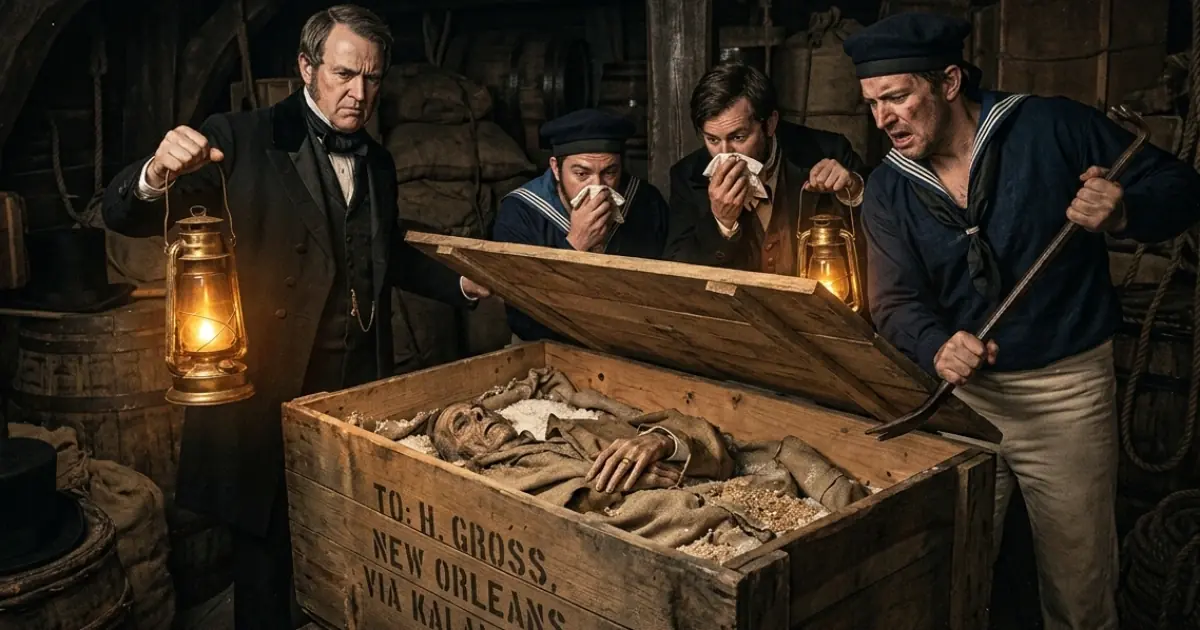
There was only an empty place at home, a growing list of questions, and one troubling fact.
Samuel Adams had told people where he was going.
He was going to see John C. Colt.
Then, the morning after Adams vanished, a wagon driver was stopped outside Colt's office.
Colt had a job for him.
There was a large wooden crate at the bottom of the stairs.
It was heavy.
Dirty.
Awkward to move.
On the outside was an address connected to New Orleans.
The driver did not ask what was inside.
Why would he?
New York's waterfront handled thousands of packages.
Boxes.
Barrels.
Trunks.
Merchandise.
Books.
Tools.
Food.
Personal belongings.
A wooden shipping crate attracted no attention simply because it was heavy.
The driver helped move it onto his wagon.
Then he carried it through Manhattan toward the East River.
At the foot of Maiden Lane waited a vessel called the Kalamazoo.
The crate was loaded aboard.
It went down into the cargo hold.
And if everything had happened according to plan, the Kalamazoo would have carried it south.
New York would have been behind it.
The ocean would have been beneath it.
New Orleans would have been ahead.
Whatever secret was inside that box might have become someone else's mystery hundreds of miles away.
But the weather changed everything.
The ship did not leave.
Rain and bad conditions kept the Kalamazoo at its berth.
One day passed.
Then another.
And another.
The crate remained below deck.
So did what John Colt had hidden inside it.
By the following week, the crew could smell something.
At first, the odor could be explained away.
Cargo spoiled.
Rats died in ships.
Water collected where it should not.
Nineteenth-century docks were filled with smells far worse than anything most modern New Yorkers would tolerate.
But this odor did not disappear.
It became stronger.
The crew traced it through the hold.
Eventually it led them to the wooden crate.
The same crate John Colt had been so eager to send to New Orleans.
When it was opened, the disappearance of Samuel Adams stopped being a missing-person case.
Inside was a human body.
Badly decomposed.
Partly stripped.
Compressed into the box.
Wrapped in canvas.
Salt and other material had been packed around it.
The head had been violently injured.
The person responsible had apparently taken steps to make identification difficult.
But not every identifying detail had been removed.
There was still a gold ring.
And there was a distinctive scar on one leg.
Those small details would give the dead man his name back.
Samuel Adams.
The printer who had walked into John Colt's office to collect a debt.
The man New York had been searching for.
The man who had never come home.
And once investigators knew where the crate had come from, the entire mystery began to reverse itself.
Not from the murder forward.
From the box backward.
Who hired the wagon?
Where was the box picked up?
Who had access to the office?
Who was Samuel Adams going to see?
Who had heard anything strange that afternoon?
And what had happened inside the second-floor room at Broadway and Chambers Street?
The answers would turn John C. Colt into one of the most notorious defendants in 1840s New York.
But the case did not begin with Colt.
It began with a printer trying to collect his money.
Samuel Adams
Samuel Adams was not the famous Revolutionary-era statesman.
This Samuel Adams was a New York printer.
Around thirty years old.
A working businessman in a city where printing was rapidly becoming one of the engines of public life.
Newspapers competed aggressively.
Pamphlets appeared constantly.
Books, commercial documents and instructional manuals needed to be printed.
One of Adams's customers was John Caldwell Colt.
Colt had produced a bookkeeping text.
Adams printed material for him.
And by September 1841, money remained in dispute.
Exactly how much was truly owed became tangled in competing accounts.
Historian Harold Schechter, writing about the case for The Yale Review, notes that Adams was demanding $71.15 while Colt calculated that he owed $55.85.
Other later retellings describe the disputed difference differently.
What is certain is that the quarrel began over a printing bill.
An ordinary business debt.
Nothing about it suggested that within days newspapers would be discussing a corpse packed inside a shipping crate.
On Friday, September 17, Adams left his printing business.
He was going to see Colt.
Colt maintained an office in a granite building at the corner of Broadway and Chambers Street.
Today, that part of Manhattan is surrounded by courthouses, government buildings, traffic and tourists.
In 1841 it belonged to a city being transformed.
New York's population had grown rapidly.
Commerce moved through its harbor.
Horse-drawn wagons filled its streets.
The waterfront connected Manhattan to the rest of the nation.
An office near Broadway could be only minutes away from ships capable of carrying cargo hundreds or thousands of miles.
That geographic fact would later become central to the crime.
Colt did not need to bury someone in the countryside.
He had the largest port in the country close by.
A box could disappear into a ship's hold.
And a ship could disappear over the horizon.
Adams climbed the stairs.
Entered Colt's office.
Sometime between three and four in the afternoon, voices rose.
In the neighboring office was another bookkeeping instructor named Asa Wheeler.
Wheeler would become one of the most important witnesses in the entire investigation.
He heard unusual sounds coming through the wall.
Not ordinary conversation.
He later compared part of what he heard to the clashing of weapons.
Then came a heavy impact.
A thud.
Something like a man being thrown down.
The room next door became quiet.
Wheeler did not yet know that a man may have just died only a few feet away from him.
John C. Colt
John Caldwell Colt was about thirty-one years old.
He came from a family whose name would soon become famous for a completely different reason.
His younger brother was Samuel Colt.
Samuel was working to establish the firearms business that would eventually turn the Colt name into one of the most recognizable names in American weapons manufacturing.
John's own ambitions centered on business and bookkeeping.
He taught bookkeeping and penmanship.
He had written and published instructional material.
He had moved through different occupations and ventures.
He was educated enough to produce a bookkeeping text and confident enough to promote himself as an instructor.
Nothing about that résumé naturally suggested homicide.
That contrast later fascinated the newspapers.
The crime did not happen in an alley.
It happened in an office.
The accused was not portrayed as some anonymous street criminal.
He was a professional man with family connections, ambitions and a recognizable surname.
And according to Colt's later explanation, Samuel Adams's death had not been planned.
Colt said the two men argued about the printing bill.
Words became insults.
Insults became physical confrontation.
Adams, according to Colt, attacked him.
Colt claimed Adams pushed him and grabbed him around the neck, twisting his neckcloth so tightly that he struggled to breathe.
He reached for an object on the desk.
Colt described it as the object he used to defend himself.
It was a heavy implement combining an ax-like blade and hammer.
He struck Adams in the head repeatedly.
Adams fell.
He did not get back up.