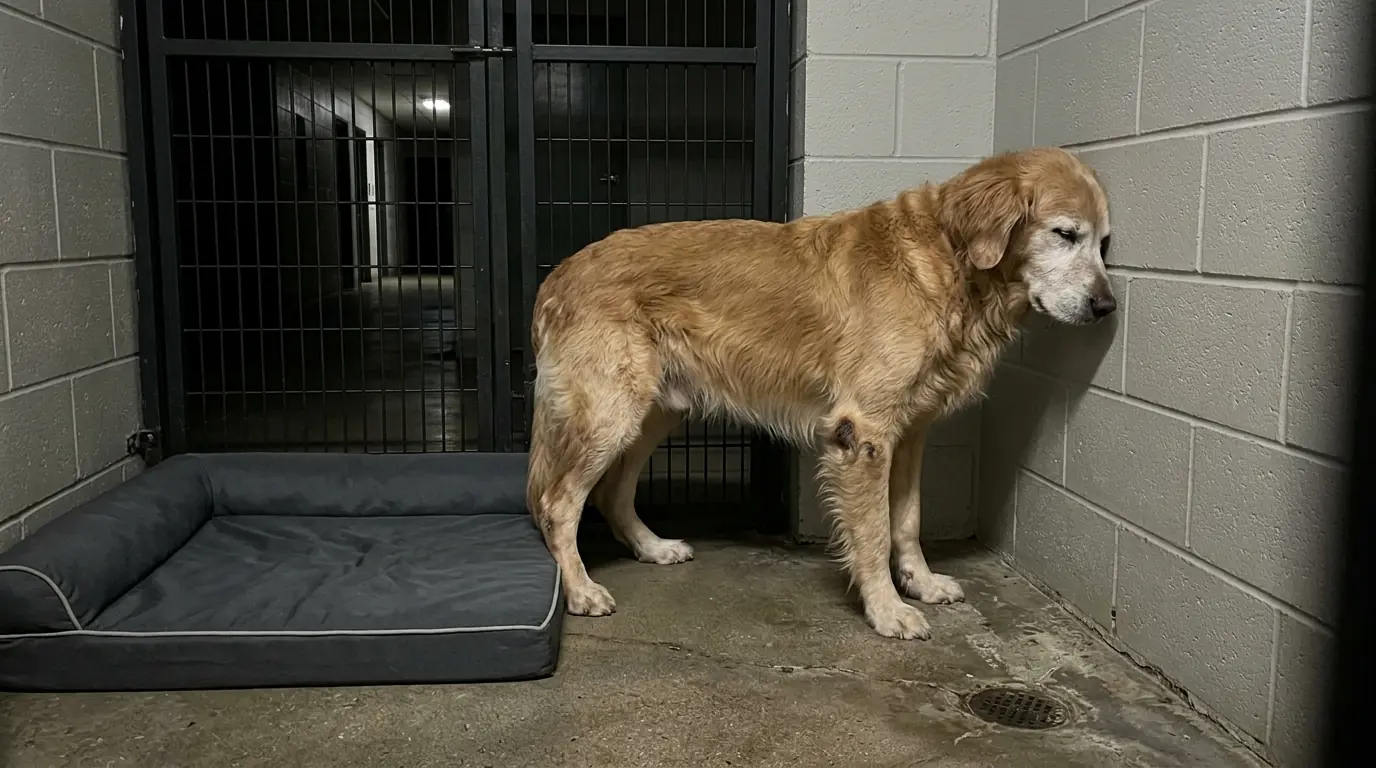
Henry has an orthopedic bed large enough for his entire body.
It is thick.
Padded.
Positioned away from the coldest part of the kennel floor.
For an eleven-year-old Golden Retriever with severe arthritis, it should be the easiest place in the room to sleep.
But when night comes, Henry walks past it.
Slowly.
One stiff step at a time.
He goes to the same corner of the kennel.
Turns toward the wall.
Then lowers his forehead until it rests against it.
Henry remains standing.
His eyes close.
Minutes pass.
Eventually, his hind legs begin to tremble.
His hips sink.
His paws slide slightly.
Still, Henry does not deliberately lie down.
He stays asleep against the wall until his aging legs can no longer support him.
Then his body slowly slides toward the floor.
And the next night, he does it again.
Henry Arrived With a Body That Had Been Resting Hard for a Long Time
Henry was already showing significant physical wear when he entered the shelter.
His joints were stiff.
Getting up was difficult.
Turning required several small steps instead of one smooth movement.
Veterinary evaluation identified severe arthritis.
There was something else too.
Along one side of Henry's body were unusually thickened, callused areas.
Pressure changes can develop when parts of a dog's body repeatedly contact firm surfaces.
They cannot reveal Henry's exact history.
They cannot prove where he slept or how he was kept.
But combined with his unusual nighttime posture, they raise questions that nobody can answer yet.
During the Day, Henry Will Use the Bed
That makes his nighttime behavior even stranger.
Henry knows the orthopedic mattress is there.
He can step onto it.
Sometimes he rests on it during the afternoon.
He may place his front half down first, hesitate, and then carefully lower his hips.
Once settled, he can remain there for quite a while.
So this is not simply a dog who does not understand what a bed is.
At night, something changes.
He Always Chooses the Same Corner
Not just any wall.
Not beside the kennel door.
Not beside his water.
Henry returns to one particular corner.
He approaches it slowly.
Then positions his front paws almost exactly where they were the night before.
His nose points toward the wall.
His forehead touches it.
And he stops.
At First, It Doesn't Look Like He Is Going to Sleep
He appears to be standing quietly.
Then his eyelids become heavy.
His head remains supported by the wall.
His neck relaxes.
His breathing becomes slower.
Henry is not merely pausing.
He is falling asleep on his feet.
His Forehead Becomes a Third Point of Support
For a dog with painful joints, changing position can require significant effort.
Standing uses one set of muscles and joints.
Lowering the body requires another complicated sequence.