Clara Whitmore understood exactly what her father intended before he ever opened his mouth.
She knew because Ephraim Whitmore had begun looking at the world differently after her mother died.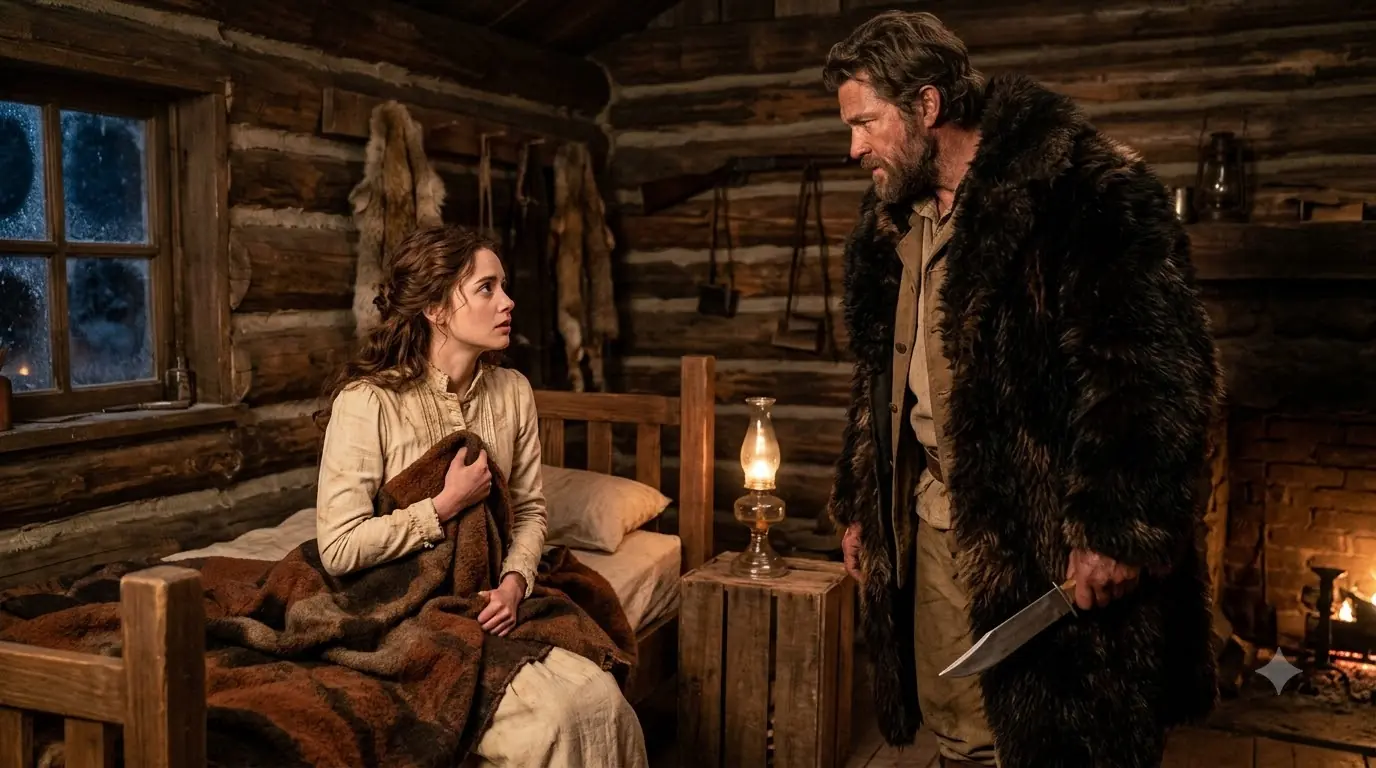
Before cholera carried away Eliza Whitmore and both of Clara’s younger brothers, Ephraim had been a difficult man, but not a cruel one. He laughed rarely, worked hard when there was work to be had, and could spend an entire evening repairing a harness buckle merely because he hated throwing anything away.
After the graves were filled, something inside him hardened.
Then whiskey found the cracks.
By the time Clara was twenty-four, her father no longer looked at a sack of flour and saw bread.
He saw how many days it would keep him alive.
He no longer looked at a blanket and saw warmth.
He saw what he could trade it for.
A horse was weight.
A rifle was money.
A neighbor was an obligation.
A daughter was labor.
And on the afternoon he decided to exchange Clara for winter provisions, she watched him calculate her value in silence.
They were inside Harlan’s trading post at the far edge of a small Wyoming settlement tucked beneath mountains already buried in early snow.
The settlement did not have a proper name on most maps.
People called it Harlan’s Crossing because Harlan Pike’s trading post, livery shed, and blacksmith lean-to had been there before almost everything else.
The wind rattled the shutters.
Snow pressed against the lower window panes.
Clara sat on an overturned flour barrel near the iron stove.
Her borrowed brown wool shawl did little against the cold.
Her shoes were split at both sides and held together with twine.
She had eaten watery potato broth that morning.
Nothing since.
Keeping her hands folded calmly in her lap required effort because they had begun to tremble.
Not from fear.
From hunger.
Across the counter, Harlan Pike examined his ledger.
He was fifty-three, square-faced, gray-bearded, and unusually honest for a man who extended credit to desperate people.
He ran one finger down the page.
Then stopped.
“Forty dollars and eleven cents.”
Ephraim Whitmore stared at the counter.
“I know.”
“You said that last month.”
“I know.”
“And the month before.”
Ephraim’s cheeks were hollow.
His coat was patched badly at one shoulder.
He smelled faintly of whiskey despite the hour.
Harlan closed the ledger.
“I can carry five dollars until spring.”
“No more.”
“I need flour.”
“You need money.”
“Salt meat.”
“No.”
“Coffee.”
“No.”
Ephraim’s jaw tightened.
“Three blankets.”
Harlan gave him a long look.
“You have two blankets already.”
“One’s ruined.”
“Then sleep under the other.”
Clara looked toward the stove.
She did not want Harlan to see her expression.
Ephraim placed both hands on the counter.
“Winter came six weeks early.”
“It came early for everybody.”
“My traps are empty.”
“Then bring furs when they’re full.”
“What are we supposed to eat until then?”
Harlan’s expression changed slightly.
He glanced toward Clara.
That was when Ephraim did too.
And Clara understood.
The look lasted only a second.
It still felt longer than the winter outside.
She straightened on the barrel.
Her father looked away.
“Ephraim.”
Harlan’s voice had changed.
“Don’t.”
Ephraim swallowed.
“I haven’t said anything.”
“I know you long enough to know when I don’t want you to.”
The front door burst open before Ephraim could answer.
Wind hurled snow across the floor.
A large man stepped through.
He had to duck beneath the frame.
Silas Rourke filled the doorway in a black-and-brown bearskin coat that made his already broad shoulders look enormous.
Snow clung to thick dark hair.
His beard was nearly black except for several copper-colored strands near the chin.
A scar ran diagonally from the upper edge of his left cheek toward the jaw.
His steel-gray eyes swept the room once.
Clara had heard those eyes described in every frightening story told about him.
Some said Silas had killed a man in Cheyenne.
Some said three.
Mrs. Avery swore he had once broken a trapper’s wrist with one hand after catching the man stealing pelts.
The butcher claimed Silas had fought a mountain lion.
The blacksmith said it had been a half-starved wolf and Silas had simply scared it away.
The stories changed.
The man did not.
Silas Rourke lived alone above the tree line where even experienced hunters rarely stayed through the deepest part of winter.
He came down several times each year.
Bought salt.
Coffee.
Ammunition.
Lamp oil.
Needles.
Nails.
Sometimes a book.
Then disappeared.
He spoke little.
Never drank in the saloon.