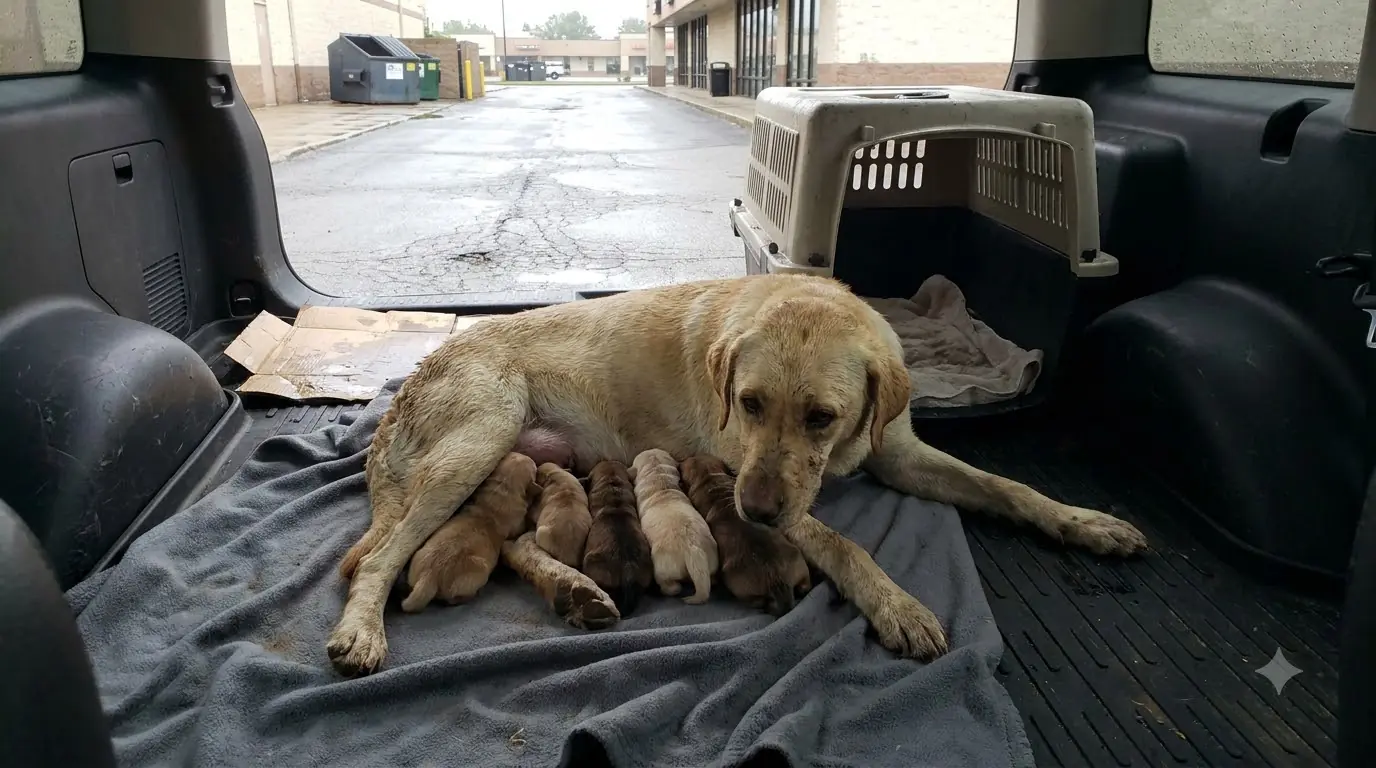
The puppies were already in the carrier.
That was what made the mother's behavior so difficult to watch.
The rescue team had reached the loading area behind a strip mall after someone reported a dog with very young puppies sheltering near the back of the businesses.
The location was exposed.
Delivery trucks moved through the area.
Metal doors opened directly onto the loading dock.
Rainwater ran along the pavement.
There was very little that could reasonably be called shelter.
The mother Lab mix had found one thing.
A cardboard box.
It had probably once been sturdy enough to hold shipped goods.
By the time rescuers saw it, the bottom was collapsing.
Rain had soaked the cardboard until the walls sagged outward. One side had torn near the base. Damp paper clung to the concrete.
Inside were puppies.
The mother had given birth there.
When rescuers began transferring the puppies one by one into a clean, warm carrier lined with dry towels, she stayed close enough to watch.
She did not charge at them.
She did not flee.
But her body remained tense.
She was thin beneath her coat.
Her abdomen hung low from pregnancy and nursing.
And when she moved, staff noticed a slight limp that made one side of her gait shorter than the other.
The last puppy went into the carrier.
The door closed.
All of them were safe.
The mother looked inside.
Then she turned around.
And walked back to the empty cardboard box.
She lowered her nose into it.
Sniffed the wet bottom.
Moved toward the collapsed corner.
Then returned to the area where the puppies had been lying.
A rescuer called softly from several feet away.
The mother looked up.
Then put her nose back into the empty box.
They brought the carrier closer.
She inspected it.
Then returned to the box again.
It happened several times.
The puppies had already left.
Their mother kept checking the place where they had been.
Only when rescuers moved the carrier to the open rescue vehicle and the puppies began vocalizing from inside did the Lab mix finally turn away from the cardboard.
She listened.
Her head lifted.
Then she limped toward the sound.
The Box Had Become the Center of Her World
There was almost nothing protective about it anymore.
The cardboard had absorbed so much water that parts of the bottom flexed under even light pressure.
The puppies had been lying on damp material.
A dry corner barely remained near one side.
Yet the mother had continued using it.
That did not mean she had selected an ideal nesting site.
Dogs raising litters outside use what is available.
A protected recess.
A crawlspace.
A pile of material.
An abandoned structure.
In this case, a discarded shipping box beside a loading dock had apparently become the place where she delivered and kept the litter.
How long she had been there could not be determined precisely.
Witness information helped establish that the dog had been seen around the commercial property, but the rescue did not create a specific timeline without evidence.
They could document what was present when they arrived.
A nursing mother.
A litter of young puppies.
A badly water-damaged box.
And a dog who was reluctant to leave it even after the puppies were no longer inside.
Staff Did Not Assume She Understood the Carrier
To a human, the clean carrier was obviously safer.
Dry towels.
Secure walls.
No vehicle traffic passing nearby.
No rain entering from above.
To the dog, it was an unfamiliar object handled by unfamiliar people.
The cardboard box was known.
It smelled like her.
It smelled like the puppies.
It was the place where she had repeatedly returned to nurse, clean, and rest with them.
The rescue team understood that difference.
They did not drag her away from it.
They did not assume that showing her the puppies once would immediately convince her to abandon the nesting site.
They gave her time.
The Puppies Came Out First
This was deliberate.
The litter needed immediate protection from the environment.
Young puppies cannot regulate body temperature as effectively as adult dogs.
Wet bedding can rapidly become a problem.
The loading area also introduced obvious risks unrelated to weather.
Vehicles.
Equipment.
Foot traffic.
Noise.
Potential contaminants on the ground.
So rescuers prioritized moving the puppies into dry containment while keeping the mother close enough to observe.
Each puppy was handled briefly.
Transferred.
Counted.
Checked visually for immediate concerns.
Then placed with littermates in the carrier.
Nobody separated them into different vehicles.
Nobody carried them away where the mother could no longer smell or hear them.
The goal was to move the family together.
The mother simply did not seem ready to trust the next step.
She Kept Returning to the Smell
Once the box was empty, staff watched her repeat a very specific route.
Carrier.
Box.
Carrier.
Box.
She sniffed the opening of the carrier.
Then walked several feet back.
Her nose entered the damp cardboard.
She investigated the folds where puppies had been pressed together.
At one point, she pawed lightly at a collapsed flap.
Then sniffed again.
There was no reason to describe the behavior as her “thinking the puppies had disappeared.”
No one could know exactly how she was processing the situation.
What staff could see was enough.
The familiar nest continued drawing her attention even though the litter had been physically moved within sight.
The Puppies Eventually Changed Her Direction
When the carrier was carried toward the rescue vehicle, the mother watched.
She did not follow immediately.
Instead, she returned to the box one more time.
The carrier was placed near the open vehicle door.
Several puppies began making the high, irregular sounds young litters make when disturbed or repositioned.
The mother's posture changed.
Her head came up sharply.
Her ears oriented toward the sound.
She looked away from the box.
Then she walked toward the carrier.
The limp was more obvious now that rescuers could see her crossing open pavement.
She approached.
Sniffed through the carrier door.
One puppy pushed its nose toward the front.
The mother remained there.
When the carrier was lifted into the vehicle, she followed.
Getting Her Into the Vehicle Required Patience
The step up was not particularly high for a healthy adult Lab mix.
For this dog, it was enough to reveal another concern.
She placed her front paws inside.
Her hindquarters hesitated.
The side she had been favoring did not push normally.
A rescuer supported her carefully without grabbing at the painful limb.
She was helped into the vehicle.
Once inside, she immediately moved toward the carrier.
She sniffed.
Circled.
Then lowered herself beside it.
For the first time since the puppies had left the cardboard box, she stopped trying to return to the loading dock.
The Box Stayed Behind
The rescue documented it.
They did not bring the soaked cardboard into the vehicle.
The material was wet, dirty, and beginning to break apart.
There was no medical or behavioral benefit to preserving it physically.
What mattered was what it had already shown them.
The litter had been living in an unsuitable outdoor nesting site.
The mother had organized her behavior around that site strongly enough that moving the puppies did not immediately make her leave it.
That information would shape the way the rescue handled her next transition.
The Veterinary Team Evaluated Mother and Puppies Separately
The mother was a nursing adult with poor body condition and an abnormal gait.
The puppies were neonates or young enough to require age-specific assessment.
Those are different medical problems.
The rescue did not treat the family as a single patient.
Each puppy was weighed.
Body temperature and hydration were assessed as appropriate.
The umbilical areas were checked if they were still young enough for that to be relevant.
Puppies were examined for congenital abnormalities, injury, respiratory concerns, diarrhea, dehydration, and their ability to nurse.
Weights would continue to be tracked because a puppy that looks normal can still fail to gain appropriately.
The mother received her own examination.
Her Thin Body Needed Attention
Nursing can place enormous nutritional demands on a dog.
A mother feeding multiple puppies may need substantially more calories than a typical adult.
If food access is inconsistent, body reserves disappear quickly.
The Lab mix was underweight.
Her ribs were easier to feel than they should have been.
Muscle over the back and hindquarters was reduced.
Her abdomen still reflected recent pregnancy.
Mammary glands were enlarged from active nursing.
The rescue assessed her body condition rather than assigning a dramatic starvation diagnosis from appearance alone.
She needed nutritional rehabilitation.
But she also needed to continue supporting a litter.
That meant the feeding plan had to serve both.
She Was Offered Food Before Anyone Expected Affection
The mother remained cautious in the medical intake environment.
Staff did not crowd her.
A bowl was placed nearby.
She sniffed.
Looked toward the puppy enclosure.
Then ate.
That was useful.
Her appetite was present.
Meals were nutritionally complete and energy-dense enough to support lactation and gradual restoration of body condition.
Portions could be divided across the day.
Water remained continuously available.
Weight was tracked.
Stool was monitored.
The goal was not rapid cosmetic weight gain.
It was enough nutrition to heal and nurse without overloading her digestive system.
The Limp Needed Its Own Examination
The rescue had first noticed it behind the strip mall.
Now, on a clean nonslip floor, the gait could be observed more carefully.
The Lab mix shortened the stride on one side.
She still used the limb.
She was not completely non-weight-bearing.
That made several possibilities plausible.
Soft-tissue strain.
Joint pain.
An older injury.
A paw problem.
Less likely but still possible, a bone injury depending on examination findings.
The veterinary team palpated the limb and surrounding joints.
They checked the paw and nails.
Range of motion was assessed.
If the examination justified imaging, radiographs were used.
The rescue did not automatically turn every limp into a fracture.
The Injury Appeared More Consistent With Something Older
There was no fresh open wound.
No dramatic instability.
The stiffness and pattern suggested that the problem may have preceded the rescue rather than occurring at the loading dock.
But exact timing could not be known.
The team managed the dog in front of them.
Pain control when appropriate.
Restricted unnecessary activity.
Good traction.
Further diagnostics based on clinical findings.
Surgery was not assumed.
A nursing mother already depleted from raising puppies did not need an invasive treatment unless there was a clear medical reason for it.
Her Mammary Health Needed Monitoring
The litter still depended on her.
That did not mean unlimited nursing should occur without observation.
An underweight mother can become further depleted.
Mammary glands can develop inflammation or infection.
Staff checked for heat, redness, painful swelling, abnormal discharge, or areas that puppies were not emptying adequately.
The mother's temperature and overall behavior mattered too.
If she stopped eating, became lethargic, or appeared increasingly painful, the plan would need reassessment.
The rescue did not romanticize a thin dog continuing to feed puppies at her own expense.
She received support.
The First Indoor Nest Was Deliberately Simple
The rescue used a secure maternity setup.
Dry bedding.
Low enough entry for the mother to step in without aggravating the limp.
Enough room for her to lie comfortably without crushing puppies against the sides.
Heat support for the puppies only as appropriate and arranged so they could move away from excessive warmth.
The environment was quieter than the general kennel row.
The carrier was placed near the pen during the transition.
The mother was allowed to investigate.
Then the puppies were moved into the clean nesting area.
She Went Back to the Carrier
Staff expected that possibility.
The carrier smelled like the puppies.
For the first few hours, the mother repeatedly checked it even after the litter was in the maternity pen.
She would nurse.
Stand.
Walk to the carrier.
Sniff.
Then return.
That behavior echoed what had happened with the cardboard box.
The dog appeared to use scent-heavy objects and locations as part of keeping track of the litter.
Staff did not remove every familiar smell immediately.
Instead, the transition was gradual.
They Did Not Put the Wet Box Back
This distinction mattered.
Respecting familiar scent does not require preserving an unsafe object.
A towel from the transport carrier could remain temporarily.
The cardboard could not.
It was soaked.
Potentially contaminated.
Structurally unstable.
Once the family had been removed from the loading dock, it had no role in recovery.
The rescue preserved familiarity in safer ways.
She Slept With Her Head Facing the Puppies
During the first night, the mother rarely seemed to enter deep rest for long.
She lay with the litter.
Then repositioned.
Raised her head when a puppy vocalized.
Sniffed.
Sometimes left the pen briefly to drink or eat.
Then returned.
That was expected behavior for a mother adapting to a new nesting environment.
Staff kept handling minimal.
There was no reason to repeatedly remove puppies for photographs or unnecessary checks.
Weights and medical assessments were important.
Constant disruption was not.
The Puppies Were Not All the Same
That became clear quickly.
One was more assertive when nursing.
Another was smaller.
One tended to sleep toward the edge of the group.
Weights gave staff objective information.
If a puppy failed to gain adequately, supplemental feeding could be introduced according to veterinary guidance.
The rescue would not rely on the mother's devotion alone.
Her body was already underweight.
She needed help carrying the nutritional burden.
The Smaller Puppy Needed Extra Monitoring
Rather than immediately declaring a crisis, staff tracked the trend.
A single lower weight does not automatically mean failure.
What matters is whether the puppy nurses effectively, remains warm, stays hydrated, and gains appropriately over time.
The smaller puppy was given additional opportunities at a productive mammary gland and monitored closely.
If supplementation became necessary, it could be introduced carefully without abruptly removing the puppy from maternal nursing.
The goal was to support normal development, not replace the mother unless medically necessary.
The Mother Began Leaving the Pen for Short Periods
At first, every puppy sound brought her back immediately.
Over time, she started taking slightly longer breaks.
She would step out.
Eat.
Drink.
Stand nearby.
Sometimes lie on a separate mat while the litter slept.
That was healthy.
Maternal recovery requires rest away from nursing too.
The rescue did not reward constant hypervigilance.
They created conditions where she could trust that the litter remained safe without her body covering them every second.
Her Limp Improved Some With Rest
That gave the medical team more information.
Once she was no longer walking around a loading dock and navigating wet pavement, her gait became somewhat easier.
She still favored the limb.
But the degree varied.
That pattern was compatible with chronic joint or soft-tissue discomfort that worsened with overuse.
A nonslip environment helped.
So did minimizing unnecessary distance.
The maternity setup placed food and water close enough that she did not need repeated long walks.
The Mother Still Checked Empty Places
For several days, caregivers noticed that if puppies were temporarily moved for weighing, she inspected the exact spot where they had been lying.
She sniffed.
Sometimes pawed the bedding.
Then oriented toward wherever the puppies had gone.
This was not identical to returning to the cardboard box.
But it helped staff understand that her first rescue-day behavior was not necessarily about attachment to cardboard itself.
The location had been saturated with the litter's scent.
When that scent and the puppies suddenly separated, she checked both.
Her World Had Been Very Small
Behind the strip mall, the essential parts of her life may have been only a few feet apart.
The box.
The puppies.
Whatever food or water she could find.
A narrow area behind businesses.
In rescue care, the environment became much larger.
Doors.
People.
Medical equipment.
A maternity pen.
Outdoor breaks.
Different sleeping areas.
She needed time to learn which parts mattered.
Predictability helped.
She Did Not Become Affectionate Overnight
The Lab mix tolerated caregivers.
That was different from trusting them.
During early examinations, her body could become tense.
She watched hands.
She remained especially alert when puppies were handled.
Staff used low-stress techniques.
One person handled the puppies while another allowed the mother to observe.
Puppies were returned quickly.
Food was used when appropriate.
Nobody leaned over her unnecessarily.
Nobody hugged her.
Trust developed through repetition.
She Eventually Started Approaching Familiar Staff
The change was small.
At first, caregivers approached her.
Later, she began meeting them partway.
Especially when food was involved.
She sniffed hands.
Accepted treats.
Once, after the litter had been weighed and returned, she remained near the caregiver instead of immediately stepping between the person and the puppies.
That was useful behavioral progress.
No dramatic affection was needed.
The Cardboard Box Had Been a Nest, Not a Symbol
The rescue remained careful about how it told the story.
It would have been easy to say the dog loved the box because it was the only home she had ever known.
There was no evidence for that.
The box was a nesting location.
It contained the puppies' scent.
She had used it repeatedly.
When the puppies disappeared from it, she checked it.
That was enough.
The emotional power came from the contrast.
The litter was already safe.
The mother did not yet understand the new arrangement well enough to leave the old one.
Her Body Condition Improved Slowly
The rescue weighed her regularly.
The first gains were modest.
That was fine.
She was still lactating.
Calories were still leaving her body through milk production.
As the puppies matured and began transitioning toward appropriate puppy food, the pressure on her nutritional reserves could gradually decrease.
Her meals remained generous but controlled.
Muscle restoration would take longer.
The dog did not suddenly become robust after a week of regular meals.
The Puppies Opened Up the Next Stage of Recovery
As they grew, their needs changed.
They became more mobile.
Their coordination improved.
They began investigating outside the tight sleeping pile.
They started interacting with one another more.
Age-appropriate food was introduced when developmentally appropriate.
The mother still nursed.
But not every calorie had to come through her.
This mattered enormously for an underweight dog.
She Began Sleeping Away From Them
The first time, it lasted only a few minutes.
The puppies were asleep in the pen.
The Lab mix stepped out.
She drank.
Then lay on the mat immediately beside the entrance.
Her head remained pointed toward them.
But her body was separate.
Later, the distance increased.
A foot.
Several feet.
Still within the room.
Still able to respond.
That was a healthier pattern than a depleted mother believing, behaviorally or instinctively, that she had to remain physically attached to the litter constantly.
Her Gait Became More Predictable
The chronic limp did not disappear.
Some days were better.
After longer activity, the stiffness returned.
The rescue adjusted.
No long walks.
No unnecessary stairs.
No rough play while nursing.
Pain management was used according to veterinary guidance.
If imaging had shown degenerative change, that became part of her long-term plan.
If the problem was primarily soft tissue, controlled recovery could gradually improve it.
In either case, nobody promised a miracle.
The Puppies Eventually Stopped Crying Every Time She Left
That was another major change.
At first, separation sounds immediately drew her back.
Later, the puppies could remain occupied.
Eat.
Play.
Sleep.
The mother could leave the pen without a chorus following every movement.
Her body gained something valuable.
Time off.
She Stopped Checking the Carrier
It happened so gradually that nobody could identify the exact day.
The carrier remained in use for transport and examinations.
At some point, it stopped being something the mother investigated repeatedly.
It had become an ordinary object.
The same was true of the corner of the room where the puppies had first been placed.
Her behavior reorganized around the current environment.
The cardboard box was now far behind them.
Foster Care Became the Next Transition
When the family was stable enough, a foster home offered a quieter maternity space.
The transition was planned carefully.
Familiar bedding traveled with them.
The puppies stayed together.
The mother was not asked to enter a completely empty room and watch everyone disappear.
The foster setup included a low-sided pen, easy access to water, and nonslip flooring for her stiff leg.
She Checked the Transport Carrier Again
That was not surprising.
New place.
Familiar object.
The mother sniffed inside it several times.
Then followed the sound of the puppies into the maternity area.
This transition went faster than the first.
Experience mattered.
The dog had already learned once that puppies could move into a new enclosure and remain safe.
The Foster Started Seeing Her as an Individual Dog
Motherhood had dominated her entire rescue story.
As the litter became more independent, other behaviors emerged.
She liked lying in patches of sunlight.
She was interested in food preparation.
She preferred soft toys she could carry without much chewing.
She sometimes chose to rest alone.
She enjoyed slow sniffing in the yard.
She was cautious with sudden noises but recovered more quickly.
These details mattered.
Eventually, she would no longer be "the mother from the cardboard box."
She needed a life after the litter.
The Puppies Needed One Too
They were handled as individuals.
Different personalities emerged.
Different activity levels.
Different responses to people.
Veterinary care, vaccination schedules, deworming, socialization, and eventual placement planning were based on developmental needs.
The rescue did not keep them as an anonymous emotional cluster.
The mother's recovery included allowing them to become separate dogs.
Weaning Was Gradual
There was no abrupt day when the puppies were simply removed.
Nursing frequency decreased as appropriate.
The puppies ate more independently.
The mother's mammary glands were monitored.
Her food intake was adjusted gradually as lactation decreased.
That prevented unnecessary discomfort and supported her own weight restoration.
She began keeping more nutritional resources for herself.
Her body slowly changed.
Her Abdomen Started Looking Less Depleted
Loose skin remained.
That is normal after pregnancy and nursing.
Her mammary tissue reduced gradually.
Muscle over the hindquarters improved somewhat.
The ribs became less obvious.
She still looked like a dog who had recently raised a litter.
The rescue did not Photoshop that reality with words.
Postpartum recovery takes time.
The Old Limp Remained Part of Her Future
Whatever had happened before the strip mall, the leg needed consideration in placement.
An adopter would need to know about the history.
Weight management would matter.
Nonslip flooring might help.
If degenerative joint changes were present, long-term pain management and veterinary follow-up could be necessary.
The dog did not need to become perfectly symmetrical to have good quality of life.
She needed comfortable function.
She Became Comfortable Leaving the Puppies Entirely
As weaning progressed, she could spend longer periods in another area.
The puppies did not panic.
She did not constantly return to check every empty spot.
That change was especially meaningful when staff thought back to the loading dock.
The first day, she could not leave an empty box.
Now she could leave a whole room full of sleeping puppies and go rest somewhere else.
She Chose a Bed for Herself
The foster placed a low orthopedic bed in a quiet corner.
The Lab mix initially ignored it.
Then, one afternoon, she used it.
No puppies.
No carrier.
No box.
Just the mother stretched on her side.
Her breathing slow.
The stiff hind leg extended behind her.
She slept for nearly an hour without getting up to investigate the maternity pen.
That was one of the clearest signs that her body and behavior were finally beginning to belong to her again.
The Puppies Eventually Moved Into Their Own Developmental Space
By the time they were old enough and medically ready, the litter spent more time apart from their mother.
The transition was normal.
She could still interact appropriately.
But she was no longer responsible for every meal, every sound, every sleeping pile.
The rescue monitored her response.
She noticed when they moved.
She did not return repeatedly to the empty pen.
That behavior had changed.
Nobody Took Her Back to the Strip Mall
There was no reason.
The box was gone.
The loading dock had nothing to offer her.
Recovery was not improved by reenacting the place where she had been found.
The rescue had documentation.
The story could be told without making the animal revisit it.
Staff Still Remember Her Nose Inside the Empty Box
That is the image that stayed.
Puppies already secured.
Rain-softened cardboard sagging around her face.
The mother sniffing the bottom.
Checking one corner.
Looking toward the carrier.
Then returning again.
It was not dramatic in the way a chase or emergency procedure is dramatic.
It was repetitive.
That made it harder to watch.
She had survived long enough to get the litter to rescue.
The rescue had moved the puppies to safety.
Her behavior had not caught up yet.
The Sound of the Puppies Finally Pulled Her Forward
That remained the turning point.
Not a leash pulling her away.
Not someone lifting her.
Not a dramatic capture.
The puppies vocalized.
She stopped checking the box.
She turned.
Limped across the pavement.
Reached the carrier.
Then followed it into the vehicle.
That was the first time the family moved toward safety together.
Months Later, the Same Sound Means Something Different
The puppies are larger now.
Their voices are stronger.
Their world is much bigger than a cardboard box.
When they vocalize, the mother may look.
Sometimes she gets up.
Sometimes she does not.
That choice is one of the clearest measures of how much has changed.
She no longer needs to respond to every sound.
Her Story Did Not End When the Puppies Were Rescued
That would have been too simple.
The puppies needed medical monitoring.
The mother needed weight restoration.
Her limp needed assessment.
Trust needed time.
Weaning needed to happen gradually.
She needed to learn that a safe nest could remain safe even when she stepped away from it.
Those were the parts of rescue that came after the dramatic photograph.
The Empty Spaces Stopped Pulling Her Back
First the cardboard box.
Then the transport carrier.
Then the maternity pen.
Each had temporarily held the puppies.
At first, she checked empty places repeatedly.
Later, she followed the living animals instead of the scent they had left behind.
Eventually, she did not need to follow them constantly either.
That progression mattered.
Recently, the Puppies Were Moved for a Routine Check
The foster room became unusually quiet.
Months earlier, that kind of sudden absence might have sent the mother searching.
This time, the Lab mix lifted her head from her bed.
She looked toward the doorway.
Listened.
Then lowered her head again.
Several minutes later, the puppies returned.
They entered noisily.
The mother stood.
Sniffed them.
One puppy tried to climb against her shoulder.
She stepped away.
Then walked back to her own bed.
The puppies turned toward something else.
She No Longer Checks Every Place They Used to Be
That is perhaps the strongest difference between the dog behind the strip mall and the dog she is becoming now.
On rescue day, the puppies left a ruined cardboard box.
Their mother kept going back to the empty space.
The carrier was safe.
The vehicle was waiting.
She still needed the familiar nest.
Now she can watch her puppies leave a room and remain where she is.
Her litter is no longer dependent on her body every minute.
Her own body is stronger.
Her leg still carries an old stiffness.
Her abdomen still shows evidence of motherhood.
But she has learned a new routine.
She Has a Bed That Does Not Collapse in the Rain
It is low enough for the stiff leg.
Dry.
Washable.
Supportive.
Sometimes she sleeps curled.
Sometimes stretched.
And sometimes, when the puppies are making noise somewhere else in the house, she does something rescuers could not imagine on the day they found her.
Nothing.
She keeps sleeping.
The Cardboard Box Was Once the Place She Refused to Leave
That fact remains true.
It was soaked.
Soft enough to collapse.
Beside a loading dock.
The puppies had been born there.
When rescuers carried them away, the mother went back.
Again.
And again.
Her nose searched the empty bottom for what had just been removed.
Nobody knows exactly what she understood in those minutes.
No one needs to.
The behavior spoke for itself.
Now the Puppies Can Leave First
They can move into another room.
Go for individual handling.
Eat without her.
Sleep without her.
The mother may watch.
But she does not have to follow every time.
That is what recovery has slowly given back to her.
Not distance from her puppies.
Freedom from the need to keep them within reach every second.
And the Ending Looks Nothing Like the Loading Dock
There is no wet cardboard.
No commercial pavement.
No carrier waiting beside an open rescue vehicle.
No underweight mother limping between her puppies and the place where they were born.
There is a quiet foster room.
A low bed.
The Lab mix asleep on it.
The puppies elsewhere, old enough to be busy with their own lives.
Every so often, one of them makes a sound.
Her ears move.
Sometimes her eyes open.
Then close again.
The dog who once could not make herself leave an empty cardboard box after her puppies were already safe no longer needs to search the places they used to be.
She knows how to rest while they are somewhere else.
And for the first time since rescuers found her behind that strip mall, the empty space beside her is allowed to stay empty.