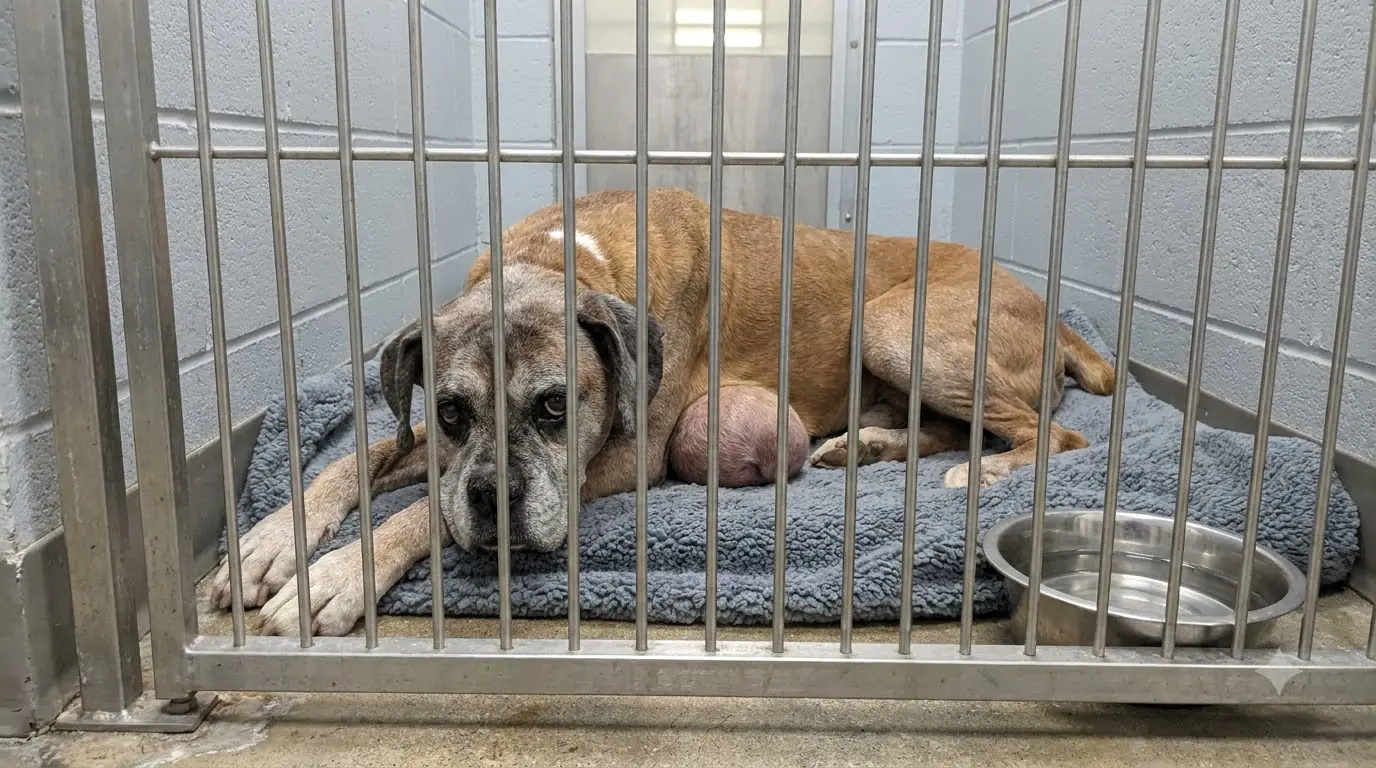
By the time someone reaches his medical kennel, the senior Boxer usually does not lift his head.
He cannot afford to.
Most of his day is spent lying on a thick padded bed with his chest supported and his front legs stretched beneath him.
There is a large mass visible along his chest.
His muzzle has gone gray.
His body is thinner than it once was.
And even while resting, his breathing is something the veterinary team watches closely.
Standing has become difficult.
Walking is harder.
A few steps can leave him exhausted enough that he needs several minutes to settle again.
So when someone stops at his kennel door, there is no longer a dog getting up to greet them.
No paws against the bars.
No walking forward.
Sometimes he does not even move his head.
Instead, his eyes lift.
They find the person standing outside.
Then something happens behind him.
Tap.
Pause.
Tap.
His tail moves against the mattress.
Usually only a few times.
Sometimes the movement is so small that a person who does not know him could miss it.
Then the tail becomes still again.
His head never leaves his front paws.
The person comes closer.
And the old Boxer watches.
Staff First Noticed the Tail Because Everything Else Had Become So Quiet
Earlier in his stay, he could still stand when someone approached.
Slowly.
Carefully.
But he could do it.
He would push through his front legs, gather his hindquarters beneath him, and remain upright long enough to sniff a caregiver's hand.
That changed as his condition progressed.
His endurance shortened.
The distance he could comfortably walk became smaller.
Eventually, staff stopped expecting him to come to the kennel door.
They came to him instead.
That was when the tail movement became impossible not to notice.
His body had lost most of the larger greetings.
The smallest one remained.
His Heart Disease Was Advanced
The Boxer had a diagnosed cardiac condition that required ongoing veterinary management.
In an older dog, advanced heart disease can affect nearly every part of daily life.
Exercise tolerance.
Breathing.
Sleep.
Appetite.
Ability to recover after activity.
Comfortable body position.
Even excitement has to be considered differently when the heart can no longer respond normally to increased demand.
The shelter medical team monitored him accordingly.
They were not trying to make him more active.
They were trying to understand how much activity his body could still tolerate without distress.
Breathing Was One of the Most Important Measures
Staff learned what his normal resting pattern looked like.
They watched his respiratory rate while he was truly relaxed.
They watched the amount of effort required for each breath.
They noticed whether his abdomen became more involved.
Whether his nostrils flared.
Whether he stretched his neck.
Whether he could settle comfortably after repositioning.
Whether coughing developed or changed.
Any meaningful increase in respiratory effort could be significant.
A dog with serious heart disease cannot be evaluated only by whether he is still eating or wagging his tail.
Comfortable breathing comes first.
The Mass on His Chest Added Another Layer of Concern
It was large enough to be visible without touching him.
Staff did not pretend to know more than diagnostic testing could establish.
A visible mass can arise from many different tissues.
Its appearance alone cannot reliably determine exactly what it is or how it will behave.
The veterinary team assessed its location, size, attachment, skin condition, and whether it appeared painful or interfered mechanically with movement or resting position.
Further diagnostics were considered in the context of the entire dog.
That last part mattered.
Not Every Test Is Automatically Kind in a Medically Fragile Senior
There is a difference between information that changes treatment and information collected simply because it is possible to collect it.
For a dog whose heart disease already makes minor exertion difficult, every procedure has to be weighed carefully.
Would sampling the mass change the plan?
Would advanced imaging lead to a treatment he could realistically tolerate?
Would sedation create unacceptable risk?
Would surgery be medically reasonable?
Those were veterinary decisions, not emotional ones.
The goal was not to chase every possible diagnosis at any cost.
The goal was to make decisions that improved or protected his remaining quality of life.
His Weakness Was Not Interpreted as Laziness
The Boxer wanted to orient toward people.
That was obvious.
His body simply could not keep doing what his interest asked of it.
If someone opened the kennel and encouraged him to stand, he might try.
That did not mean they should ask.
Staff learned very quickly that willingness and physical capacity were no longer the same thing.
So they stopped testing the difference unnecessarily.
Everything Began Coming to Him
Water.
Food.
Medication.
Fresh bedding.
People.
If he needed to move for cleaning or elimination, the movement was planned.
Slow.
Supported when necessary.
Short.
No standing around after the task was complete.
No long hallway walks simply because walking looked emotionally encouraging.
His heart had limited reserves.
Those reserves needed to be respected.
The Bed Became the Center of His World
That sounds sad.
In practical terms, it was also what kept him comfortable.
The mattress supported pressure points.
Blankets could be changed easily.
His chest could be positioned in whichever way made breathing easiest.
Water could remain close.
Staff could examine him without making him cross the kennel.
The bed was not where he had been forgotten.
It was where care had been organized around him.
He Usually Preferred His Chest Upright
When comfortable, he often rested with his sternum down rather than completely flat on his side.
Front legs extended.
Head lowered across them.
That position allowed him to remain settled while still lifting his eyes toward the kennel front.
Staff did not force a particular posture unless medically necessary.
Dogs with cardiopulmonary disease often choose positions that feel easiest for breathing.
His preferences were useful information.
Then Someone Would Stop
Shoes at the gate.
A quiet voice.
Maybe a familiar scent.
His eyes moved first.
The head might rise an inch on a better day.
Often it did not.
Then the tail.
Two or three soft impacts against the bedding.
That was all.
Staff Were Careful About Calling It Happiness
A wagging tail is not a universal happiness meter.
Dogs move their tails in many emotional states.
Context matters.
Body tension matters.
Facial expression matters.
The rest of the behavior matters.
In this Boxer's case, the small tail movement frequently appeared when familiar people approached calmly.
His face remained soft.
He oriented toward them.
He accepted gentle contact.
He often relaxed afterward.
It was reasonable to describe the movement as a social response.
It was not reasonable to claim that a few tail taps meant he felt medically well.
He Was Very Sick Even When the Tail Moved
That distinction became one of the most important parts of his care.
A dog can still respond to affection while experiencing serious disease.
A dog can still eat while approaching the end of life.
A dog can still recognize routines.
A dog can still enjoy someone's presence.
None of those observations erase respiratory difficulty.
Quality-of-life decisions cannot be based on one appealing behavior.
The veterinary team watched the whole picture.
His Meals Became Smaller
Large meals required more effort.
So food was offered in manageable portions according to his medical plan.
The bowl was positioned where he did not need to stand over it for long.
Sometimes he ate while lying upright on his chest.
Sometimes staff supported the bowl slightly.
He was allowed to take his time.
If he stopped, the meal ended.
No one tried to coax him indefinitely simply to achieve a number on a feeding chart.
Appetite Was Still Useful Information
Some days he ate readily.
Other days he showed less interest.
Patterns mattered more than one meal.
The team tracked changes.
A sustained decline in appetite could signal progression, discomfort, nausea, medication effects, or worsening systemic disease.
That information was considered alongside breathing, mobility, rest, and social engagement.
He No Longer Went on Normal Walks
Bathroom trips were functional.
Not exercise sessions.