For sixty-one days, Megan Carter had measured time by things she could not see.
She knew when breakfast was coming because the hallway became noisy ten minutes beforehand. She knew when evening count was near because the fluorescent lights seemed harsher when everyone stopped moving. She knew roughly when the sun was setting because a thin strip of pale orange sometimes appeared high on the painted block wall opposite the narrow window in her housing unit. What she did not know, most days, was whether Rufus still waited by the front door at 5:40 in the afternoon.
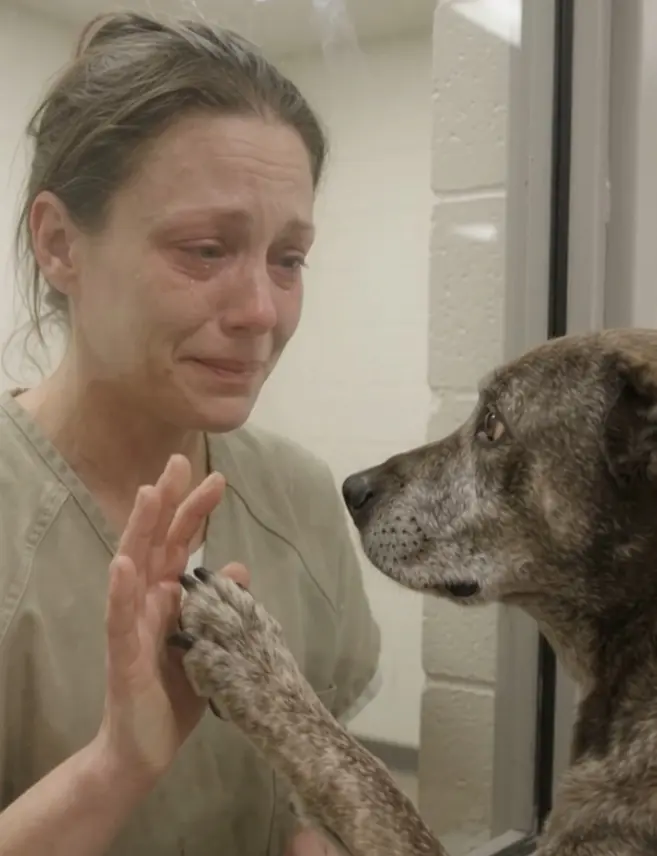
That question followed her more faithfully than almost anything else.
Rufus was twelve now, although the gray around his muzzle made him look older. He was a brindle mixed-breed dog with a narrow white line under his chin, one ear that stood higher than the other, and the slow, deliberate walk of an animal whose hips had begun negotiating every change in elevation. Megan had adopted him nearly eleven years earlier from a county shelter when he was listed simply as “hound mix, approximately one year.”
The shelter worker had warned her that he was not an immediately affectionate dog. Rufus did not run to the kennel gate or throw himself against strangers. He stood several feet back and watched. When Megan crouched, he approached only far enough to smell her fingers, then stepped away as if he needed time to consider the evidence.
She chose him anyway.
For the first week in her apartment, Rufus slept beside the front door rather than on the bed Megan had bought for him. For the second week, he moved halfway down the hallway. By the end of the first month, he slept beside her couch. Eventually the distance disappeared almost completely.
He became the structure around which ordinary years arranged themselves.
Megan worked administrative jobs for a plumbing supplier and later for a regional grocery warehouse. She left home a little before eight most mornings and returned around 5:40, depending on traffic. Rufus learned the sound of her car, the rhythm of her keys on the outside stairwell, and apparently the difference between her footsteps and everyone else who crossed the second-floor landing.
A neighbor named Denise Palmer lived two doors down for seven of those years. Denise used to joke that she never needed a clock on weekday evenings because Rufus started moving toward Megan's door before Megan's car had even entered the lot.
At 5:35, he became interested.
At 5:38, he stood.
At 5:40, on a normal day, his tail began hitting the wall.
That routine survived a divorce, two apartment moves, the death of Megan's mother, a job loss, a new job, a badly sprained ankle, and one winter when the heat in the building failed for four days and Megan slept in a sweatshirt with Rufus pressed along the back of her legs.
There was nothing extraordinary about most of their life together. That was precisely why losing access to it felt so enormous.
Megan was forty-three when she entered the county jail to serve a short sentence connected to a nonviolent probation violation. She did not tell the story as though she had been unfairly singled out or as though the rules should not apply to her. She had made decisions she regretted, missed requirements she should have met, and reached the point where a judge decided consequences could no longer be postponed.
She accepted that.
What she had not prepared for was what would happen to Rufus while she was gone.
At first, Denise agreed to keep him.
Megan left enough dog food for several weeks, the arthritis medication in a plastic organizer on the kitchen counter, the veterinarian's number taped to the refrigerator, and a handwritten page describing the dog's habits with the anxious precision of someone trying to reduce eleven years of companionship to instructions.
Breakfast at 6:30.
Half tablet with food.
Short walk in the morning, longer one after dinner if his hips look good.
He sometimes refuses water if the bowl is too close to the washing machine.
He does not like thunder.
He will stare at the front door around 5:40. Don't worry. That's normal.
Megan read that last line twice before folding the paper.
She had expected to be gone about ten weeks. Denise believed she could manage that. But life rearranged itself faster than either woman expected. Three weeks into Megan's sentence, Denise's sister in Arizona suffered a stroke, and Denise needed to leave Ohio almost immediately to help with her recovery.
There was no family member waiting to take Rufus.
Megan's older brother lived in an apartment that prohibited dogs over forty pounds. Her adult daughter was finishing nursing school in another state and rented a room in a house with two cats. Megan's former husband had not been part of Rufus's life in years. The few friends willing to help either had dogs that did not tolerate other animals or worked schedules that made caring for an elderly dog unrealistic.
For several days, people improvised.
A neighbor fed Rufus in the morning. Megan's brother came after work. Denise delayed her own departure by forty-eight hours. But everyone understood that this was not a plan.