Ruby Never Ate Where She Found the Food
The first thing people noticed about Ruby was not her limp.
It was what she did with food.
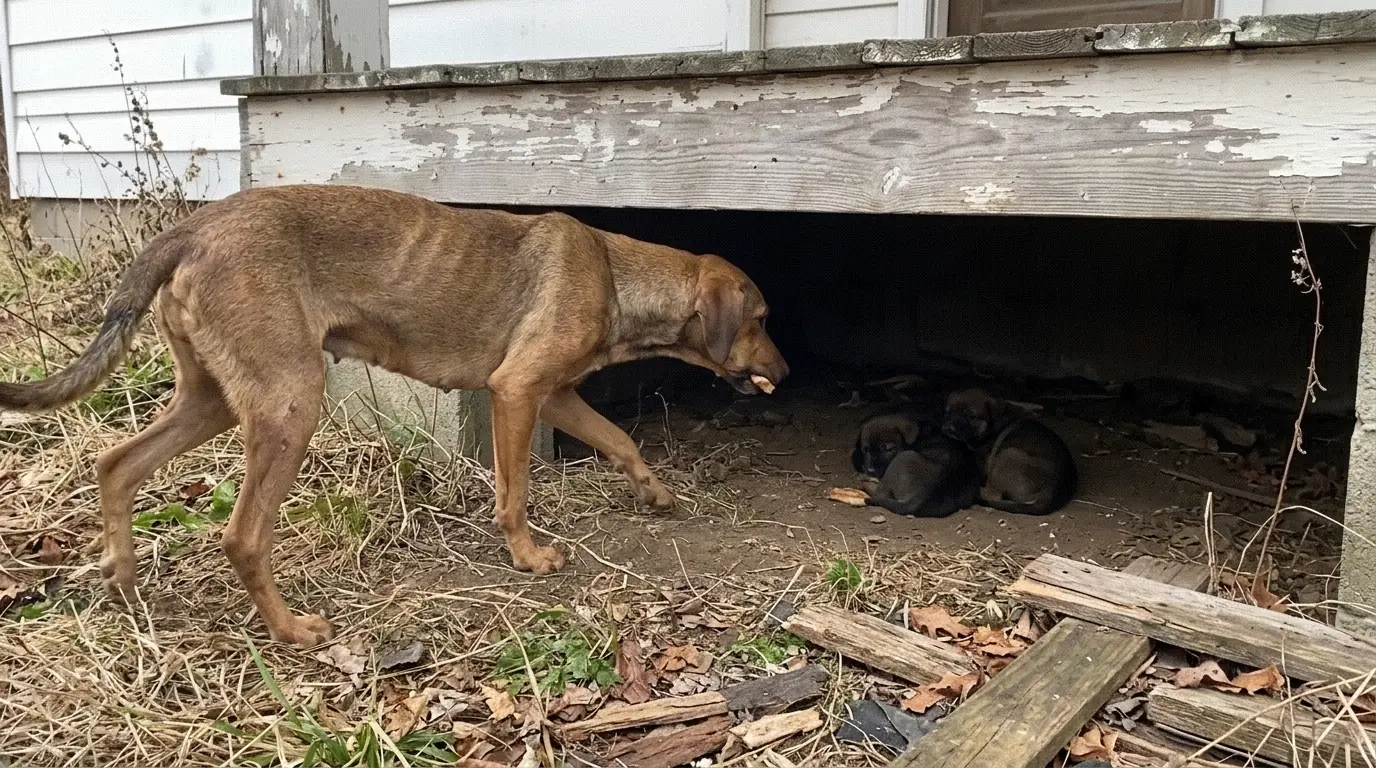
She had been seen moving through a row of vacant houses, thin enough that her ribs showed through her coat and favoring one hind leg with every step. The neighborhood was quiet most of the day, with boarded windows, overgrown yards, broken fencing, and several structures that had clearly been empty for a long time.
When food appeared, Ruby approached cautiously.
She did not stay to eat.
She took one piece in her mouth and left.
Then she came back.
She took another piece and disappeared again in the same direction.
At first, it looked like food caching.
Some dogs carry food away because they do not feel safe eating near people or other animals. Others hide food for later.
But Ruby was not burying it.
She was carrying it to a partially collapsed porch attached to one of the abandoned houses.
There was a narrow dark space beneath it, protected by broken boards, weeds, and a section of sagging foundation.
Inside were two very young puppies.
They lay pressed against each other near the back.
Ruby brought the food to them.
Then she came out again.
Her Limp Made Every Trip Slower
Ruby had an old injury affecting one hind leg.
We did not know exactly when it happened.
We could not confirm whether it came from a vehicle, a fall, an untreated orthopedic problem, or something else.
There was no responsible way to invent that part of her history.
What we could see was that the problem was not new.
Ruby did not completely refuse to use the leg, but she shortened the stride and shifted weight away from it. On uneven ground, the limp became more obvious. When she turned quickly, she tended to pivot more heavily through the opposite side.
Despite that, she repeated the same route over and over.
From the food source.
Across the broken yard.
Past a section of leaning fence.
Back to the porch.
Then out again.
The distance was not enormous.
For a thin dog with a compromised hind limb, it was still significant.
She could have eaten the food where she found it.
She did not.
We Did Not Assume the Puppies Were Eating Kibble
The behavior was emotional to witness, but it also required careful interpretation.
The puppies were young.
Young puppies do not necessarily have the ability to chew and digest ordinary dry dog food safely depending on their developmental stage.
So Ruby carrying pieces back did not automatically mean the puppies were surviving on kibble.
Some pieces were left near them.
Others may have been eaten by Ruby once she reached the protected space.
She may also have been moving food simply because the porch was the location where she felt safest.
What mattered was that she repeatedly transported resources back to the same place where the puppies were hidden.
That told us where her priority was.
It also told us that any rescue attempt focused only on catching Ruby would be incomplete.
There were three dogs involved.
The Porch Was Barely a Shelter
The structure Ruby had chosen provided concealment, but very little else.
Several boards had collapsed downward.
The remaining gap was narrow enough that a large person could not simply crawl underneath safely.
The soil beneath it was damp in places.
Trash and fragments of old building material had collected along the edges.
The puppies were protected from direct sun and some wind, but the area was not clean, dry, or secure.
There was also no guarantee the remaining porch would stay stable.
That made the situation urgent without making it necessary to panic Ruby.
A rushed approach could cause her to move the puppies or flee.
A frightened mother dog can be extremely difficult to capture if she decides people are a threat.
So the plan had to keep all three animals in mind.
Ruby Watched From a Distance
When rescuers first approached the property, Ruby did not come forward.
She moved away from the porch and stopped at a distance.
Her body stayed low.
Her tail remained neutral to tucked depending on how close people came.
She watched.
If someone moved directly toward her, she increased the distance.
If people stayed still, she remained in sight.
There was no reason to force an interaction.
Food was placed nearby.
Water was left where Ruby could access it without passing close to people.
Then everyone backed away.
She eventually returned.
The limp was even more noticeable when she came back after resting.
Her first few steps were stiff.
Once moving, she settled into the familiar uneven gait.
She checked the porch before approaching the food.
Then she picked up a piece and carried it back.
The Puppies Needed to Be Assessed Before Anything Else Changed
The puppies could not be evaluated properly while they remained deep under unstable boards.
But their condition could be observed from a safe distance.
They were small and still spending much of their time sleeping together.
They were mobile enough to reposition themselves but were not wandering away from the protected area.
Ruby returned to them frequently.
That suggested ongoing maternal care.
Still, appearance alone could not confirm that both puppies were thriving.
Very young puppies can deteriorate quickly if they become chilled, dehydrated, underfed, or ill.
The rescue plan therefore needed to remove them from the unsafe structure as soon as that could be done without causing Ruby to disappear.
Catching Ruby First Was Not Automatically the Best Option
There are situations where securing the mother first is the safest approach.
There are others where accessing the puppies must happen in coordination with her capture.
Here, the collapsed porch complicated everything.
If Ruby were trapped and removed too early, the puppies could be left inaccessible while rescuers worked around unstable material.
If rescuers reached aggressively into the porch first, Ruby might panic and move away from the area.
So both parts were prepared together.
A humane containment setup was established nearby.
Food placement became predictable.
The rescue team identified how the porch could be opened safely enough to reach the puppies without causing a larger collapse.
The goal was not speed for its own sake.
It was control.
Ruby’s Hunger Worked Against Her Caution
Over the next several feeding visits, Ruby became slightly more predictable.
She still would not approach closely.
But she returned sooner after people stepped away.
She began eating a few bites before carrying food back.
That was important.
Her body needed calories too.
A nursing mother who is already thin can become depleted quickly.
Milk production demands significant energy.
Add an orthopedic problem, outdoor exposure, and repeated travel for food, and the physical cost increases.
Ruby was not simply feeding puppies.
She was trying to maintain her own body at the same time.
The Capture Happened Quietly
When the setup was ready, Ruby was allowed to approach the food on her own.
There was no chase.
No group of people closing in from different directions.
No one tried to grab her collar.
She entered the secured area because the food was where she expected it to be.
Once contained, her first response was not aggression.
She froze.
Her body lowered.
Her eyes moved toward the porch.
That made the next step even more important.
The puppies needed to come with her.
The Puppies Were Pulled From the Dark One at a Time
With Ruby safely secured, the porch could be accessed more carefully.
Loose boards were stabilized and moved only as much as necessary.
The puppies were located toward the back, still pressed close together.
Each was removed individually.
They were small enough to be carried safely and young enough that minimizing heat loss mattered.
They were immediately placed together on warm bedding.
Both were alert enough to respond to handling.
Neither appeared to have a major visible injury.
That was only a first impression.
They still needed full evaluation.
Ruby could hear them.
Her posture changed when they vocalized.
She stood despite her limp and turned toward the sound.
Once the puppies were secured, all three were transported together.
Ruby’s Intake Exam Revealed How Much Her Body Had Been Carrying
At the clinic, Ruby’s body condition was documented.
She was underweight.
The muscle over her hindquarters was reduced, especially around the injured side.
Her coat was dirty but not so matted that it hid her skin completely.
Her mammary glands confirmed active nursing.
Each gland was checked for abnormal heat, swelling, firmness, pain, or discharge.
Maternal dogs can develop mastitis, particularly when nursing is intense or milk removal becomes uneven.
Ruby did not show signs of a severe mammary infection at intake, but continued monitoring was necessary.
Her hydration was assessed.
Her temperature, heart and lung sounds, oral condition, abdomen, and skin were examined.
Because she was thin and caring for puppies, baseline bloodwork and fecal screening were appropriate.
The goal was to identify problems that might affect both her recovery and her ability to continue nursing safely.
The Hind Leg Was Clearly a Chronic Problem
Ruby’s injured leg received a separate orthopedic assessment.
The limp was real.
The leg was not simply weak because she was thin.
Her joint movement, muscle condition, weight bearing, paw placement, and pain response were evaluated.
Imaging was warranted because the history was unknown and the abnormal gait appeared longstanding.
The findings supported an older orthopedic injury that had healed imperfectly rather than a fresh fracture requiring emergency surgery.
That distinction was important.
Ruby did not need a dramatic operation simply because she limped.
The damage had already remodeled over time.
Her veterinary team focused first on pain management, function, and the question of whether corrective surgery would genuinely improve her quality of life enough to justify the recovery burden.
At that stage, conservative management was appropriate while her nutritional status improved.
Her Medication Plan Had to Account for Nursing
Ruby could not be treated exactly like an adult dog recovering alone.
Any medication used while she continued nursing had to be selected with the puppies in mind.
Pain relief mattered.
So did safety.
Her veterinary team chose an approach appropriate for a lactating mother and adjusted it as needed.
The puppies were also assessed individually rather than being treated as a single unit.
Each was weighed.
Hydration was checked.
Mouths, eyes, skin, abdomen, and overall responsiveness were evaluated.
Their developmental stage was estimated.
Those weights became important because the litter’s progress could not be judged by appearance alone.
The Puppies Had Been Surviving, but Ruby Needed Help
Both puppies were nursing.
That was good.
But Ruby was thin enough that relying entirely on her without support would have been unfair.
The puppies were monitored for weight gain.
If either failed to gain appropriately, supplemental feeding would be introduced according to age and veterinary guidance.
As they reached the appropriate developmental stage, a soft weaning diet could gradually become part of their nutrition.
That reduced pressure on Ruby.
The goal was not to separate the puppies abruptly.
It was to stop making an underconditioned, injured mother responsible for every calorie they needed.
Her First Meal Indoors Looked Different
Ruby was given food in the maternity area.
At first, she approached the bowl cautiously.
She took a mouthful.
Then she turned.
The puppies were only a few feet away on warm bedding.
Ruby carried the food toward them.
She dropped it nearby.
Then she went back to the bowl.
The behavior from the abandoned houses had followed her indoors.
Now there was no collapsed porch.
No long walk.
No need to disappear into darkness.
But Ruby still moved food away from the source.
It had become part of her routine.
We Changed the Setup Rather Than Trying to Stop Her
There was no reason to punish or correct the behavior.
Instead, Ruby’s feeding area was adjusted.
Her bowl was placed closer to where she naturally wanted to remain.
That reduced the distance she traveled on the injured leg.
Her meals were divided into portions appropriate for nutritional rehabilitation.
Water stayed close.
The puppies had their own warm resting space, but Ruby could reach them easily.
Once the food source and the litter were no longer separated by a yard full of broken ground, Ruby had less reason to keep transporting every bite.
At first, she still did.
Then slowly, she began eating more of the meal beside the bowl.
She Watched the Puppies While She Ate
During the early days, Ruby rarely ate without checking them.
She would lower her head to the bowl.
Take several bites.
Lift her head.
Look toward the bedding.
Then eat again.
If one puppy vocalized, Ruby often stopped and moved toward them.
That vigilance was understandable.
For an unknown period, she had been keeping them hidden in a place where she controlled access.
Now people entered the maternity area.
Laundry changed.
Bowls moved.
The environment was safer, but completely unfamiliar.
We did not expect Ruby to know that immediately.
Sleep Was Harder for Ruby Than Eating
The puppies slept deeply.
Ruby did not.
At first, she rested in short periods.
Her body curled around the puppies whenever they nursed.
When they were asleep, she often stayed close rather than using the separate bed available to her.
Hallway sounds made her lift her head.
People entering caused her to watch carefully.
The first behavioral sign of relaxation was not tail wagging.
It was sleep.
After several predictable days, Ruby began lowering her head while a familiar caregiver remained nearby.
Later, she slept through portions of routine cleaning happening outside the maternity area.
Eventually, she chose to lie on a second bed a short distance from the puppies.
That was the first time she appeared willing to let physical space exist between them while everyone was resting.
Her Weight Had to Return Gradually
Ruby’s meals were calorie-dense enough to support lactation and recovery, but weight restoration still required time.
Her body condition was monitored regularly.
So was stool quality.
Too much food too quickly can create digestive problems in a dog whose intake has been inconsistent.
The goal was steady gain.
As her nutrition improved, her coat began looking better.
Her energy increased.
She could stand longer without appearing as depleted.
But the limp remained.
Better nutrition could strengthen the muscles around the injured leg.
It could not undo old structural damage.
Her Limp Became More Noticeable Once She Was More Active
This can seem counterintuitive.
When Ruby was exhausted, she did very little.
As she began feeling stronger, she moved around more.
That made the limits of the injured leg easier to observe.
She followed caregivers for short distances.
She repositioned around the puppies.
She showed more interest in going outside.
With increased activity came more opportunities to see the uneven gait.
That information helped guide her mobility plan.
Walks remained short.
Traction was prioritized.
Sudden turns and unnecessary jumping were avoided.
Her body needed conditioning without repeated overload.
The Puppies Began to Move Away From the Pile
As the puppies grew, they stopped spending all of their time pressed together.
They began crawling farther.
Then walking awkwardly.
Then investigating the edges of the maternity area.
Each puppy developed a slightly different pattern.
One was bolder about leaving the bed.
The other tended to remain closer to Ruby.
Their weights continued to be tracked separately.
Their transition toward weaning happened gradually.
Soft food was introduced at the appropriate stage.
Nursing continued, but it was no longer their only source of nutrition.
That changed Ruby’s recovery too.
She No Longer Had to Carry Food to Them
Once the puppies were eating on their own, there was no reason for Ruby to transport pieces of her meal.
For a while, she still occasionally did it.
She would pick up a piece.
Walk toward the puppies.
Drop it.
Then return.
But the behavior became less frequent.
The litter was no longer hidden under a porch.
Their food was available.
Ruby’s food was available.
Nothing needed to be moved from one safe place to another.
Predictability slowly replaced the old routine.
Ruby Began Resting Away From the Puppies
As nursing decreased, Ruby started taking longer breaks.
At first, she remained only a few feet away.
Then she began choosing a separate bed.
The puppies could sleep together without her body wrapped around them.
Ruby could stretch out without two small dogs immediately crawling underneath her.
That separation was healthy.
Maternal care is physically demanding.
A recovering mother needs the ability to rest without constant nursing.
Her mammary glands were monitored as milk production decreased.
Weaning was not abrupt.
The puppies’ independence increased as Ruby’s obligation to remain constantly available decreased.
Her Orthopedic Plan Became Clearer After Weaning
Once Ruby was no longer supporting the full nutritional demands of nursing, her own medical needs could take a larger role.
Her hind leg remained abnormal.
Follow-up examination showed that the old injury had left chronic mechanical changes.
The question was not whether the leg looked normal.
It did not.
The question was how comfortable and functional Ruby could be.
She could bear weight.
She could walk.
She could toilet independently.
She could navigate flat surfaces.
She was slower on uneven ground.
She tired sooner when the injured leg had to do more work.
Those abilities supported continued conservative management.
Her rehabilitation focused on maintaining muscle, controlled strengthening, appropriate pain management, and avoiding excess body weight.
Foster Care Was Chosen With the Leg in Mind
When Ruby and the puppies were ready to leave the shelter environment, foster care offered a quieter place for the next stage.
The home was prepared with nonslip rugs.
Stairs were limited.
Ruby had a low bed.
The puppies had a contained area appropriate for their growing mobility.
Food and water were easy to reach.
Ruby did not need to cross a large house every time the puppies made noise.
The first days were quiet.
She explored slowly.
She checked doors.
She sniffed along the base of walls.
Then she found a covered corner beside the puppy enclosure and lay down there.
It was not difficult to see the connection.
Ruby still preferred places where part of her body was protected.
She Tried to Carry Food to the Puppy Pen Again
During an early foster meal, Ruby took a mouthful from her bowl.
She turned toward the puppies.
She walked several steps.
Then she dropped the food near the edge of their pen.
The puppies were already eating an age-appropriate diet of their own.
They did not need it.
Ruby did it anyway.
Her foster caregiver simply picked up the piece later.
No one corrected her.
The bowl was moved slightly closer to her preferred resting area.
Over the next several days, the food carrying decreased again.
The Puppies Eventually Needed Less of Her Than She Expected
The litter became more active.
They played.
They chewed toys.
They interacted with people.
They ate independently.
They began sleeping in separate positions rather than always stacked together.
Ruby continued checking them, but her responses changed.
A small vocalization no longer always brought her immediately to the pen.
Sometimes she lifted her head and stayed where she was.
That was a major change from the dog who had once carried every available piece of food across an abandoned yard to a dark space beneath a porch.
Ruby’s Own Personality Finally Became Easier to See
For much of her rescue, Ruby had been defined by two things: motherhood and her injured leg.
Once the puppies became independent, we began seeing more of the dog outside those roles.
She liked slow scent walks.
She spent a long time investigating one patch of grass.
She was cautious with unfamiliar people but increasingly social with those she knew.
She preferred gentle contact around her shoulders and chest before accepting handling closer to her hindquarters.
She liked resting near people without always touching them.
She did not need constant attention.
She seemed most comfortable when routines were predictable and movement was unhurried.
Those details mattered for her eventual home.
The Puppies Were Ready Before Ruby Was
Young dogs move through developmental stages quickly.
Ruby’s orthopedic problem would be lifelong.
By the time the puppies were ready for placement, they were active, eating independently, and no longer dependent on nursing.
Ruby still needed continued mobility management.
That meant their futures did not have to move at the same pace.
The puppies could begin their next stage while Ruby remained in foster care.
That separation was done appropriately rather than suddenly.
By then, nursing had already ended.
Ruby was spending significant time away from them voluntarily.
The puppies were functioning as independent young dogs.
The Quiet After They Left Was Different
When the puppies left the foster home for their next placements, Ruby noticed the change.
She checked the area where their pen had been.
She sniffed the bedding.
She moved through the room.
Then she returned to her bed.
We did not claim she understood adoption or wondered where they had gone.
We described what she did.
For the first several days, she was more attentive to certain household sounds.
Then her routine settled.
Her meals remained consistent.
Her walks continued.
Her sleep became deeper.
Her body was finally no longer dividing resources between her own recovery and milk production.
She Began Gaining Muscle Around the Injured Side
Ruby’s leg never became normal.
But consistent nutrition and controlled activity improved the surrounding muscle.
Her gait became slightly more efficient.
She still limped.
On harder days, the difference between the two hind limbs remained obvious.
After longer rest periods, she could be stiff.
Uneven ground still required caution.
But she was no longer making repeated trips across rubble while underweight and nursing.
That alone changed the practical demand placed on the leg.
Her Permanent Home Needed to Accept the Limp
Ruby was not a dog who should be advertised as completely recovered.
The old injury remained part of her.
A future family would need to maintain a healthy body condition.
Regular low-impact exercise would be preferable to occasional intense activity.
Slippery flooring might require rugs.
Veterinary follow-up would remain important if her gait changed, pain increased, or mobility declined.
She might eventually develop additional arthritis around the previously injured area.
Those possibilities needed to be understood.
The right home was not one that expected Ruby to stop limping.
It was one that could keep the limp from becoming the center of every day.
Months Later, She Dropped a Piece of Food and Left It There
One evening in foster care, Ruby was eating dinner when a piece of kibble fell out of her bowl.
It rolled several feet away.
For a moment, the scene resembled the beginning of the behavior that had defined her rescue.
Ruby stopped chewing.
She looked toward the piece.
Then she looked toward the room behind her.
There was no collapsed porch.
No pair of puppies hidden in darkness.
No reason to carry the food anywhere.
Ruby walked over.
She ate it where it had landed.
Then she returned to her bowl.
It was a small moment.
Nothing dramatic happened.
That was exactly why it mattered.
She No Longer Has Somewhere She Needs to Carry Dinner
When Ruby was first seen among the abandoned houses, almost every resource she found seemed to move in the same direction.
Back toward the ruined porch.
Back through the weeds.
Back across the uneven ground on a leg that already hurt.
Back to two puppies pressed together in the dark.
We still do not know how long she had been making those trips.
We do not know exactly how her hind leg was injured.
We do not know how much food she had been finding before anyone noticed her.
Those parts of Ruby’s history remain unknown.
What we do know is what her behavior looked like then.
She found food.
She picked it up.
She carried it away instead of eating.
And every time, she returned to the same two small bodies hidden beneath the porch.
Today, Ruby still walks with an uneven gait.
The old injury remains.
She still needs thoughtful exercise and long-term joint care.
But she is no longer underweight.
She is no longer nursing.
The puppies no longer need her body to keep theirs going.
And when Ruby’s dinner is placed in front of her now, she can lower her head and eat without planning another trip.
Sometimes a piece still falls from the bowl.
These days, Ruby usually eats that piece exactly where she finds it.