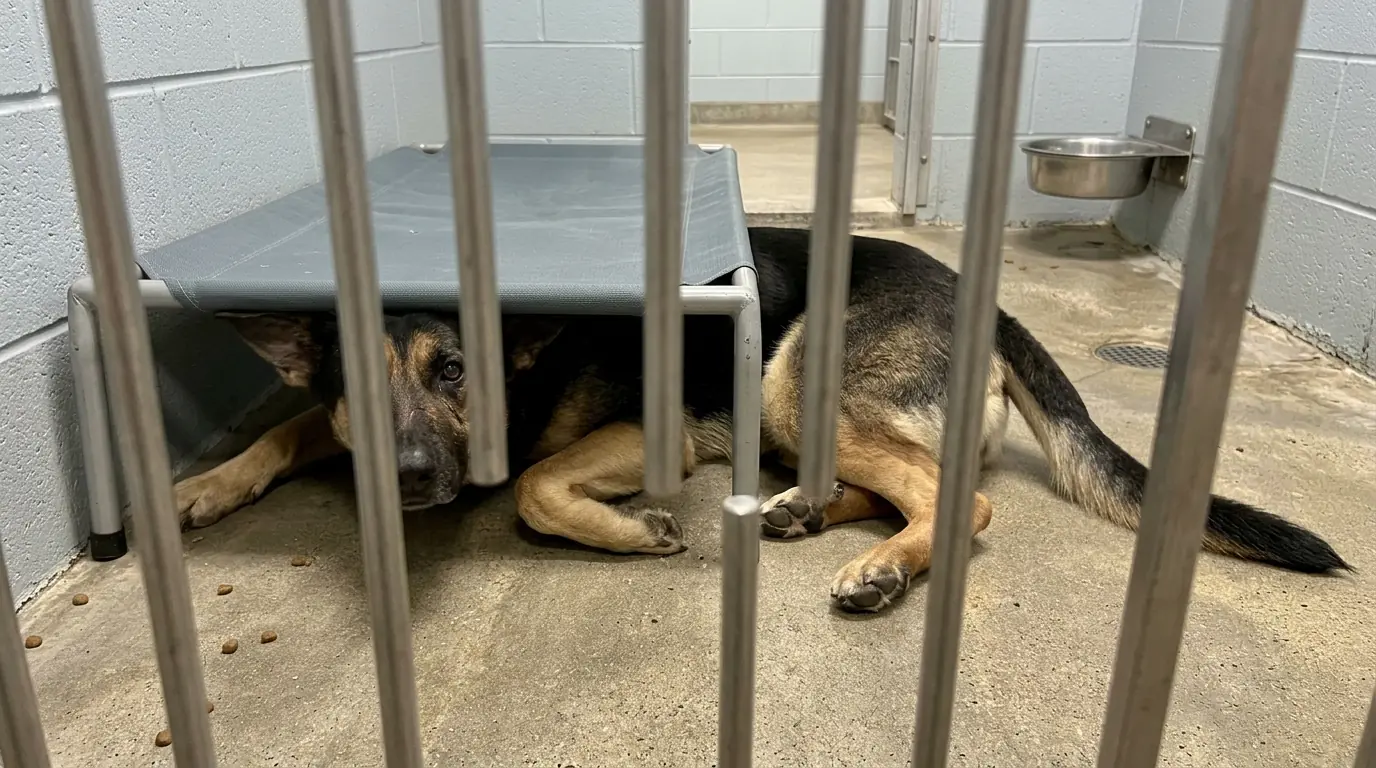
Kaiser is far too big to fit under his bed.
The seven-year-old German Shepherd mix has only a few inches of clearance beneath the low shelter cot. When he is calm, that does not matter.
He sleeps on top of it.
He stretches beside it.
He walks around it without hesitation.
Then the hallway gets loud.
One dog begins barking.
Another answers.
Within seconds, the sound rolls through the shelter in waves.
Kaiser gets up.
At first, he simply walks around his cot.
One circle.
Then another.
His pace increases.
His turns become tighter.
The barking continues.
Kaiser circles faster.
Then, abruptly, he drops his chest to the floor and pushes his head beneath the cot.
His shoulders follow.
He flattens himself as much as he can and keeps crawling.
But Kaiser is a large dog.
There isn't enough space.
His front half disappears beneath the bed while his hips and back legs remain exposed behind him.
Still, Kaiser keeps trying to move farther underneath.
Eventually, he stops.
His body trembles.
His hindquarters remain completely visible.
But as long as his head and shoulders are hidden beneath the cot, Kaiser refuses to come back out.
The Circling Always Comes First
That detail quickly becomes important.
Kaiser does not usually dive beneath the cot without warning.
There is a sequence.
Noise rises.
Kaiser stands.
He begins walking.
The walking becomes circling.
The circling accelerates.
Then he drops.
By the time Kaiser is trying to force himself beneath the bed, his distress has already been building for several moments.
That gives staff something valuable to watch for.
The cot is not the beginning of the episode.
It is where the episode ends.
Kaiser Arrived With Old Scars Around His Muzzle
Several healed scars remain visible around his face.
They are part of Kaiser's physical condition.
They are not a biography.
Old scars cannot tell shelter staff exactly how they happened, who caused them, or what Kaiser experienced before arriving.
It would be easy to connect the scars with his reaction to barking and create a specific history around them.
There is no responsible way to do that without evidence.
What staff do know is happening in front of them.
Kaiser reacts intensely when multiple dogs begin barking around him.
One Bark Usually Isn't Enough
A single distant bark may make his ears move.
Kaiser looks toward the kennel door.
Then he settles.
But when several dogs begin barking in rapid succession, his posture changes.
His mouth closes.
His head lowers.
He begins moving.
That distinction matters.
Kaiser may not simply be reacting to “noise.”
The intensity, number of dogs, proximity, or unpredictability of the barking could all influence his response.
The First Circle Can Look Almost Casual
Kaiser walks around the cot.
If someone watched only those first few seconds, they might assume he was preparing to lie down.
Dogs often circle before resting.
But Kaiser does not lie down.
He completes another lap.
Then another.
His stride gets faster.
His body remains tense.
Soon there is nothing relaxed about the movement.