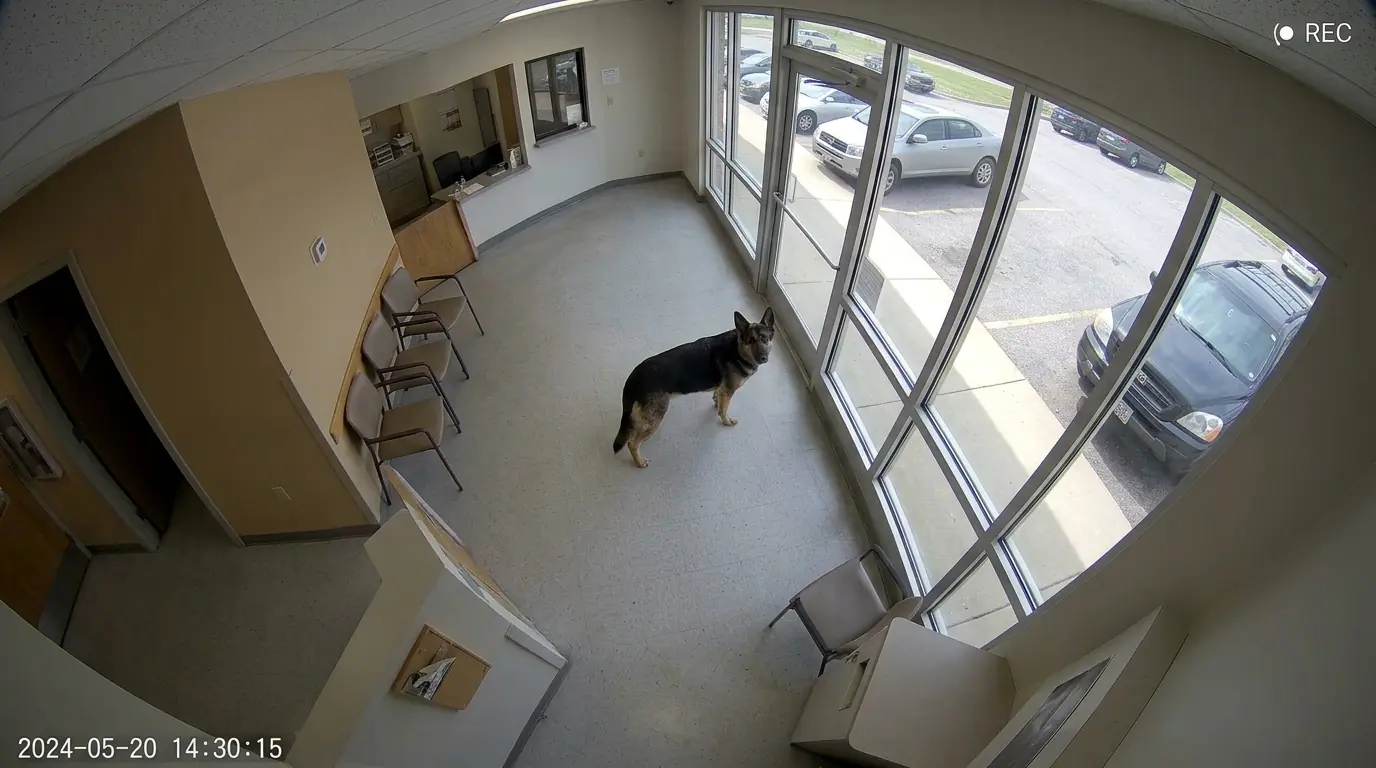
Kaiser can no longer walk to the shelter lobby the way he once could.
His front legs still work.
His shoulders are still strong enough to pull.
But behind him, the 11-year-old German Shepherd's body is changing.
A degenerative spinal condition has left his hind legs so weak that they can barely support his weight.
When Kaiser moves, his front paws often do most of the work.
Plant.
Pull.
Rest.
Then pull again.
That is why staff began bringing him out of the medical wing carefully, giving him a chance to spend time somewhere beyond the same kennel walls.
But once Kaiser reaches the larger area, he repeatedly tries to go farther.
Toward the shelter lobby.
Toward the glass entrance.
And whenever a car pulls into the parking lot outside, something happens that staff have now watched many times.
Kaiser's ears rise.
His front legs brace.
He tries to stand.
For a few seconds, his body lifts.
Then his hind legs give way.
Kaiser drops back down.
And from the floor, he keeps staring through the glass.
At First, Staff Thought Kaiser Simply Wanted Out of the Medical Wing
That would have made sense.
He had spent much of his time resting there.
Medical kennels are designed around safety and care, not entertainment.
A change of environment could offer different smells, sounds, and human activity.
So when Kaiser pulled himself toward the lobby, staff initially treated it as ordinary exploration.
Then they noticed his destination rarely changed.
Kaiser wanted the front.
He Would Pass Other Things to Get There
A caregiver might sit nearby.
Kaiser could receive attention without moving.
There were other places where he could settle.
But when given the opportunity, his body often oriented toward the entrance.
His front paws pulled.
His chest moved forward.
His hindquarters followed awkwardly behind.
Sometimes staff had to help before he exhausted himself.
Eventually, Kaiser reached a place where he could see through the glass.
Then he stopped.
The Parking Lot Became the Center of His Attention
Cars came and went throughout the day.
Most produced at least a glance.
Some produced much more.
A vehicle slowed near the entrance.
Kaiser's head lifted.
It stopped.
His ears came forward.
Then came the sound of a car door.
That was often enough.
Kaiser tried to rise.
Watching Him Stand Made the Severity of His Condition Obvious
His front legs pushed against the floor.
His chest lifted first.
For a moment, his hindquarters attempted to follow.
Sometimes Kaiser managed to get all four paws underneath himself.
But the position rarely lasted.
His rear legs trembled.
His hips dropped.
His paws lost position.
Then his hindquarters folded.
Kaiser returned to the floor.
Sometimes within seconds.
Yet His Eyes Stayed on the Glass
That was the part people remembered.
The failed attempt to stand did not end his interest.
Kaiser simply remained down.