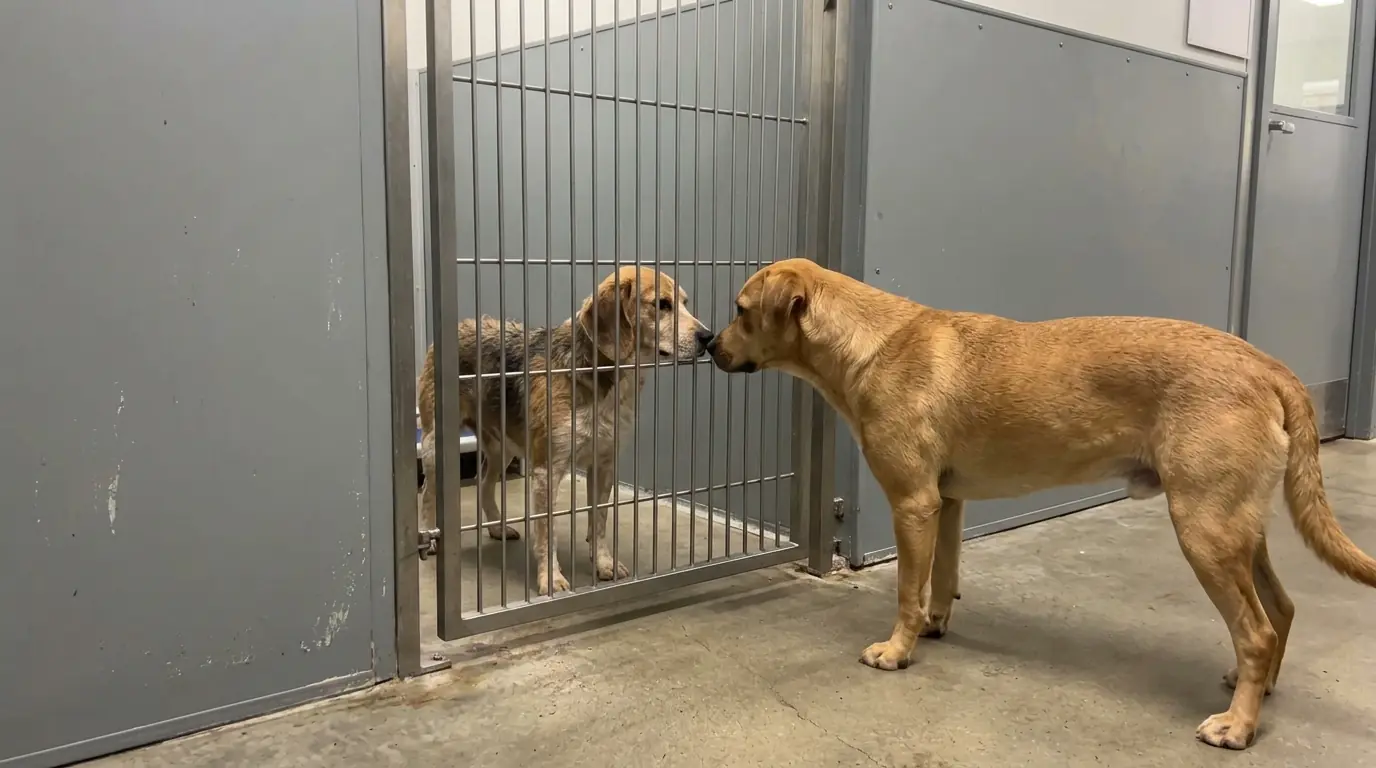
Cooper Never Walked Past Her Kennel Without Stopping
Cooper and Lucy had lived in the same home before they entered rescue.
That was one of the few parts of their history we could confirm.
Cooper was a sturdy adult Lab mix. Lucy was a smaller Beagle mix who arrived needing medical care and could not immediately be housed with him.
Because Lucy required a quieter medical kennel where her activity, medications, appetite, and recovery could be monitored closely, the two dogs had to be placed in different areas.
They were not separated because of aggression.
They were not being evaluated as incompatible.
They were simply at different stages of care.
Lucy needed the medical ward.
Cooper did not.
The first time Cooper passed her kennel on the way outside, he stopped.
Not for long.
Just long enough to turn his head toward the metal door and sniff.
On the next trip, he stopped again.
Then the behavior became difficult to miss.
Whenever Cooper was walked through that hallway, he slowed as he approached Lucy’s kennel.
He would move close to the bars, lower his head, and begin sniffing through the narrow openings.
His nose worked quickly at first.
Then Lucy would notice him.
She was moving more slowly because of her condition and recovery, so she did not rush to the front.
She would get up, cross the kennel carefully, and approach the door.
Cooper stayed where he was.
Lucy moved closer.
Then she pressed her nose toward the same opening.
For several seconds, sometimes longer, the two dogs remained almost completely still.
Two noses.
One metal barrier between them.
Then Cooper would eventually continue down the hallway.
We Were Careful Not to Decide What the Behavior Meant Too Quickly
It would have been easy to label them a bonded pair immediately.
They had lived together.
They repeatedly sought contact through the kennel door.
They clearly recognized one another.
But rescue work requires more than a compelling moment.
Dogs can be familiar without being deeply dependent on each other.
They can seek out another dog while still having very different needs.
They can also behave differently under shelter stress than they did in a home.
So we watched.
We documented what actually happened.
Cooper consistently slowed near Lucy’s kennel.
Lucy consistently approached when she became aware of him.
Neither dog showed escalating frustration at the barrier.
There was no lunging.
No frantic scratching.
No snapping through the bars.
Instead, both dogs usually became quieter.
Cooper’s body softened.
Lucy’s pace remained slow but purposeful.
Their noses met at nearly the same point on opposite sides of the kennel door.
Then they stood there.
The behavior repeated often enough that it became part of their daily routine.
Lucy’s Medical Needs Had to Come First
Lucy had entered rescue with a condition that required treatment and restricted activity.
Her recovery was not dramatic, but it was significant enough that she could not safely return to ordinary kennel housing right away.
The medical area allowed staff to monitor her more closely.
Her food intake could be measured.
Her medications could be given on schedule.
Her movement could be limited.
Her resting posture, elimination, hydration, and comfort could be observed without the added activity of a general kennel environment.
The exact details of her prior medical history were incomplete.
We did not know how long she had been uncomfortable before entering care.
We could document the condition identified during her veterinary examination and treat the dog in front of us.
What mattered most was that Lucy needed time.
She moved more cautiously than Cooper.
She tired more easily.
She needed a predictable routine.
And while Cooper might have preferred to remain physically close to her, placing them together before Lucy was ready could have complicated that recovery.
Even a friendly dog can accidentally bump, step on, crowd, or excite another dog.
For a patient healing in a medical kennel, calm is part of treatment.
Cooper Did Not Understand the Shelter Layout, but He Learned Her Location
We could not say what Cooper thought about the separation.
That would have been speculation.
What we could see was that he learned exactly where Lucy was.
The first few trips down the medical hallway seemed exploratory.
He sniffed several kennel fronts.
He glanced around.
He responded to the normal shelter sounds.
But after a short time, his behavior changed.
He began approaching Lucy’s kennel with more directness.
His pace slowed before reaching it.
He turned toward the same section of bars.
Sometimes Lucy was already standing there.
Other times she was resting farther back.
When she did not immediately appear, Cooper would sniff along the lower part of the door and wait.
If Lucy remained resting, he eventually moved on.
If she got up, he stayed.
That distinction was important.
Cooper was not simply fixated on the kennel because another dog was inside.
His behavior changed specifically in response to Lucy.
Lucy’s Side of the Interaction Was Quieter
Lucy’s reaction was less obvious at first because she did everything slowly.
She did not leap up when Cooper approached.
She did not bark.
She did not throw herself toward the door.
Instead, her response often began with her head lifting from the bedding.
She would listen.
Then she would stand.
Standing itself required more effort during the early part of her recovery, so her movement toward the kennel front was deliberate.
She crossed the short distance.
Her nose lowered.
Then she found the same opening where Cooper was waiting.
Once there, Lucy usually stopped moving.
Sometimes her eyes partially closed.
Sometimes she sniffed through the gap.
Sometimes the two dogs simply held position.
That calmness was one reason we allowed the brief barrier interactions to continue when they fit safely into Lucy’s medical routine.
The contact did not appear to agitate her.
If anything, she often settled again after Cooper left.
Their Separation Became Part of Lucy’s Recovery Plan
Keeping dogs together can be emotionally appealing.
It is not always medically appropriate.
Lucy needed to heal.
That meant we had to be willing to tolerate the temporary separation even when the dogs repeatedly sought each other out.
Her medical kennel gave her something she could not get in a shared enclosure: control over activity.
If Cooper shifted suddenly beside her, she might move too quickly.
If he became excited at a hallway noise, she might try to follow.
If they shared a bed, Lucy could be jostled.
None of those risks meant Cooper was unsafe.
They simply meant that Lucy’s body needed more protection than usual.
So the plan became a compromise.
They would remain housed separately.
Cooper could continue his normal routine.
Lucy could continue medical recovery.
And when Cooper happened to pass her kennel during controlled movement through the hallway, brief calm contact through the barrier could occur as long as neither dog became distressed.
The Nose-to-Nose Moment Was Not Staged
The behavior began without prompting.
No one positioned the dogs.
No one placed food near the bars.
No one called Lucy forward.
No one held Cooper’s face against the door.
That mattered.
In rescue storytelling, small behaviors can become exaggerated very quickly if people begin recreating them for emotional effect.
We did not want that.
The most meaningful part was that Cooper stopped on his own.
Lucy approached on her own.
The two dogs chose the same tiny space between the bars.
Sometimes the contact lasted only a few seconds.
Sometimes longer.
If Cooper needed to continue moving, he did.
If Lucy was tired, she stayed on her bed.
There was no expectation that the moment had to happen every time.
It was simply something they often chose.
Cooper Had His Own Adjustment to Make
Although Lucy’s medical recovery was the obvious concern, Cooper also had to adapt to shelter life.
He was suddenly without the familiar home environment he had shared with Lucy.
His daily routine changed.
Different people handled him.
The sounds and smells were unfamiliar.
Dogs barked from nearby kennels.
Doors opened and shut throughout the day.
Cooper was social with familiar handlers but not instantly relaxed in every situation.
His first days involved a lot of scanning.
He sniffed constantly.
He stood near the front of his kennel during activity in the hallway.
At rest, he sometimes remained alert rather than fully stretching out.
That behavior gradually softened as routines became predictable.
He began eating consistently.
He rested more deeply.
He responded to familiar caregivers.
He showed interest in walks.
He also continued stopping at Lucy’s kennel.
The behavior did not disappear as he became more comfortable elsewhere.
We Watched for Signs That the Separation Was Becoming Harmful
A strong attachment can be supportive.
It can also become a problem if one animal cannot function without the other.
So Cooper and Lucy were observed independently.
Did Cooper eat when Lucy was not nearby?
Yes.
Could Lucy rest after Cooper left the hallway?
Yes.
Could Cooper engage with people away from her kennel?
Yes.
Could Lucy tolerate medical care without Cooper present?
Yes.
That was useful information.
Neither dog appeared completely unable to function alone.
That gave us flexibility.
At the same time, their repeated voluntary contact suggested that the relationship mattered.
This was the balance we needed to understand.
They were not helpless without each other.
But they clearly continued to seek each other out.
Lucy’s Recovery Progressed in Small Steps
Lucy’s medical plan focused on comfort and controlled return to normal activity.
Her appetite remained important.
So did hydration.
Her elimination was monitored.
Any change in energy, discomfort, swelling, incision appearance if applicable, or willingness to move would have prompted reassessment.
Her physical progress came gradually.
At first, crossing the kennel to reach Cooper took noticeable effort.
She moved carefully.
Her turns were slow.
She often rested soon afterward.
As days passed, those transitions became smoother.
She began standing with less hesitation.
She could move from the back of the kennel to the front with fewer pauses.
That did not mean she was ready to resume unrestricted activity.
Healing tissue and recovering strength require time.
But it meant the range of safe options available to her was beginning to grow.
Cooper Seemed to Notice When She Reached the Door Faster
Again, we could not claim to know what Cooper understood.
But his observable behavior changed as Lucy became more mobile.
Early on, he sometimes waited several seconds before she reached him.
He would sniff through the bars while she rose from the bedding.
Later, Lucy began arriving sooner.
On those days, their noses met almost immediately.
Cooper often stopped sniffing once she was there.
His head remained low.
Lucy’s nose stayed pressed to the opposite side.
The stillness was striking.
Shelters are rarely silent.
There is always movement somewhere.
Metal bowls shift.
Dogs bark.
Laundry carts roll.
Doors latch.
Yet the two dogs often became remarkably quiet when they reached each other.
A Controlled Reunion Was Considered Only After Lucy Was Ready
The repeated barrier contact made it tempting to reunite them quickly.
We resisted that temptation.
A dog can be emotionally ready for contact before being physically ready for shared space.
Lucy had to reach appropriate medical milestones first.
Her veterinary team needed to be comfortable with the amount of movement she could safely tolerate.
She needed to be able to stand, turn, and move away if necessary.
Her condition had to be stable enough that a normal social interaction would not place her at unreasonable risk.
When those conditions were met, a carefully controlled reunion could be planned.
Not in a crowded kennel.
Not by opening Lucy’s medical door and letting Cooper rush inside.
The environment needed space.
The surface needed traction.
The interaction needed to remain calm.
Their First Time Together Again Was Almost Less Dramatic Than the Bars
When Lucy was finally cleared for a brief controlled interaction, both dogs were brought into a quiet area.
They approached each other without the metal door between them.
Cooper moved first.
His nose went toward Lucy’s face, then her shoulder.
Lucy sniffed him in return.
There was no explosion of excitement.
No jumping.
No frantic wrestling.
That was exactly what we wanted.
They moved around each other slowly.
Cooper sniffed.
Lucy stayed close but did not cling to him.
After a short period, they settled within a few feet of one another.
It was quieter than the nose-to-nose moments at the kennel door.
And in many ways, that made the relationship more convincing.
They did not need drama to recognize each other.
They simply resumed being near one another.
Lucy Still Returned to the Medical Kennel
The first reunion did not mean the separation was over.
Lucy still needed protected recovery time.
After the session, she returned to her medical space.
Cooper returned to his own kennel.
That could have felt disappointing if the only goal had been to create a happy ending as quickly as possible.
But rescue care is not organized around emotional scenes.
It is organized around what is safest for the animals.
Lucy had tolerated the interaction well.
That was enough for one day.
More opportunities could follow if her body continued handling them comfortably.
The Barrier Behavior Continued Anyway
Even after they had been allowed brief contact without the bars, Cooper continued stopping at Lucy’s kennel.
The pattern was now deeply familiar.
Walk down the hallway.
Slow near the medical ward.
Turn toward Lucy.
Lower his head.
Sniff.
Lucy would approach.
Nose to nose.
Pause.
Then Cooper moved on.
It was almost as though the controlled reunions had not replaced the older ritual.
They had simply added another form of contact.
For staff, that reinforced how consistent the behavior had become.
Lucy Gradually Needed Less Medical Isolation
As her condition improved, Lucy began spending more time outside the medical kennel.
Her activity was still controlled.
She was not suddenly released into unrestricted play.
But she could tolerate short walks.
She could spend time in quieter areas.
She could have additional calm interactions with Cooper.
Her stamina improved.
She rested less immediately after movement.
Her appetite remained stable.
Her body language became more relaxed in new spaces.
Those changes allowed us to start thinking beyond the medical ward.
We Had Enough Evidence to Treat Their Relationship as Important
By then, Cooper and Lucy had given us repeated information across multiple contexts.
They had lived together before rescue.
They sought each other through the kennel barrier.
They voluntarily approached during controlled reunions.
They settled near one another without constant physical contact.
They could function separately.
Neither dog appeared to pressure or overwhelm the other.
Their presence together seemed compatible with both animals’ welfare.
At that point, describing them as a closely attached pair was supported by observation rather than assumption.
That had practical implications.
Future housing decisions needed to consider the value of keeping them together if possible.
It did not mean they needed to occupy the same square foot of space every minute.
It meant their relationship should be treated as part of their quality of life.
Cooper Still Needed a Life Outside Lucy
Even after their relationship was established, Cooper continued receiving individual care.
He needed walks suited to his own energy level.
He needed enrichment.
He needed time with people.
He needed to remain comfortable functioning without Lucy constantly beside him.
That independence was healthy.
A strong pair relationship does not require making one dog responsible for the emotional stability of the other.
Cooper could enjoy a walk and return.
Lucy could rest while he was gone.
They could reconnect afterward.
This gave both dogs a more sustainable future.
Lucy Needed the Same Independence
Lucy’s medical recovery also required her to rebuild confidence in her own movement.
She could not rely on following Cooper everywhere.
Her physical activity needed to be based on what her body could safely manage.
That meant individual sessions.
Short walks.
Controlled movement.
Rest.
Follow-up veterinary evaluation.
As she became stronger, her world expanded.
She explored without Cooper.
She interacted with familiar caregivers.
She learned that movement could be safe even when he was not immediately beside her.
The relationship remained important without becoming the only thing either dog had.
Their Housing Eventually Changed
Once Lucy no longer required the level of medical isolation she had needed at intake, the question of shared housing could be reconsidered.
Reuniting dogs in the same living space requires more than assuming they will be comfortable because they once lived together.
Resources matter.
Beds matter.
Food matters.
Space matters.
Each dog needs room to move away.
Their behavior around resting areas and meals must be considered.
When Cooper and Lucy were given increasing supervised time together, there were no significant concerns around proximity.
They could rest separately.
They could share space without constant interaction.
Their body language remained loose.
The eventual transition toward more shared time was therefore gradual rather than dramatic.
The First Shared Rest Was Not Nose-to-Nose
One of the most telling moments came during a quiet period.
Lucy was lying on a padded bed.
Cooper entered the room.
He approached her.
They sniffed briefly.
Then Cooper turned and lay down nearby.
Not pressed against her.
Not touching.
Just close enough that both dogs were within easy reach of one another.
Lucy lifted her head once.
Then she put it back down.
Within minutes, both were asleep.
For dogs that had spent days meeting only through metal bars, the lack of urgency was meaningful.
They no longer had to use the narrow opening in a kennel door to maintain contact.
They had space.
And once they had that space, they did not need to fill every inch between them.
Their Future Planning Had to Include Both Dogs
Any permanent placement would need to understand their history and current behavior honestly.
We would not claim that the dogs could never survive apart.
Their shelter behavior showed otherwise.
We also would not ignore the repeated evidence that they preferred to remain connected.
Keeping them together would be desirable if an appropriate home could meet both dogs’ needs.
Lucy might continue to require medical follow-up.
Cooper had his own routine, temperament, and activity needs.
Their relationship did not erase those differences.
A home taking both dogs would need to care for two individuals, not one emotional story split between two bodies.
The Bars Had Served a Purpose
The medical kennel door had been frustrating in one obvious way.
It kept two familiar dogs apart.
But it had also protected Lucy when she needed protection.
It gave her a quiet place to heal.
It limited unnecessary activity.
It allowed treatment to happen without Cooper accidentally complicating her recovery.
That was why we never treated the barrier itself as something cruel.
Temporary separation can be part of responsible care.
The important thing was what we learned while it was necessary.
Cooper kept returning.
Lucy kept approaching.
Their behavior remained calm and consistent.
And once Lucy was medically ready, the barrier no longer needed to do that job.
Cooper Still Pauses Where Her Kennel Used to Be
By the time Lucy was spending more of her day outside medical housing, the hallway routine had already started changing.
Cooper no longer needed to find her behind the same door.
Sometimes she was walking elsewhere.
Sometimes she was resting in another room.
Sometimes she was beside him.
But during the transition, he still occasionally slowed near the old medical kennel.
He would turn his head.
Sniff once.
Then continue.
The behavior gradually became less frequent as his daily routine adjusted to Lucy being available in other places.
Now There Is No Metal Between Their Noses
The image that defined their first weeks in rescue was simple.
Cooper on one side of a kennel door.
Lucy on the other.
His head lowered.
Her slow approach from the back of the medical kennel.
Then both dogs pressing their noses toward the same narrow gap.
We never needed to claim that Cooper understood why Lucy was behind the door.
We never needed to say that Lucy believed he was coming back for her.
Their behavior was enough.
They recognized each other.
They repeatedly sought contact.
They became calm when they reached the same spot.
And they continued doing it until Lucy’s body was ready for something more.
Now, when they are given quiet time together, Cooper sometimes approaches Lucy exactly the way he used to approach the bars.
Head lowered.
Slow sniff.
Nose forward.
Lucy steps toward him.
But there is no metal door anymore.
Sometimes their noses touch.
Sometimes they pass each other and lie down several feet apart.
Lucy still has recovery needs.
Cooper still needs his own activity.
Neither dog has become dependent on constant contact.
What changed is simply that the choice to be near each other is no longer limited to a narrow space between steel bars.
For weeks, Cooper could only stop outside a medical kennel and press his nose as close to Lucy as the door allowed.
Now, when he approaches her, there is finally nothing in the space between them.