When Lena first arrived at the shelter, she did not behave like a dog trying to attract anyone’s attention. The slender tan sighthound-type mix sat quietly on the blanket at the back of her kennel, lowered her head whenever unfamiliar footsteps stopped outside, and often looked away when someone leaned toward the gate. She was young, physically healthy enough to be considered for placement, and striking enough that visitors noticed her long legs and narrow face almost immediately, but the dog they saw behind the bars rarely gave them the reaction they expected.
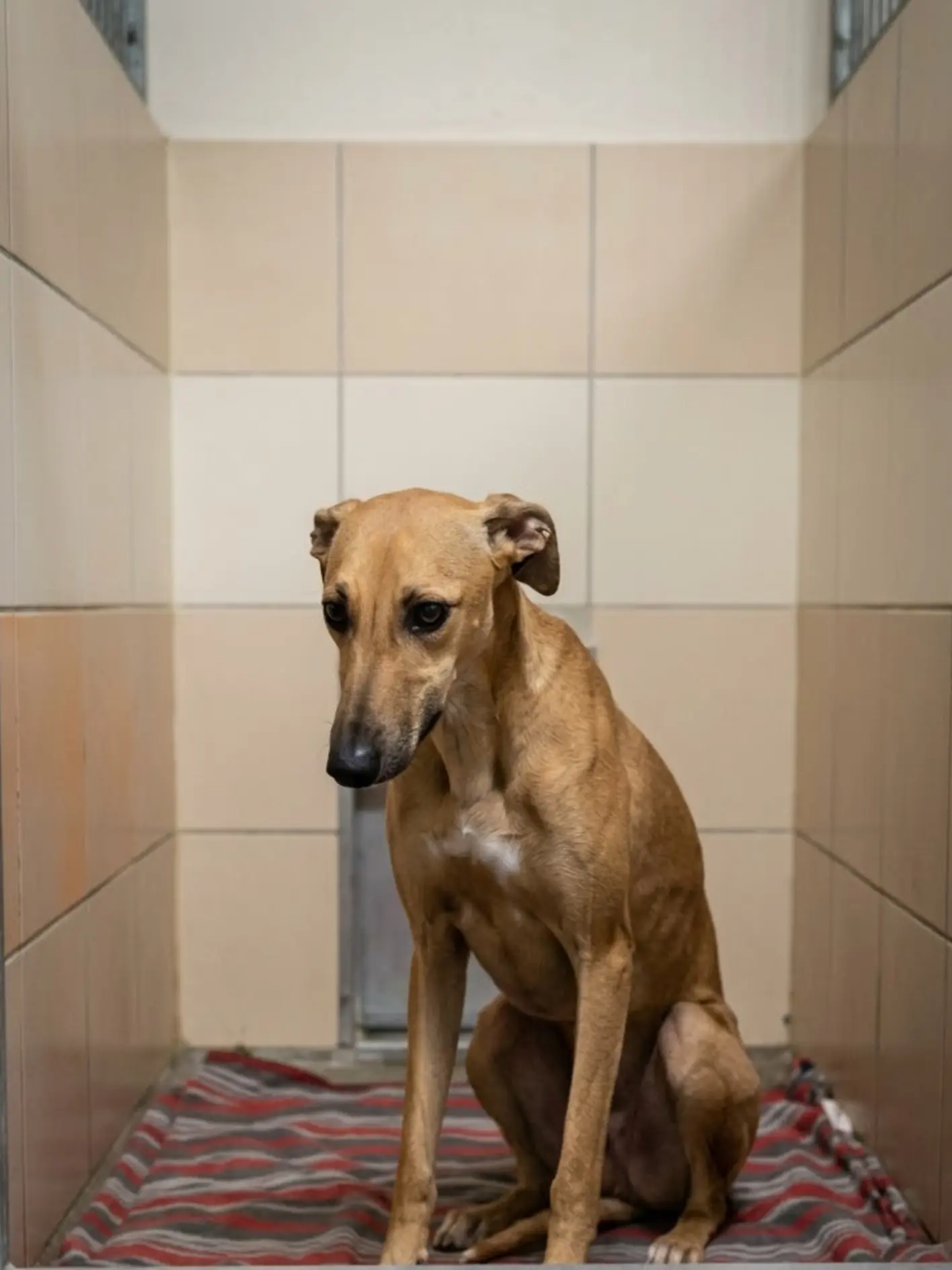
Staff believed Lena was somewhere around two years old. She had been found alone near the edge of a residential neighborhood after several people reported seeing a thin tan dog moving between yards for more than a day. Animal-control officers eventually secured her without incident, but there was no identification that immediately connected her with an owner. Efforts to locate someone looking for her did not produce a reunion, and by the time she became available for placement, the shelter had almost no reliable information about the life she had known before entering the building.
What employees could see was a dog who appeared deeply uncomfortable with rapid change. Lena allowed routine handling but frequently froze when unfamiliar people approached too quickly. She showed no known bite history during her stay, and staff did not describe her as aggressive. Her response was almost the opposite. When overwhelmed, Lena seemed to make herself smaller, lowering her body and waiting for whatever was happening around her to end.
That behavior made her easy to misunderstand.
During the first weekend she was available, several families stopped at her kennel because of her unusual appearance. People admired her elegant build and large dark eyes, and some asked whether she might be part Greyhound or another sighthound breed. Staff could not confidently identify her exact mix, but they explained what they had observed: Lena was timid in the kennel, needed time with strangers, and appeared considerably more comfortable in quieter areas.
Most visitors nodded.
Then they continued down the hallway.
The shelter was filled with dogs who responded very differently. Some pressed their entire bodies against the gates whenever people approached. Others barked, wagged, jumped, or immediately accepted treats through the bars. Those dogs created an instant interaction. Lena often created none.
A visitor might stand in front of her for thirty seconds and see a dog staring toward the floor.
For many people, thirty seconds was enough.
The first family who seriously considered her had come looking for a medium-sized young dog. They were drawn to Lena because she remained quiet while several dogs around her barked, and at first they interpreted that stillness as evidence that she would naturally be calm inside a home. A shelter employee encouraged them to meet her outside before reaching any conclusion.
The difference became obvious once Lena left the kennel.
She was not immediately affectionate, but after several minutes in a quiet exercise area she began investigating the ground instead of watching every movement around her. She followed the handler willingly and eventually approached the mother of the family long enough to accept a treat. The interaction was slow, but it was progress.
The family liked her.
Then their two young children joined the meeting.
The children were excited rather than intentionally rough, but their quick movements and loud voices immediately changed Lena’s posture. She moved behind the shelter employee and remained there. The parents tried to encourage her forward, but staff advised them not to force the interaction.
After talking it through, the family decided they wanted a dog with a more established history around children and greater confidence in a busy household.
Nobody criticized the decision. A timid dog does not automatically belong in a quiet home forever, but asking a family with young children to gamble on a match they do not feel prepared to manage would not be responsible.
Lena returned to her kennel.
Several days later, another visitor asked to meet her after seeing a photograph online. This woman lived alone, worked from home, and had previously owned rescue dogs. Shelter employees became hopeful because the household sounded much closer to what Lena seemed to need.
The meeting went well for nearly an hour. The woman sat instead of repeatedly approaching Lena, allowed her to choose the distance, and eventually earned enough trust for the dog to remain near her. She asked about veterinary care, feeding, exercise, and how long a decompression period might realistically last.
Then the woman explained that she already owned two cats.
There was no reliable information about Lena’s behavior around cats. Staff could not promise compatibility simply because she appeared quiet around people, particularly if she had sighthound ancestry and potentially strong chase instincts. The woman appreciated the honesty but did not want to risk the safety of animals already living in her home.
She left without Lena.
Again, the decision was sensible.
Again, Lena spent the night in the shelter.
By the end of her first week, one of the kennel attendants named Michelle had begun paying particular attention to her. Michelle noticed that Lena’s behavior depended heavily on familiarity. With strangers, the dog often lowered her head and remained still. With employees she had seen repeatedly, she stood sooner when they approached and followed them more readily.
Michelle began sitting inside the kennel for several minutes whenever work allowed. She did not constantly touch Lena or try to convince her to behave differently. Sometimes she simply sat on the edge of the raised bed while finishing paperwork or checking messages.
For the first several visits, Lena remained on the opposite side.
Then one afternoon she moved closer.
Not much closer.
Perhaps two feet.
Michelle noticed anyway.
A few days later, Lena approached far enough to smell her hand.
After that, the progress became easier to see. She began standing when Michelle entered. She accepted treats without immediately retreating. Outside, she walked several feet ahead but repeatedly looked back to check where Michelle was.
Those small changes mattered because they suggested that the version of Lena visible to visitors was incomplete. The shelter environment was showing people a dog at the beginning of every relationship, before trust had time to develop.
Unfortunately, adoption halls rarely give shy dogs weeks to make an impression on each person.
Most people choose from what they see that day.
Michelle began taking photographs of Lena outside the kennel. In the new images, the dog was still reserved, but her body was looser and her head was higher. A short video showed her walking beside Michelle after several minutes outdoors and eventually standing close enough for the volunteer to gently stroke her shoulder.
The shelter updated Lena’s profile with a clearer explanation. She appeared shy in the kennel and needed a patient introduction. She had shown no known bite history during her stay, but she was not likely to become instantly affectionate with strangers. A quieter household and an adopter willing to allow her to settle at her own pace might give her the best chance.
The post received far more attention than her original photograph.
People wrote that they could see sadness in her eyes, although staff avoided making claims about exactly what Lena felt. Others called her beautiful and asked how such a young dog could still be homeless. Several tagged rescue organizations that worked with sighthounds or fearful dogs.
One person offered to pay her entire adoption fee.
Another offered money toward professional training.
A third said she would donate to any rescue willing to pull Lena.
The comments made the situation look active.
The shelter record looked different.
No adoption.
No foster.
No rescue commitment.
Lena remained in the same kennel.
This gap between attention and placement can become dangerous in overcrowded shelters. A dog with hundreds of comments may look safe to people scrolling online. One viewer assumes an adopter must already be coming. Another sees multiple rescues tagged beneath the post and believes somebody is arranging a transfer. A third person who might genuinely be able to foster decides not to call because the dog appears to have plenty of options.
The public sees interest.
The shelter needs a destination.
Those things are not interchangeable.
As Lena’s stay continued, the shelter itself began getting busier. Several stray dogs arrived during the same week, including animals whose owners still needed time to locate them. Two dogs were surrendered after a family lost housing unexpectedly, and another kennel became unavailable while staff managed an animal requiring medical separation.
The number of usable spaces began shrinking.
Lena had not done anything to create that pressure. She had not developed a serious medical problem, and there had been no new behavioral incident. In fact, employees were seeing improvement as she became more familiar with them.
The problem existed around her.
Animal shelters operate within physical limits. Lost dogs still need somewhere safe while owners search. Injured animals cannot necessarily wait outside until space becomes available. Families dealing with hospitalization, eviction, or other emergencies may have nowhere else to take pets.
The system works only when animals are also leaving.
Adoption opens a kennel.
Foster care opens a kennel.
Rescue transfer opens a kennel.
Owner reunification opens a kennel.
When incoming animals begin outnumbering those exits, dogs who seemed secure a few days earlier can suddenly become vulnerable.
Lena was becoming one of them.
Staff contacted rescue organizations before her case reached the most urgent stage. A sighthound rescue reviewed her profile and expressed interest, but every foster home appropriate for a timid young dog was occupied. Another rescue offered to share her information but explained that it could not physically accept her without someone willing to provide temporary housing.
A third organization believed Lena might benefit enormously from foster care because so much of her difficulty seemed tied to the shelter environment. It agreed to support her if a foster could be found.
Michelle began searching specifically for that.
The request was different from asking somebody to adopt Lena forever. A foster could give her a quieter place to decompress while the rescue learned more about her behavior in a home and continued searching for a permanent match.
For several days, nobody volunteered.
Then a woman named Denise contacted the rescue.
She lived alone, had fostered nervous dogs before, and worked from home. There were no children or resident pets, and everything about the household sounded unusually appropriate for Lena.
Michelle allowed herself to become hopeful.
Denise came to the shelter for a meeting.
She sat quietly and followed every recommendation staff gave her. Lena remained distant for most of the first half hour but eventually approached enough to take food from her hand. Denise seemed comfortable with the slow progress and said she understood that the first days at home might involve almost no visible affection.
The foster looked close to confirmed.
Then Denise received a phone call.
Her mother, who lived in another state, had been admitted to the hospital unexpectedly. Denise needed to leave town and did not know how long she would be gone.
She could no longer foster.
Nobody was at fault.
Lena remained.
For Michelle, the timing was difficult because the dog had no idea how close she had come to leaving. The following morning, Lena stood when Michelle approached and walked outside with her as though nothing had changed.
To the humans, a safe room had appeared and disappeared overnight.
To Lena, breakfast had simply been followed by another walk.
The shelter continued searching.
A couple expressed interest in adoption after reading about the failed foster. They owned a quiet home and had no children, but during the conversation it became clear that they expected Lena to accompany them immediately to restaurants, crowded outdoor events, and frequent social gatherings. Staff explained that she might eventually become more confident but that nobody could promise a timid shelter dog would quickly enjoy those environments.
The couple chose another dog.
A man offered to foster but already had four dogs and no practical way to give Lena the quiet decompression period staff believed she needed.
Another person said she could keep Lena in an outdoor kennel until an adopter was found.
That was not considered an appropriate solution.
Urgency could not turn unsuitable placements into safe ones.
As the days accumulated, Lena became increasingly familiar with the employees around her. She began walking toward the kennel gate when Michelle arrived and occasionally pressed her shoulder against the woman’s leg during quiet moments outside.
Those behaviors did not transform her into an outgoing dog.
They demonstrated what time could do.
The tragedy was that the shelter was losing exactly that resource.
By the third week, staff were notified that several longer-stay dogs needed immediate placement because intake had continued exceeding available space. Lena’s name appeared among them.
Her profile changed from ordinary adoption promotion to urgent networking.
The response online grew again.
People who had previously said she simply needed time were now asking how much time remained. Donations were offered. Rescue groups were tagged. Strangers argued beneath the post about why nobody had taken her.
Michelle tried to keep the conversation focused on what would actually change Lena’s circumstances.
She did not need hundreds of people to agree that she deserved a home.
She needed one home.
Or one foster.
Or one rescue placement with physical space.
The shelter could provide temporary care only while temporary space existed.
That distinction became painfully important as another group of dogs arrived.
Staff eventually received the notice they had spent weeks trying to prevent.
If Lena did not have an appropriate adopter, foster, or rescue placement confirmed by tomorrow, she could be euthanized because of space.
Tomorrow.
The word changed the emotional meaning of the day for every person involved.
It changed nothing for Lena.
She still ate breakfast.
She still lifted her head when familiar employees entered.
When Michelle appeared with the leash, Lena stood.
There was no way for her to understand that people elsewhere were sharing her photograph with a deadline attached to it.
Dogs do not understand the administrative language that determines shelter capacity. Lena knew patterns. The sound of a food cart. The opening of a kennel latch. The person she had learned to trust standing near the gate.
Michelle took her outside.
The two followed the same quiet route they had used for weeks. Lena spent several minutes investigating the fence line and then returned toward Michelle. The volunteer sat on a low bench.
Lena stayed nearby.
After a while, she lowered herself onto the ground beside Michelle’s feet.
Nothing about the scene resembled the drama of the online post.
Lena was not pleading for her life.
She was simply sitting beside someone who had given her enough time to become familiar.
Michelle found that harder than any dramatic goodbye would have been.
The dog had finally started trusting people just as the shelter had almost run out of time to wait for the rest of the world to notice.
They stayed outside longer than usual.
Eventually, Michelle brought Lena back.
The kennel gate closed again.
Another urgent update was posted.
Lena had until tomorrow.
No confirmed adopter.
No foster.
No rescue.
People were asked not to assume that the large number of comments meant someone else had already solved the problem.
Several new inquiries arrived that afternoon.
One family wanted her but could not come until the weekend.
The shelter could not guarantee a weekend.
A woman offered to adopt Lena as a companion for her highly energetic young dog, but staff believed the proposed immediate introduction could overwhelm the timid newcomer. They suggested a controlled meeting first.
The woman lost interest.
Another caller wanted Lena for a large rural property and intended to allow her to roam freely outdoors because “dogs need space.”
Staff would not send an already fearful dog into an unsecured environment where she could potentially disappear.
The clock kept moving.
By evening, Michelle had stopped reading most of the comments beneath the post.
They all seemed to ask some version of the same question.
How could nobody want her?
Michelle knew the answer was more complicated.
People wanted Lena.
One lacked the right housing.
Another had cats.
Another household was too busy.
A suitable foster experienced a family emergency.
Rescue groups wanted to help but had no open homes.
Concern surrounded Lena.
Space did not.
That night, her post reached a man named Andrew Collins.
Andrew was 61 and worked as an overnight security supervisor at a medical distribution warehouse. His schedule had been unconventional for most of his adult life. He worked nights, slept during part of the morning, and spent much of each afternoon alone in the small house he had owned for twenty years.
His wife had died four years earlier.
Their last dog, a quiet mixed-breed named Lucy, had died the following year.
Andrew had never adopted another.
He had not decided that he disliked dogs. He had simply grown accustomed to an extremely quiet house and convinced himself that beginning again at sixty-one would be unnecessary.
Lena’s photograph appeared because one of his coworkers shared it.
Andrew almost scrolled past.
Then he noticed her posture.
She was not pressing against the gate.
She was not barking.
She looked like a dog trying not to occupy too much space.
Andrew opened the full post.
What caught his attention was not the deadline.
It was Michelle’s description of how long Lena had needed before she began approaching familiar people.