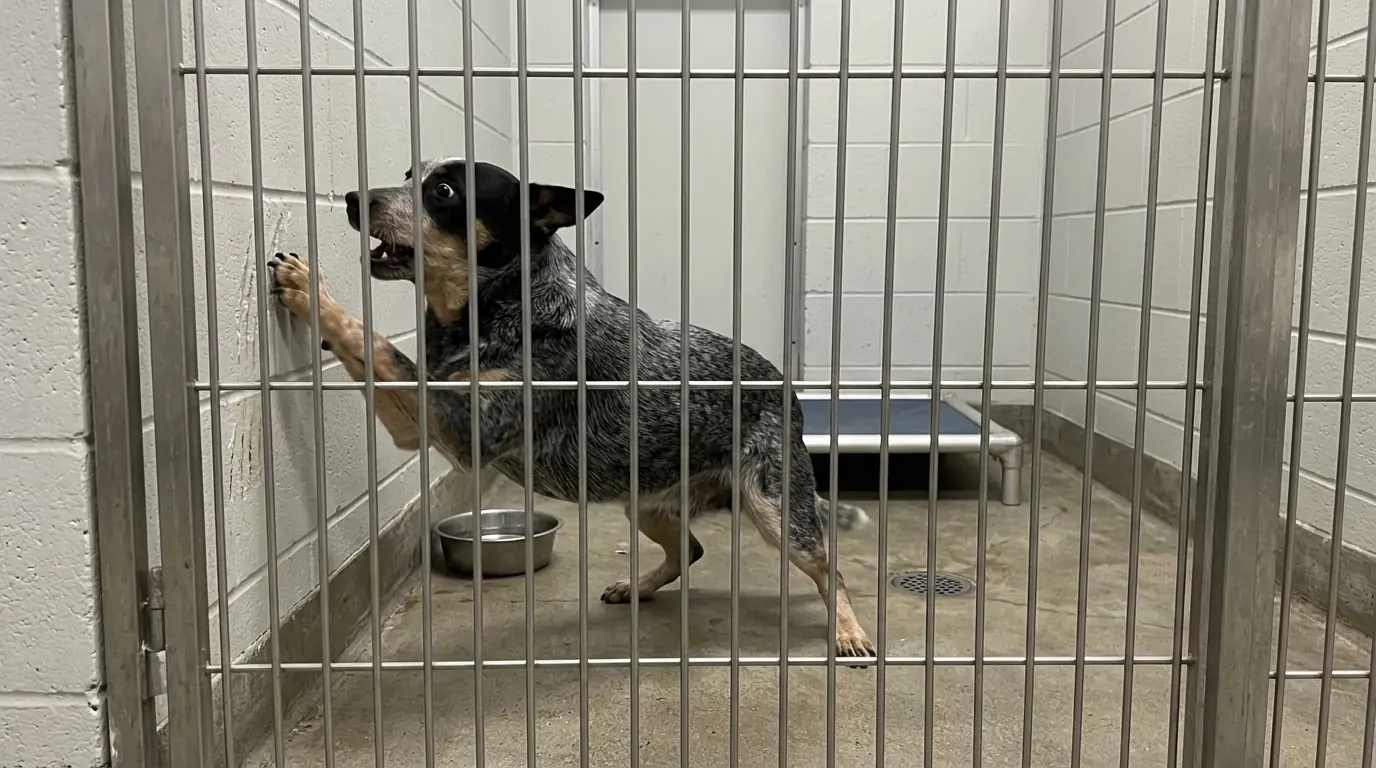
Lola does not panic when another dog appears.
That is the strange part.
The six-year-old Cattle Dog mix can stand quietly behind her kennel gate while another dog walks down the shelter hallway. Her ears follow the movement. Her eyes stay fixed on the passing dog.
But she does not throw herself at the gate.
She does not immediately bark.
Sometimes she barely moves at all.
The other dog continues down the hallway.
Ten feet.
Fifteen.
Then it reaches the corner beside Lola’s kennel and disappears from view.
That is when Lola explodes.
She races from the gate to the side wall.
Her front paws hit the exact corner where the other dog vanished.
She scratches rapidly at the wall.
Barks.
Growls toward nothing but painted concrete.
Then she stands there listening.
There is no dog in front of her anymore.
Nothing visible to chase.
Yet Lola reacts more intensely to the empty wall than she did to the dog itself.
And the next time another dog disappears around that same corner, she does it all over again.
The Other Dog Is Not the Obvious Trigger
At first, Lola’s behavior looks like ordinary kennel reactivity.
Shelters can be stimulating places. Dogs hear barking, smell unfamiliar animals, watch movement through gates, and live with far less control over distance than they would in many other environments.
Some dogs bark when another dog approaches.
Some lunge at the gate.
Some retreat.
Lola’s pattern is different.
She remains relatively composed while the dog is actually visible.
The strongest reaction begins only after visual contact ends.
That distinction quickly becomes important.
Staff Start Watching the Entire Sequence
Another dog enters the hallway.
Lola notices immediately.
Her head turns.
She walks toward the front of the kennel.
The dog passes.
Lola follows it with her eyes.
Still quiet.
The dog reaches the corner.
Its hindquarters disappear last.
For less than a second, Lola stares at the empty hallway.
Then she runs.
Not in the direction the dog originally came from.
Not randomly around the kennel.
Straight toward the wall beside her.
Her Paws Go to Almost the Same Place Every Time
Lola rises onto her hind legs.
Her front nails scrape the lower section of the wall.
She drops down.
Scratches again.
Her nose moves close to the corner.
Then the barking begins.
Sometimes she growls between barks.
Sometimes she stops and listens before scratching again.
What makes the behavior so noticeable is its precision.
Lola appears focused on the point where the other dog ceased being visible.
The Wall Has to Be Checked First
Before assuming something complicated is happening behaviorally, the physical environment matters.
Could Lola hear dogs more clearly through that section?