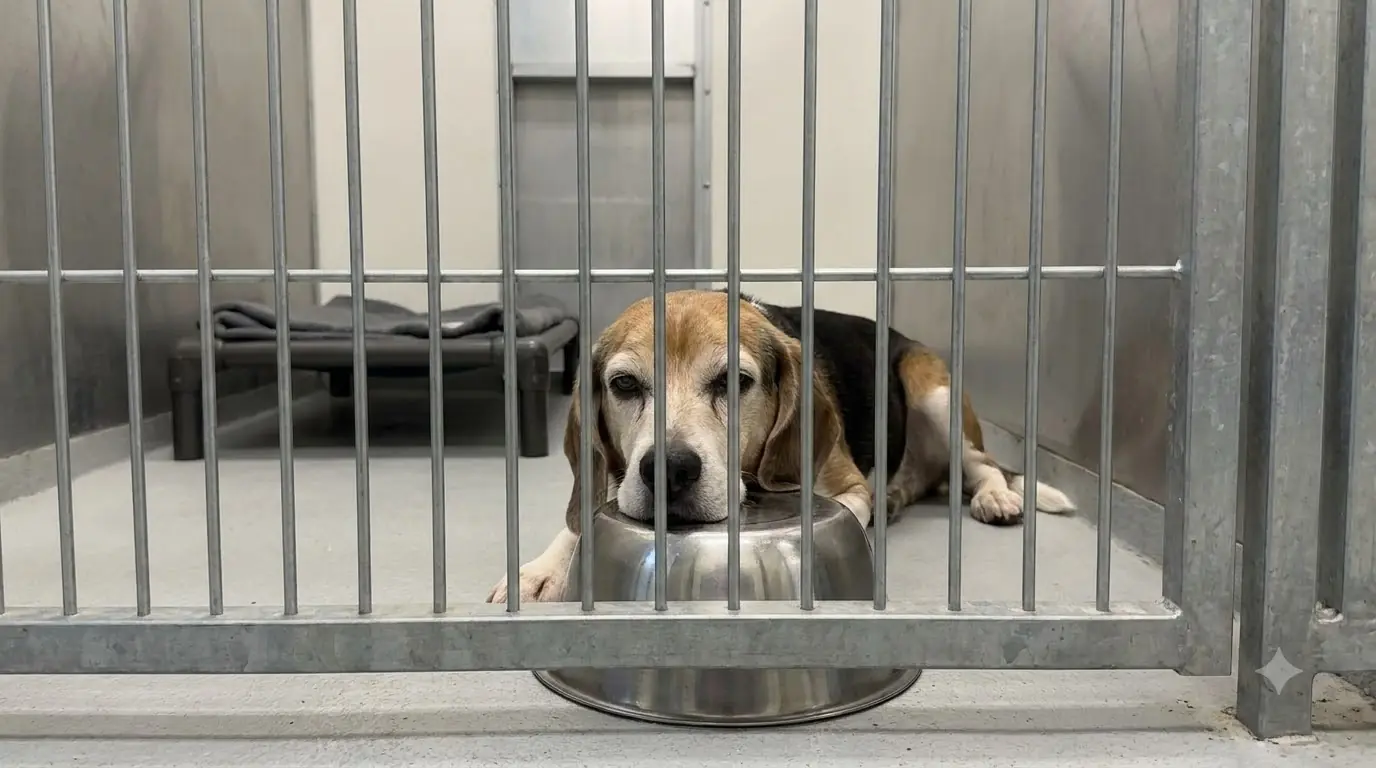
Louie is 11 years old, a senior Beagle living with advanced cancer inside a medical kennel.
He has lost significant weight, eats very little now, and spends most of his day lying down. An orthopedic bed gives his weakened body somewhere soft to rest.
Louie is being presented as a dog at risk of euthanasia. However, no exact deadline, shelter name, or location was provided, so those details cannot responsibly be invented.
What has been observed is a strange little routine Louie repeats after his meals.
When he finishes eating—or eats as much as he can—Louie turns his stainless-steel food bowl upside down.
Then he brings it back to bed with him.
Every Night, Louie Does the Same Thing With His Bowl
Louie's appetite is poor now.
After a meal, there may still be food left behind. But when Louie is finished, he turns his attention to the stainless-steel bowl itself.
He lowers his nose against its edge.
Slowly, he works at it until the bowl flips over.
Then Louie begins moving it toward his orthopedic bed.
He nudges and drags the upside-down bowl across the kennel floor until it reaches the place where he sleeps.
Once it is positioned beside the bed, Louie lies down.
Then he lowers his head.
Instead of resting entirely on the soft bedding, Louie places his chin on the flat bottom of the overturned metal bowl.
And that is how he settles for sleep.
Staff have moved the bowl to different places.
The next night, Louie does it again.
He finds it.
He flips it.
He brings it back.
Then the 11-year-old Beagle rests his chin on it.
Staff Don't Know Why Louie Does It
There is no confirmed explanation for Louie's behavior.
Perhaps the position feels comfortable to him. Perhaps the cool metal feels different against his chin. Perhaps it is simply a routine he has developed inside the medical kennel.
Anything beyond that would be speculation.
There is no way to say that Louie is protecting his bowl, remembering something from his previous life, or deliberately keeping it close because he understands his condition.
What can be documented is the repetition.
Even when staff change where the bowl is placed, Louie eventually brings it back to the same general place beside his bed.
For a dog whose energy has become extremely limited, that means he is repeatedly spending some of it on this small nightly routine.
Louie's Body Has Changed Significantly
Louie has advanced cancer and has lost considerable weight.
His appetite has also declined.
He now eats very little and spends most of his time resting inside the medical kennel.
No specific type of cancer was provided. There is no information here about whether the disease has spread, what treatments have been attempted, or what prognosis his veterinary team has given him.
His medications, pain-management plan, diagnostic results, and current weight were not provided either.
Those details should not be guessed.
What is known is that Louie's disease is advanced enough that his physical condition and normal daily behaviors have changed significantly.
His poor appetite is particularly important.
For anyone considering helping Louie, questions about how much he is currently eating, whether he is maintaining hydration, and what veterinary staff believe is contributing to his decreased appetite should be directed to the shelter.
His History Before the Shelter Is Unknown
No information was provided explaining how Louie entered the shelter.
It is unknown whether he arrived as a stray, was surrendered by an owner, transferred from another organization, or entered through another circumstance.
His history before intake is unknown.
There is also no verified information about when Louie's cancer was first discovered or how long his appetite and body condition have been declining.
Nothing provided establishes abuse, deliberate neglect, abandonment, or another specific cause.
Those details should not be added simply to make Louie's situation more dramatic.
His condition today is serious enough on its own.
The Bowl Has Become Part of His Bedtime Routine
During the day, Louie does not have much energy.
He rests.
He eats only a small amount.
Then, after the meal, the bowl becomes part of a routine staff have learned to recognize.
His nose goes beneath the edge.
The stainless-steel bowl tips.
Louie slowly works it across the kennel.
It eventually reaches his orthopedic bed.
Then Louie lies down beside it.
The soft bed supports his thin body, while his chin comes to rest on the hard metal bottom of the bowl.
It may look uncomfortable to a person.
Louie keeps choosing it.
Even changing the bowl's location has not stopped the behavior.
By the following night, staff can find it back beside him again.
The bowl is upside down.
Louie's head is resting on it.
And he is asleep.
His Medical Needs Could Be Significant
Louie should not be considered an ordinary senior-dog placement.
Advanced cancer, substantial weight loss, and poor appetite can create serious medical and supportive-care needs.
Anyone considering adopting, fostering, or rescuing Louie should first obtain his current veterinary records.
Important questions include his exact cancer diagnosis, prognosis, medications, pain management, appetite, hydration, mobility, and quality-of-life assessment.
Potential helpers should also ask whether Louie needs assistance with eating or other basic activities and whether he can safely tolerate transportation.
None of those details were provided here.
Information about Louie's behavior around other dogs, cats, children, or household environments was also not supplied.
Those things should be confirmed through shelter staff rather than assumed.
Why Is Louie at Risk?
Louie is being presented as a shelter dog at risk of euthanasia.
The specific reason for that status was not provided.
His advanced cancer and declining physical condition are important parts of his current situation, but there is not enough information to say that his illness alone is the reason he is at risk.
There is also no confirmed information about overcrowding, length of stay, behavioral concerns, or lack of a placement commitment.
An exact euthanasia deadline was not provided either.
That means there is no factual basis for saying Louie has a certain number of hours or days remaining.
His case is urgent.
His exact remaining time needs to be confirmed directly with the shelter.
Louie's Deadline Needs to Be Verified
Anyone who may be able to help Louie should contact the shelter as soon as possible and ask for his current status.
If a euthanasia deadline has been assigned, ask for the exact date and time.
The fact that no deadline was included with the information here should not be interpreted as meaning Louie has plenty of time.
Shelter circumstances can change quickly, particularly for medically fragile dogs.
The shelter should also confirm what placement options are available.
There is no information establishing whether Louie can leave through direct adoption, foster placement, or rescue pull.
Those policies should not be assumed.
Tonight, the Bowl May End Up Beside Him Again
There is no confirmed adopter, foster, or rescue commitment included with Louie's information.
There is no verified update indicating that his euthanasia risk has been removed.
For now, Louie remains in the medical kennel.
His body is thin from advanced cancer.
His appetite is poor.
Much of his day is spent resting.
Then another meal arrives.
Louie eats what he can.
When he is finished, he puts his nose against the stainless-steel bowl and turns it over.
Slowly, he brings it toward his orthopedic bed.
Eventually, his body settles onto the bedding.
His head lowers.
And once again, Louie places his chin on the bottom of that upside-down bowl and falls asleep.
Staff can move it tomorrow.
If Louie has enough strength, he may bring it back again.
And until the shelter confirms that his situation has changed, his case remains unresolved.
DOG INFORMATION
Name: Louie
Breed: Beagle
Age: 11 years old
Current condition: Advanced cancer; significant weight loss; poor appetite; low energy
Current placement: Medical kennel with an orthopedic bed
Deadline: Exact deadline not provided
Current status: At risk of euthanasia; current availability and deadline should be confirmed directly with the shelter
HOW TO HELP
Anyone interested in Louie should contact the shelter directly as soon as possible to determine whether adoption, foster placement, or rescue pull is currently available.
Because Louie has advanced cancer, substantial weight loss, and a poor appetite, potential helpers should request his most recent veterinary records and ask about his diagnosis, prognosis, medications, pain management, nutritional needs, mobility, and current quality of life.
If you cannot personally care for a medically fragile senior dog, sharing Louie's case may help put him in front of an adopter, foster, or rescue organization equipped to support his needs.
Please contact the shelter directly for the most current information about availability, rescue requirements, medical condition, and deadline status.
Shelter status can change quickly. Anyone interested in helping Louie should confirm his current status directly with the shelter before making plans.