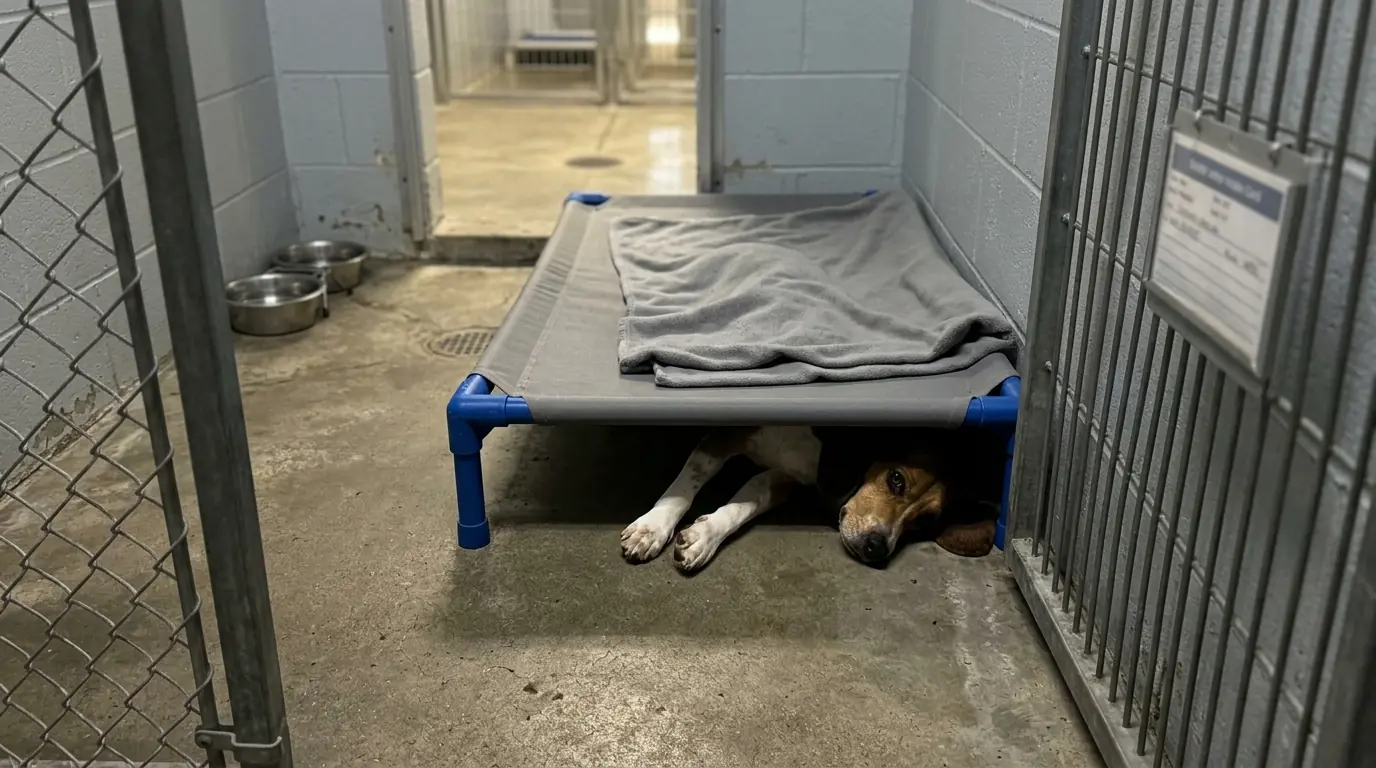
Lucy has a bed.
It is raised slightly above the kennel floor, giving the 6-year-old Beagle somewhere softer and warmer to sleep than bare concrete.
But every night, Lucy makes a different choice.
She approaches the cot.
Lowers herself to the floor.
Then slowly squeezes her entire body into the narrow space underneath it.
By the time she settles, almost nothing is visible.
Sometimes shelter staff can see only two small paws extending beyond the edge of the bed.
The rest of Lucy is underneath.
Her belly pressed against concrete.
Her back beneath the cot.
Her body tucked into a space so narrow that most dogs would never consider it a comfortable place to sleep.
And even though the entire bed above her remains empty, Lucy stays there until morning.
At First, Staff Thought She Had Crawled Under There by Accident
A nervous dog might retreat beneath furniture after being startled.
Perhaps something in the hallway had frightened her.
Perhaps she would come out once the building became quiet.
But the next night, Lucy did it again.
The cot remained unused.
Lucy disappeared beneath it.
Then it happened the following night.
And the night after that.
Soon, staff realized this was not an occasional hiding response.
Given the choice, Lucy repeatedly chose the smallest space available.
Her History Made That Choice Hard to Ignore
Lucy had come from a property where too many dogs had been living together.
She had received very little normal exposure to people or open environments.
That background did not tell staff exactly what Lucy had experienced.
It did not prove she had been physically abused.
It did not mean anyone could know precisely what she remembered.
But it did help explain why an ordinary shelter kennel might feel enormous to her.
For Lucy, open space did not appear to mean comfort yet.
Even the Kennel Could Feel Too Exposed
To most people, the kennel was already small.
Four walls.
A gate.
A cot.
Food and water.
There was nowhere particularly far to go.
But Lucy seemed to make the space smaller still.
During the day, she often kept herself close to boundaries.
A wall.
A corner.
The side of the cot.
She rarely positioned herself in the middle of the kennel when activity was happening nearby.
And at night, she went underneath the bed.
The Cot Wasn't the Problem
That distinction mattered.
It would have been easy to assume Lucy simply disliked the bed.
Maybe it was uncomfortable.
Maybe the material felt unfamiliar.
Those possibilities were worth considering.
But staff also noticed that Lucy used the cot differently from most dogs.
She did not avoid it entirely.
She used it as cover.
The object designed to support her body had become something she preferred to put above her body instead.
That Changed What Staff Needed to Ask
The question was no longer:
How do we get Lucy to sleep on her bed?
It became:
What is she getting from the space underneath it?
Nobody could know exactly.
But the physical characteristics were obvious.