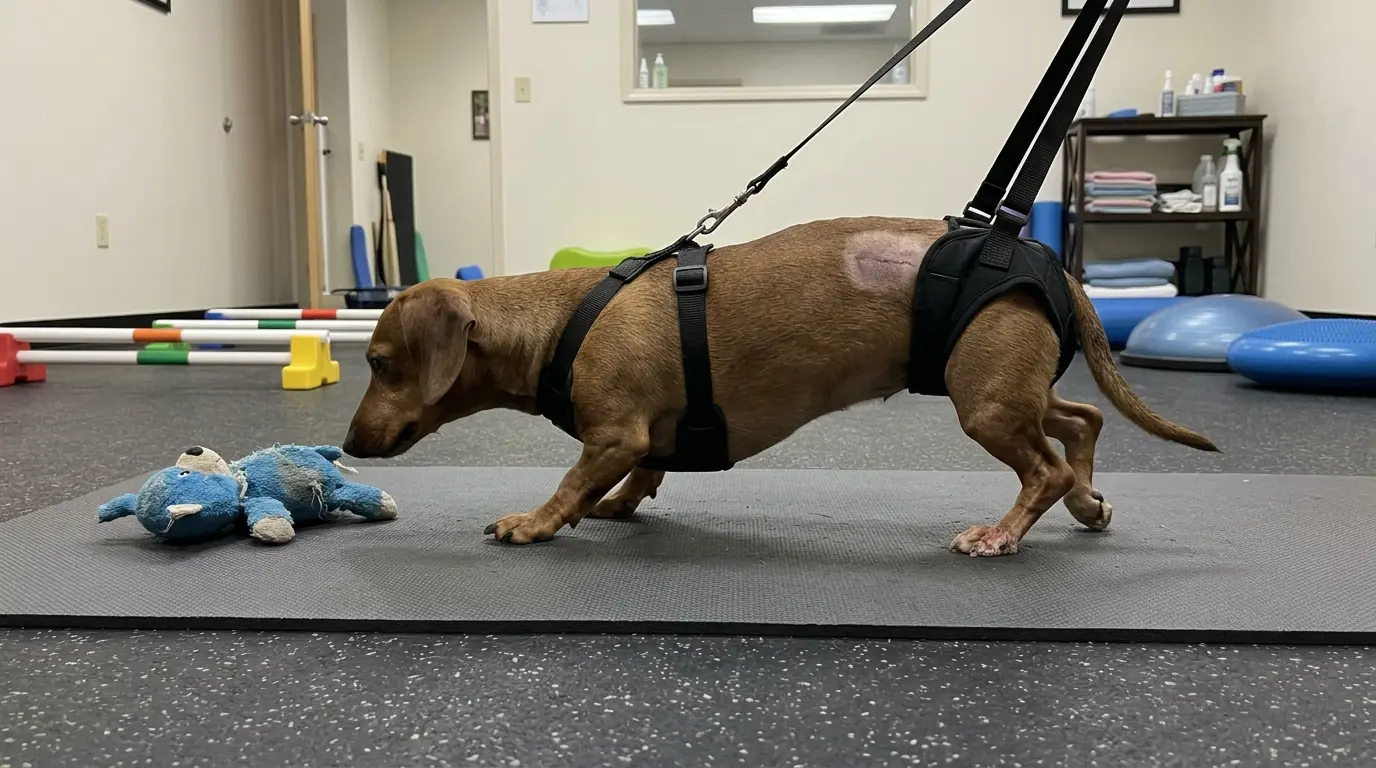
The toy is only a short distance away.
Luna sees it and starts moving toward it immediately.
Her front paws reach forward, grip the rehabilitation mat, and pull. Her narrow Dachshund body slides behind them in the same familiar motion she relied on when her back legs could barely help her at all.
But something is different now.
One of those hind legs has begun to move again.
It can make a small step.
Yet Luna does not consistently use it when she starts after the toy.
Instead, she pulls herself forward with her front legs, and the paw that has recently regained movement trails behind her, dragging across the mat rather than being deliberately placed underneath her body.
That is what makes this stage of Luna's recovery so complicated.
Her leg is beginning to do something it could not do before.
Her old way of moving has not disappeared with it.
For Months, Her Front Legs Had to Do Most of the Work
Luna is a five-year-old Dachshund recovering from intervertebral disc disease, commonly known as IVDD.
IVDD can affect the spinal cord when material associated with a spinal disc compresses or injures it. Depending on the location and severity of the problem, affected dogs can develop pain, weakness, poor coordination, or significant loss of movement in the hind limbs.
Luna had lost nearly all useful movement in both back legs.
That changed the mechanics of almost everything she did.
If she wanted to move forward, her front half had to compensate.
Her front paws reached.
Her shoulders pulled.
Her chest moved first.
Her hindquarters followed.
Over time, that was no longer an occasional response to weakness. It became the way Luna got from one place to another.
Now neurological rehabilitation has brought a small but important change.
Movement is beginning to return.
But recovery has created a strange mismatch between what Luna's body may be becoming capable of doing and the movement strategy she has already practiced countless times.
The First Small Step Changed the Picture
The return of movement in a hind limb can be encouraging during neurological rehabilitation.
But one visible step does not mean normal function has returned.
Movement requires more than muscle strength alone.
A dog has to know where a limb is, coordinate it with the other limbs, shift weight appropriately, place the paw, support the body, and repeat those actions in sequence.
That entire process depends on communication between the nervous system and the rest of the body.
For Luna, one hind leg has begun participating again.
Sometimes the paw comes forward.
Sometimes it reaches the surface.
Sometimes it looks, for a moment, as though her body is beginning to remember a four-legged pattern.
Then the toy appears.
Her front legs take over.
And the recovering paw gets left behind.
The Paw Can Move—But It Doesn't Always Join the Movement
This is one of the most important distinctions in Luna's recovery.
Being able to produce movement is not the same as being able to use that movement effectively.
A limb might show voluntary motion without yet providing reliable support or coordinated stepping.
A dog might move a paw during one exercise but fail to position it correctly during another activity.
Neurological recovery can involve strength, sensation, balance, coordination, and awareness of limb position, and those abilities do not necessarily return at exactly the same rate.
That is why Luna's newly moving leg cannot be judged only by whether it moves.
The more useful question is what happens when she actually tries to go somewhere.
When Luna starts toward her toy, the answer becomes visible.
The front legs move first and fastest.
Her chest slides forward.