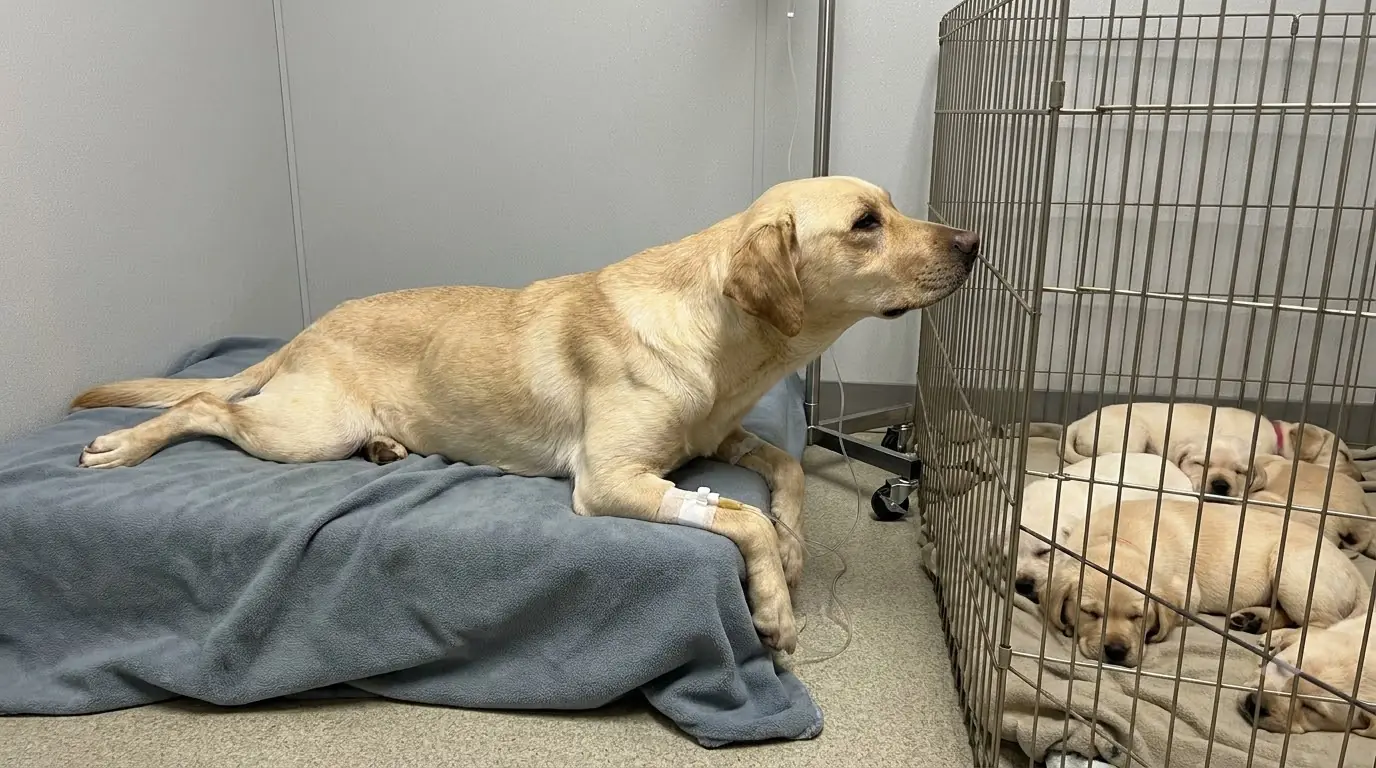
The puppies were close enough for Maggie to hear them.
That was what made the first night so difficult to watch.
The Labrador Retriever lay on a recovery bed at the veterinary rescue with an IV line providing the support her depleted body needed. Only a short distance away, her puppies had been placed together in a separate pen where staff could keep them warm, fed, and closely monitored.
Maggie could not see them clearly from every position on her bed.
But whenever one of them began to cry, her response was immediate.
Her eyes opened.
Her head lifted.
Then she planted both front paws against the bedding and tried to push her chest upright.
For a few seconds, she could hold herself there.
Her nose pointed toward the puppy pen.
Then Maggie tried to pull herself closer to the edge of the bed.
She rarely made it far.
Within seconds, her front legs began to tremble.
Her chest lowered.
And Maggie's exhausted body sank back onto the bedding.
The puppies were only a few feet away.
The veterinary team needed to figure out how to make Maggie strong enough to safely reach them again.
Maggie Had Arrived With Almost Nothing Left in Reserve
Maggie and her litter had come into veterinary rescue together.
The puppies immediately needed the ordinary things very young dogs depend on: warmth, nutrition, monitoring, and frequent care.
But their mother needed help too.
Maggie was severely depleted.
Caring for a litter places enormous nutritional and physical demands on a mother dog even when she begins in good condition. Maggie had reached rescue without enough reserve to continue normally.
Her weakness was significant enough that veterinary support, including IV fluids, became necessary.
For the moment, that meant staff could not simply put the entire litter back onto the recovery bed and expect Maggie to resume caring for them.
She needed rest.
The puppies needed reliable care.
So their pen was positioned nearby.
It solved one medical problem.
Then staff began seeing how Maggie reacted whenever she heard them.
She Tried Again With Nearly Every Cry
It wasn't a single unusual moment.
A puppy squeaked from the pen.
Maggie's head came up.
Several puppies began fussing together.
She shifted her front paws beneath her chest.
If the sound continued, she tried to rise farther.
Staff started recognizing the sequence before Maggie completed it.
Listen.
Lift her head.
Brace both front legs.
Push up.
Turn toward the sound.
Try to move.
Then fatigue.
Sometimes Maggie managed to reach the edge of the recovery bed before lying down again.
Other times, she barely got her chest off the bedding.
That variability showed staff how little endurance she had.
She wanted to respond to activity in the puppy pen.
Her body simply could not sustain the movement.
And that became one of the biggest challenges of her early recovery.
The Team Couldn't Let Her Exhaust Herself Every Time They Cried
Maggie's interest in the puppies was encouraging.
Physically struggling toward them over and over was not.
Her body needed the energy for stabilization and recovery.
Repeatedly pushing herself upright until her legs shook could work against the rest she desperately needed.
So the team began adjusting the setup around her.
The puppies remained close enough for appropriate monitoring, but caregivers tried to reduce the amount of effort Maggie had to make to orient toward them.
When possible and medically appropriate, staff brought safe contact closer rather than expecting Maggie to cross the distance herself.
The principle was simple.
Maggie did not need to prove that she could reach her puppies.
She needed to become strong enough that reaching them would no longer exhaust her.
Her Weakness Wasn't Something a Single Meal Could Fix
Food was important.
But recovery from severe depletion had to be managed rather than rushed.
The veterinary team needed to watch Maggie's hydration, appetite, gastrointestinal tolerance, body condition, strength, and ability to meet the enormous nutritional demands associated with nursing.
They also had to consider the puppies separately.
If Maggie could not safely provide everything they needed at that stage, staff had to make up the difference.
That meant Maggie's recovery and the puppies' care were happening at the same time.
There was no dramatic moment when everyone could simply be reunited and the problem declared solved.
First, Maggie had to stabilize.
And for the first few days, even small movements continued to show just how far she had to go.
Standing Was Still Too Much
Maggie could move her front legs.
She could raise her chest briefly.
But supporting her entire body was another matter.
When caregivers helped her reposition, they could feel how little strength she had available.
Her hindquarters were particularly quick to fatigue.
That mattered because safely interacting with an active litter requires more than simply being awake.
A mother dog needs to reposition herself.
She needs to avoid accidentally trapping a puppy beneath her.
She needs enough endurance to move away when necessary.
Maggie's interest in her litter had returned before those physical abilities had.
So staff continued doing something that was emotionally difficult but medically necessary.
They kept helping the puppies while Maggie rested.
Then One Morning, She Stayed Upright a Little Longer
The change was easy to miss.
A puppy began calling from the neighboring pen.
Maggie's eyes opened.
Her paws moved beneath her chest.
She pushed herself up.
Staff expected the familiar trembling to begin almost immediately.
It did.
But Maggie did not drop back down as quickly.
She remained chest-up for several more seconds.
Her nose stayed pointed toward the sound.
Then she lowered herself onto the bed.
It wasn't enough for a reunion without assistance.
It wasn't proof that the weakness was gone.
But it was longer than she had managed before.
That became the kind of progress the team started watching for.
Not dramatic milestones.
Seconds.
Her Appetite Became Part of the Story Too
As Maggie stabilized, consistent nutrition became increasingly important.
Her body was trying to recover while also dealing with the physiological demands associated with having recently nursed a litter.
Staff watched whether she ate voluntarily and how well she tolerated what she was given.
Gradually, her interest in food improved.
Then her energy began showing small changes too.
She repositioned herself more often.
She lifted her head without immediately putting it back down.
She stayed alert for longer stretches.
And when the puppies made noise, Maggie still responded.
Only now, she did not always collapse immediately after raising her chest.
The First Close Visit Was Kept Short
When the veterinary team felt Maggie was stable enough, staff allowed carefully managed contact with her puppies.
Nobody expected her to walk across the room to them.
The distance was removed for her.
The puppies were brought close under supervision.
Maggie immediately oriented toward them.
Her nose moved from one puppy to another.
She sniffed.
Her body remained supported.
The interaction was deliberately brief.
The goal was not to create an emotional reunion.
It was to see what Maggie could physically tolerate without draining the energy she needed for recovery.
Afterward, she slept.
That told staff they still needed to go slowly.
The Puppies Needed a Stronger Maggie, Not an Exhausted One
From then on, contact was guided by what was medically appropriate for both mother and litter.
Staff continued providing whatever supplemental care the puppies required rather than placing the entire burden back onto Maggie too quickly.
That gave her something she had not had enough of before arriving.
A chance to rest.
Over time, the difference became visible.
Her body was still thin.
Her strength was not normal.
But when Maggie braced her front legs beneath herself, the movement became steadier.
Eventually, she could hold her chest up without immediately shaking.
Then came another milestone.
She tried to stand.
Her First Supported Stand Lasted Only Seconds
A caregiver helped stabilize her as Maggie brought her legs underneath herself.
For a moment, all four paws were supporting weight.
Her legs trembled.
Staff did not wait for her to collapse.
They helped her back down.
That was enough for one session.
Later came another attempt.
Then a few controlled steps.
The puppies remained nearby throughout it all.
Sometimes Maggie could hear them while she worked.
But now the distance between hearing them and being physically able to respond was beginning to shrink.
One Day, She Reached the Edge of the Bed Without Collapsing
A puppy cried.
Maggie's head came up.
The familiar sequence started again.
Front paws underneath.
Chest up.
Nose toward the pen.
But this time, when Maggie pulled herself toward the edge of the recovery bed, her body stayed upright.
She paused there.
Her legs were not perfectly steady.
She was not ready to rush across the room.
Still, she had reached the place where she used to run out of strength.
And she was still holding herself up.
Staff came to her before she could overdo it.
For them, that was enough.
Maggie Is Still Rebuilding What Her Body Lost
Her recovery has not been treated like a race back to normal motherhood.
She continues to need nutritional support, appropriate veterinary monitoring, rest, and gradual increases in activity.
The puppies continue receiving the care they need independently of how much Maggie can provide on any particular day.
Her body condition will take time to rebuild.
So will muscle and endurance.
Some days she is stronger than others.
That is part of recovery.
But the Maggie staff see now can do things the dog who first arrived could not.
She can remain upright longer.
She can reposition herself more easily.
She can tolerate more interaction.
And increasingly, she can be close to her puppies without using every bit of energy she has just to get there.
She Still Lifts Her Head When They Cry
That part has barely changed.
A sound comes from the puppy pen.
Maggie's ears respond.
Her eyes open.
Her nose turns toward them.
What happens afterward is different.
During those first days, she would brace her paws against the recovery bed and drag herself toward the edge until her legs trembled and her body gave out.
Staff would watch her sink back down while the puppies continued calling only a few feet away.
Now Maggie can hold herself up longer.
On stronger days, she can take controlled steps with appropriate supervision.
The distance itself was never very large.
For Maggie, it only felt enormous because her body had almost nothing left to give.
The puppies are still close enough for her to hear.
But little by little, Maggie is becoming strong enough that hearing them no longer means exhausting herself trying to reach them.