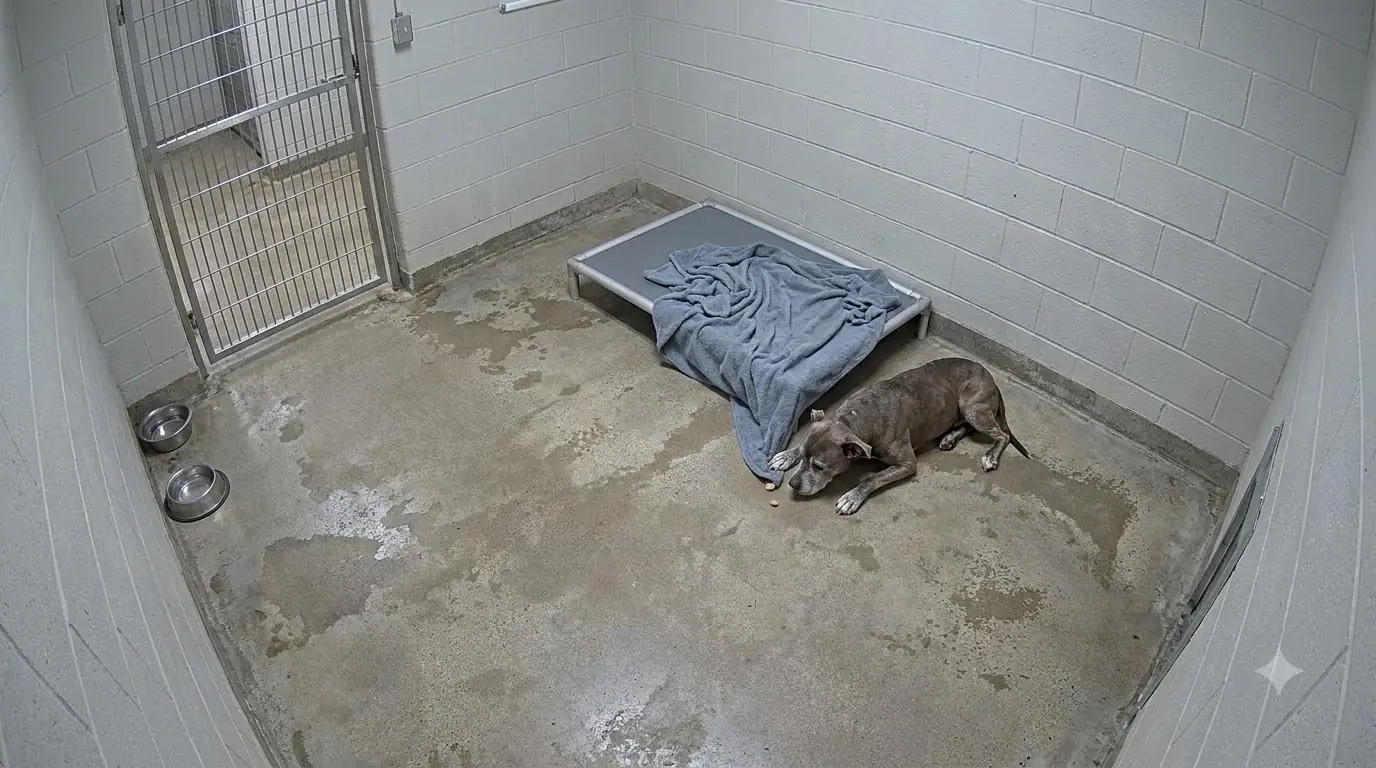
Maverick's medication routine looks simple.
A staff member brings the 9-year-old American Pit Bull Terrier his daily heart medicine, tucked inside a small amount of soft food.
Maverick takes it.
He chews.
The caregiver watches for a moment, then continues with the medical rounds.
But sometimes Maverick hasn't actually swallowed the pill.
Once the person moves away, he quietly spits it out.
Then he lowers his nose to the blanket covering his medical bed.
Push.
The edge lifts slightly.
Maverick nudges the pill underneath.
Then he lies down directly over that spot.
The first time staff found one there, they assumed it had simply fallen out of his mouth.
Then they found another.
And eventually, when they lifted the same corner of Maverick's blanket during a check, they discovered more medication that should have been inside him.
That changed everything.
Because Maverick wasn't hiding treats.
He was hiding medicine his heart depended on.
Maverick Was Already a Medically Fragile Dog
By the time Maverick was living in the medical kennel, his heart disease was affecting more than a diagnosis on his chart.
His body had become noticeably thinner.
His stamina was limited.
A few steps could be enough to leave him needing another period of rest.
Most of his day was intentionally quiet.
Food and water were kept accessible.
Unnecessary exertion was minimized.
Staff watched for changes in his breathing, energy, appetite and overall comfort.
His medication was part of that larger management plan.
It was not something they could simply assume he had taken because the pill had disappeared from sight.
At First, Nothing Looked Wrong With the Routine
Maverick was not dramatically refusing medication.
He did not always turn his head away.
He did not necessarily spit the pill onto the floor while someone was watching.
That was what made the pattern easy to miss.
The medication was hidden in soft food.
Maverick accepted it.
For a moment, it looked as though the job was finished.
Then, later, a pill appeared beneath the blanket.
Staff started paying much closer attention.
The Same Corner Kept Giving Him Away
During one kennel check, a caregiver moved Maverick's bedding.
There it was.
A tablet tucked beneath the edge.
Another check revealed another pill in nearly the same area.
Sometimes the medication had softened from contact with food or moisture.
Sometimes it was still recognizable.
The important part was obvious.
At least some doses Maverick appeared to have taken had never been swallowed.
Nobody knew exactly why he was placing them beneath the blanket.
But the medical consequence did not depend on understanding his reason.
Missing Heart Medication Could Not Become Part of His Routine
With a chronically ill dog, medication schedules are established for a reason.
Exactly what a missed dose means depends on the specific drug, dose and medical condition, so staff could not make assumptions or simply give another pill whenever one was discovered.
Finding an old tablet created its own problem.
When had Maverick hidden it?
Was it from the current dose?
Was it from earlier?
Had he swallowed any of the medication he was supposed to receive?
Those questions mattered.
Giving medication again without knowing what had already been absorbed could also create risk.
So the discovery had to be handled through the veterinary team's medication protocol rather than guesswork.
Staff Changed the Way They Watched Him Take It
The soft-food trick alone was no longer enough.
Maverick needed to be observed until caregivers were confident the medication had actually been swallowed.
That did not mean turning every dose into a stressful struggle.
He was a senior dog with heart disease and limited stamina.
Keeping him calm mattered too.
Instead, staff slowed the routine down.
Maverick received the medication according to veterinary instructions.
Then the caregiver stayed.
They watched him finish.
They checked that the pill had not simply been separated from the food.
And they remained long enough to make sure Maverick had not quietly deposited it somewhere else.
Only then was the dose considered complete.
They Also Had to Ask Why He Was Doing It
The behavior could not automatically be treated as stubbornness.
Dogs may reject medication for many reasons.
Some tablets have unpleasant tastes or smells.
A dog may learn to separate a pill from surrounding food.
Changes in appetite can make medicating more difficult.
Illness itself can affect how interested a dog is in eating.
There may also be physical reasons that swallowing becomes less straightforward.
Because Maverick was already seriously ill and losing weight, staff could not simply assume he had become clever at avoiding pills and leave it there.
Any change in how he ate or swallowed deserved attention.
His Weight Loss Made Every Meal Important Too
Maverick's medication was not the only thing caregivers were monitoring.
His body had become thin enough that maintaining nutrition was also part of his daily care.
That complicated things.
If every meal became associated with discovering hidden medicine, staff did not want Maverick becoming suspicious of all food.
His regular nutrition still needed to remain as comfortable and predictable as possible.
Medication administration and feeding therefore had to be managed thoughtfully.
The goal was not to trick Maverick at any cost.
It was to get necessary treatment into him while protecting his appetite and minimizing stress.
Then Staff Saw the Entire Sequence
One day, a caregiver remained nearby after giving Maverick his medication.
Maverick accepted the soft food.
For several seconds, nothing unusual happened.
Then his mouth moved differently.
His head lowered.
A small tablet dropped onto the bedding.
Maverick immediately brought his nose toward it.
He nudged the pill once.
Then again.
It disappeared beneath the folded edge of the blanket.
Maverick turned his body.
Lowered himself.
And lay directly over the place where he had pushed it.
There was no dramatic reaction.
No frantic digging.
No obvious distress.
Just a quiet, practiced-looking sequence.
Staff finally understood exactly how the pills had been ending up there.
What they still did not know was why.
The Blanket Wasn't Taken Away
Removing all of Maverick's bedding might have eliminated one hiding place.
It would also have taken comfortable support away from a thin senior dog who spent most of his day lying down.
That was not a reasonable trade.
Maverick needed cushioning.
His body needed comfortable places to rest.
So staff changed the medication routine rather than punishing the behavior.
The blanket could stay.
The pills simply could not stay underneath it.
Every Dose Became a Little More Deliberate
Caregivers learned to check Maverick's mouth and immediate bedding area as appropriate after medication.
They watched what he did with the food.
They stayed alert for the small head movement that sometimes came before a pill appeared.
And they documented concerns so everyone caring for Maverick knew that apparent acceptance did not always mean successful administration.
That consistency mattered.
A medication routine can fail if one caregiver knows a dog's trick and the next person does not.
Maverick's little blanket corner had made that very clear.
His Heart Disease Still Set the Pace of His Day
Even with the medication problem identified, Maverick's larger condition remained the real concern.
He tired quickly.
Some days he was interested in what was happening outside the medical kennel.
Other days, getting up seemed like too much work.
Staff did not ask him to walk farther simply because he had a little more energy one morning.
They did not treat a tail wag or a stronger appetite as proof that his heart disease had disappeared.
Management meant looking at the whole dog.
How comfortably was he breathing?
How much activity could he tolerate?
Was he eating?
Could he rest?
Was his weight stabilizing?
And was he reliably receiving the treatment prescribed for him?
Eventually, Fewer Pills Appeared Under the Blanket
Once staff knew what to watch for, the hidden tablets became less common.
Not because Maverick had necessarily stopped trying every time.
The routine around him had changed.
Caregivers no longer walked away immediately after the pill seemed to disappear.
If Maverick separated it from the food, they noticed.
If he dropped it, they could respond according to the veterinary plan rather than discovering an unidentified old tablet hours later.
The little collection beneath the blanket stopped growing.
That was an important improvement.
But it was not the end of Maverick's medical challenges.
Some Days, Medication Is Harder Than Others
There are days when Maverick eats readily.
There are others when his interest in food is lower.
For a dog with serious chronic disease, those changes matter.
If medication suddenly becomes much more difficult to administer, caregivers have to consider whether something else has changed too.
The solution is not simply to keep disguising pills in increasingly elaborate foods.
The veterinary team may need to reassess the situation and determine what is appropriate for Maverick's condition and prescribed treatment.
His comfort remains part of every decision.
Staff No Longer Laugh When They Find a Pill
At first glance, a dog hiding medicine under a blanket can sound almost funny.
Maverick had apparently found a way to make an unwanted tablet disappear.
But inside a medical kennel, the behavior carries more weight.
The pill under the blanket represents a dose that may not have reached a dog who needed it.
And with Maverick's body already thin and his stamina limited, staff cannot afford to mistake clever avoidance for successful treatment.
So every pill matters.
Every dose is checked.
And every change in his appetite or ability to take medication is taken seriously.
Maverick Still Loves That Corner of His Blanket
He spends hours there.
His body curls into the soft bedding.
His head rests near the folded edge.
Sometimes he watches the medical area without getting up.
When someone enters, his eyes follow them.
If he has enough energy, his tail may move gently against the bed.
The blanket itself was never the problem.
It is where Maverick rests.
Where he stays warm.
Where a body that tires after only a few steps can remain comfortable.
It just also happened to become the place where he thought pills could disappear.
And Sometimes, He Still Tries
The medication arrives inside a small amount of soft food.
Maverick takes it.
The caregiver stays beside him.
For a moment, everything looks normal.
Then Maverick lowers his head.
A tablet slips from his mouth onto the blanket.
His nose moves toward it.
He gives the pill a gentle push toward that familiar folded edge.
But this time, someone is still there.
The medication is noticed before it disappears.
The caregiver follows the appropriate plan and makes sure Maverick receives his treatment safely.
Then the blanket is left exactly where it was.
Maverick lowers his thin body onto it and rests.
Staff may never know exactly why he started hiding his medicine in the same corner.
They don't need to turn it into a story about what Maverick is thinking.
They only needed to notice what he was doing.
Because for a healthy dog, a pill beneath a blanket might be a strange little habit.
For Maverick, it could mean missing something his failing heart still needs.