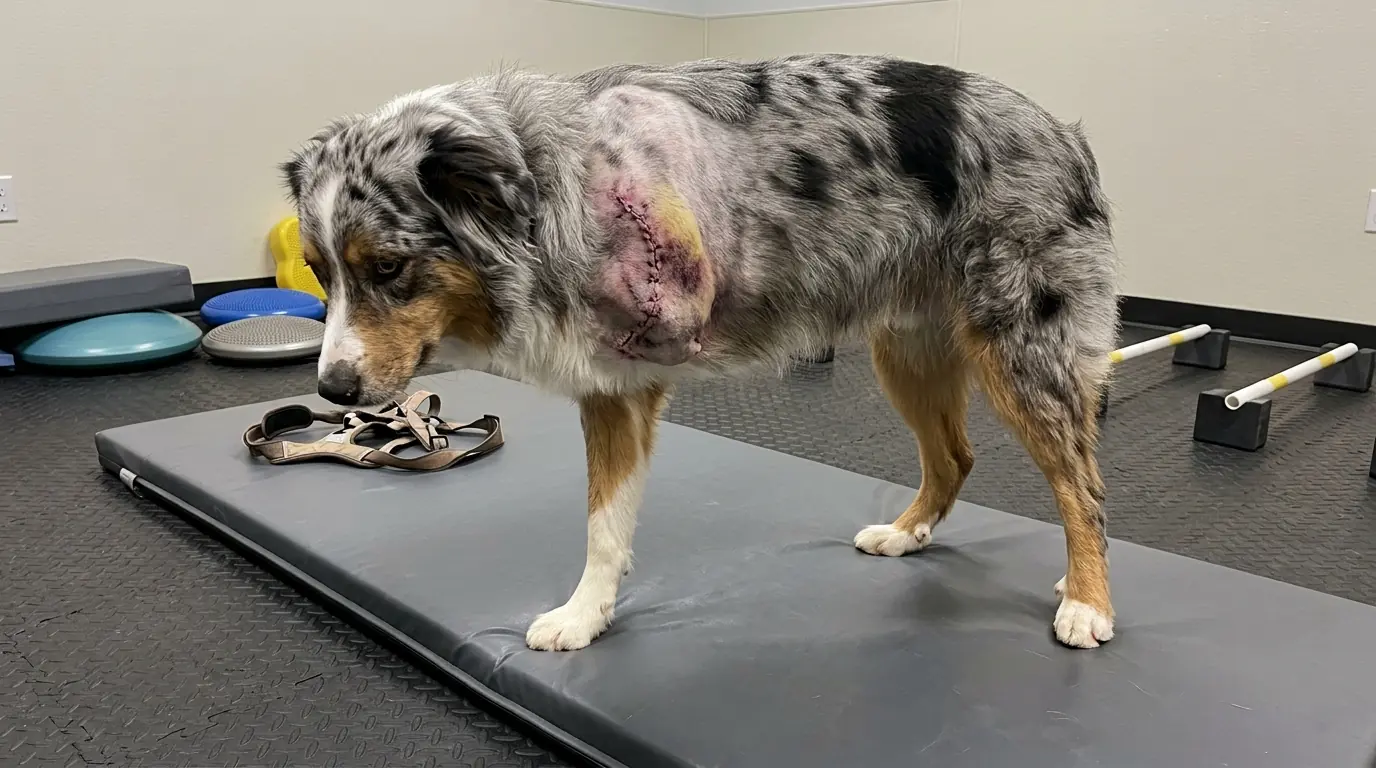
Milo is moving slowly across the padded rehabilitation area when everything looks almost right.
His remaining front paw lands.
His two hind legs follow in a careful three-legged rhythm.
For several steps, the three-year-old Australian Shepherd keeps himself moving.
Then he stops.
His body shifts toward the side where his front leg used to be.
There is nothing there to catch his weight.
Milo immediately takes one more small step with a remaining leg, repositioning himself before the lean becomes a fall.
Then he stands again.
It happens so quickly that the extra step could look insignificant.
For Milo, it is one of the clearest signs that learning to walk on three legs and learning to stand on three legs are not exactly the same challenge.
Losing a Front Leg Changed Milo's Balance Permanently
Milo recently underwent a front-limb amputation after a severe injury.
The surgery removed a limb that could no longer remain, but it also changed the physical system Milo had used for every step, stop, turn, and standing posture throughout his life.
Dogs normally distribute their body weight across four limbs, with the front limbs carrying a substantial share.
Milo now has only one front limb available to handle that part of the job.
His body has to adapt.
His remaining limbs must take on different loads.
His center of mass has to be controlled over a smaller base of support.
Even something as ordinary as coming to a stop requires a new strategy.
Walking provides Milo with momentum and a repeating sequence.
Stopping removes that sequence.
Suddenly, he has to stabilize himself.
And sometimes his body still shifts toward a support point that no longer exists.
Walking Came Before a Comfortable Stop
On the padded surface, Milo can already take slow steps.
That is meaningful progress.
But it does not mean he has completely adapted to life after amputation.
As long as he keeps moving carefully, his paws cycle through a new pattern. His remaining front leg accepts weight, followed by adjustments through his hindquarters.
Then Milo decides to stop.
The rhythm disappears.
His body has to settle into a stable three-legged stance.
That is when the lean appears.
His shoulders drift toward the amputated side.
For a fraction of a moment, his posture resembles the beginning of the weight shift he might once have made toward the missing leg.
Then Milo corrects himself.
Step.
Reposition.
Stand.
The extra step keeps him upright.
That Small Step Is Not a Failure
It would be easy to look at Milo's correction and assume he simply needs to learn to stop trying to use the missing limb.
His rehabilitation is more complicated than that.
A dog does not spend years coordinating four limbs and immediately develop perfect three-legged balance after surgery.
Milo's entire movement pattern has changed.
Muscles that once worked within a four-legged system are now contributing to a different one. His remaining limbs must compensate for the missing support, while his body learns how to control transitions without the leg that used to be there.
The corrective step shows that Milo recognizes instability at some level and is able to respond physically.
But it also reveals that his first stopping position is not always stable enough.
That matters.
The goal should not be to prevent Milo from taking the corrective step just because it looks awkward.
Right now, that little step may be exactly what prevents him from falling.