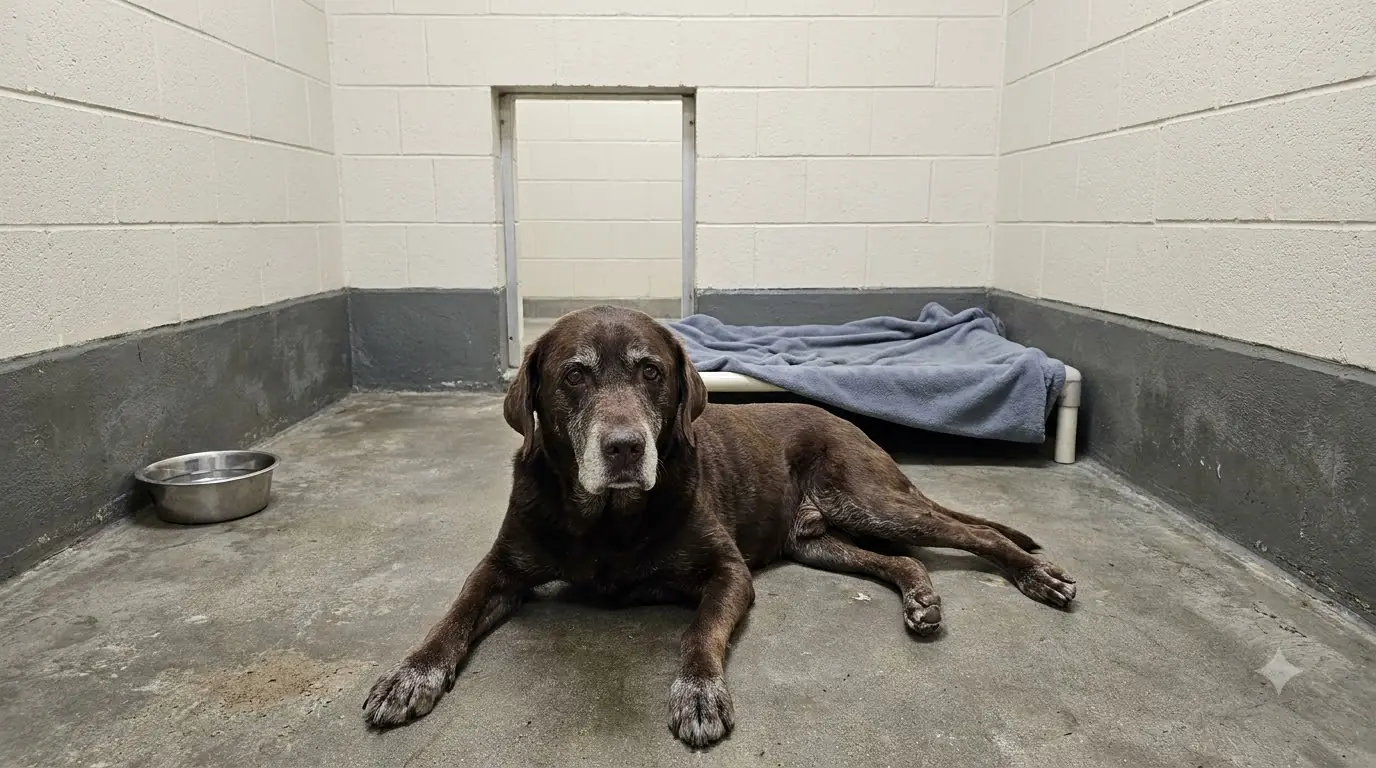
Milo can still walk.
That is what makes the scene so deceptive.
The 10-year-old Chocolate Labrador Retriever is not paralyzed. He can still push himself upright, take a few careful steps, lower his head to drink, and turn back toward his bed.
But by the time he does all of that, there is often almost nothing left.
His hind legs have lost a significant amount of muscle.
His arthritis is advanced.
The few feet between the water bowl and his orthopedic bed have become a distance his body can no longer reliably finish.
The first time staff saw what happened, Milo had just taken a long drink.
He stood over the bowl for several seconds afterward.
His rear legs were already trembling.
Then he turned.
The orthopedic bed was visible behind him.
Only a few steps away.
Milo took one.
Paused.
Took another.
His hindquarters lowered slightly.
He tried to correct himself.
One more step.
Then he stopped.
His front legs folded.
His chest came down.
His hips followed.
Staff expected him to rest for a moment and get back up.
Instead, Milo placed his gray-brown muzzle on the concrete.
His eyes closed.
Within less than a minute, he was asleep.
The bed was still right there.
Close enough that a healthy Labrador could have crossed the distance without thinking.
Milo simply had no energy left to reach it.
Staff Initially Thought He Had Slipped
An old dog lying in the middle of a kennel can mean many things.
Maybe the floor was slick.
Maybe he had lost his footing.
Maybe one arthritic joint had suddenly hurt.
So staff helped him back onto the orthopedic mattress and watched him more closely.
The next trip to the water bowl went normally enough.
He stood slowly.
Walked.
Drank.
Turned back.
Then stopped halfway again.
This time, there was no slip.
No sudden fall.
Milo simply lowered himself because his body had reached its limit.
And again, once down, he fell asleep before he could make another attempt.
That was when staff understood the problem was not the floor alone.
The problem was endurance.
Milo’s Back Legs Had Been Losing Strength for Some Time
At intake, the loss of muscle through his hindquarters was obvious.
The thighs were thinner than expected for a Labrador his size.
His rear legs did not generate the same power as the front.
When he stood, most of the initial work came from the shoulders and front legs.
His hindquarters came up later.
Sometimes much later.
That pattern is common in older dogs with chronic orthopedic pain and deconditioning.
The less comfortably a dog moves, the less muscle he uses.
The less muscle he has, the harder movement becomes.
It can become a cycle.
Pain reduces activity.
Reduced activity causes muscle loss.
Muscle loss makes standing harder.
Standing becomes more painful and exhausting.
Then the dog moves even less.
His Arthritis Was Severe
The veterinary team examined Milo carefully.
His hips were stiff.
His knees had reduced comfortable range.
His elbows showed age-related wear too.
There was no one dramatic acute injury explaining everything.
This was chronic degenerative joint disease.
The kind of condition that does not disappear.
The goal was not cure.
The goal was function.
Comfort.
Keeping him able to stand and walk enough to meet his needs without turning every trip across the kennel into an exhausting event.
The Muscle Loss Made the Arthritis Harder to Manage
Joint disease alone is difficult.
Joint disease plus muscle atrophy creates a bigger functional problem.
Muscles stabilize joints.
They help control the body when standing and lowering.
They absorb some of the work that otherwise falls on painful structures.
Milo had less of that support than he once did.
That was why even a tiny journey could drain him.
His Front Half Was Compensating
Shelter staff noticed it in the way he moved.
Front paws plant.
Shoulders pull.
Rear end follows.
His body looked almost front-heavy.
That compensation helped him remain mobile.
It also meant the shoulders were doing more work than they should.
If Milo repeatedly pushed himself past fatigue, he could start creating new problems in the parts of his body that were still stronger.
The Water Bowl Became the Hardest Necessary Trip
Food could be brought close.
Staff could visit him at the bed.
Bedding could be adjusted around him.
But water was a repeated need.
Milo drank several times a day.
Each time, the sequence was the same.
Rise.
Walk.
Drink.
Turn.
Try to return.
The return trip was often where his body gave out.
Staff Moved the Bowl Closer
That was the obvious first step.
The water dish was repositioned near the orthopedic bed.
Not directly against it at first.
Close enough that Milo did not need to cross the whole kennel.
The next time he got up, he made it to the bowl more easily.
Drank.
Turned.
Then lowered himself before fully reaching the mattress.
Better.
Not enough.
The Bowl Moved Closer Again
Eventually it sat beside the bed.
Now Milo could remain partly on the orthopedic surface while drinking.
That changed the mechanics completely.
He no longer needed to stand for every sip.
Sometimes he remained lying chest-down with his front half near the edge.
Extended his neck.
Drank.
Then rested.
No return trip at all.
That was the first major improvement in the routine.
The Best Solution Was Removing the Trip
Not making Milo stronger fast enough to complete it.
That distinction mattered.
Rehabilitation could help.
Pain management could help.
Muscle might improve gradually.
But those things take time.
Milo needed relief immediately.
If the environment could eliminate an unnecessary journey today, there was no reason to wait for his body to become stronger tomorrow.
Staff Added a Second Water Station
This became useful once they realized Milo liked resting in more than one place.
One bowl near the main orthopedic bed.
Another near a secondary padded area.
If he moved on a stronger day, he did not need to travel back across the kennel just to drink.
That preserved energy.
He Began Sleeping More on Soft Surfaces
Once water and bedding were arranged together, the number of times staff found him asleep on concrete decreased.
That was exactly what they wanted.
The heartbreaking image had made everyone notice the problem.
Good care made the image less common.
Milo’s Bed Was Adjusted Too
Even an orthopedic mattress can be difficult if it is too high or too soft.
Milo needed support without having to climb.
The shelter made sure the bed had a low edge.
Enough firmness that he did not sink deeply and struggle to rise.
Enough cushioning to protect joints.
Nonslip material underneath so it did not slide when he pushed against it.
Those small details matter for a weak senior dog.
His Rising Technique Was Watched Closely
Some dogs with severe arthritis struggle more to stand than to walk.
Milo was one of them.
He would bring the front legs underneath.
Push.
Pause.
Then the rear end attempted to follow.
If the hind paws were too far forward or too far back, the attempt failed.
Staff learned to give him time.
No pulling his collar.
No rushing.
On harder days, support came from a harness.
A Rear-Support Harness Helped on Bad Days
The harness did not carry him completely.
It reduced the load.
Milo could use his front legs while a caregiver supported part of the hindquarter weight.
That made bathroom trips safer.
It also reduced the risk of a sudden collapse.
The Goal Was Not to Use the Harness for Everything
Independence still mattered.
If Milo could stand comfortably on his own, he was allowed to.
If he could take several steps safely, he did.
Support was added when necessary.
The shelter wanted to preserve what function remained rather than replace it.
His Pain Plan Was Reviewed
Chronic arthritis often requires more than one strategy.
Medication where medically appropriate.
Weight management.
Warm supportive bedding.
Short controlled movement.
Traction.
Monitoring.
Because Milo was older, any long-term medication plan needed veterinary oversight and appropriate laboratory monitoring.
The team adjusted care based on his actual response.
He Was Not Overweight
That helped.
Extra body weight would have made every step harder.
For a Labrador with weak hind legs, staying lean is especially important.
Milo still needed enough nutrition to support muscle.
The goal was not simply “keep weight low.”
It was preserve a healthy body condition while rebuilding strength where possible.
Nutrition Became Part of Rehabilitation
Older dogs with muscle loss need adequate protein and calories appropriate to their overall health.
The veterinary team looked at the whole picture.
Appetite.
Body condition.
Other medical issues.
No assumption that muscle could return through exercise alone.
His body needed material to rebuild.
Rehabilitation Started Small
Very small.
A few controlled stands.
Short walks on nonslip flooring.
Weight shifting.
Encouraging proper foot placement.
No long sessions.
No trying to make Milo walk until he was exhausted.
That would defeat the purpose.
The First Goal Was Better Transitions
Could he rise with fewer failed attempts?
Could he stand long enough to stabilize?
Could he turn without the rear legs sliding?
Could he lower himself more deliberately instead of collapsing?
Those changes mattered more than distance.
Milo Had Good Days and Bad Days
That was expected.
One morning he might rise on the first attempt.
Later that same day, he might need the harness.
A stronger walk did not mean the arthritis had disappeared.
A harder evening did not mean rehabilitation had failed.
The team looked at trends.
On Better Days, He Tried to Walk Farther Than He Should
That was another problem.
Milo still had the personality of a Labrador.
He was interested.
He wanted to sniff.
He sometimes kept moving because something smelled interesting.
Staff had to be the limit.
Turn around before fatigue.
Rest before collapse.
Do not wait until the dog demonstrates the maximum he can physically tolerate.
He Began Recovering Faster After Bathroom Trips
That was one of the first functional improvements.
At intake, even a short trip could result in immediate sleep.
Later, Milo returned to the bed.
Settled.
But remained awake.
Sometimes he drank.
Sometimes watched the hallway.
That showed he had slightly more reserve.
The Concrete-Floor Naps Did Not Disappear Overnight
One afternoon, Milo left the bed to investigate a sound.