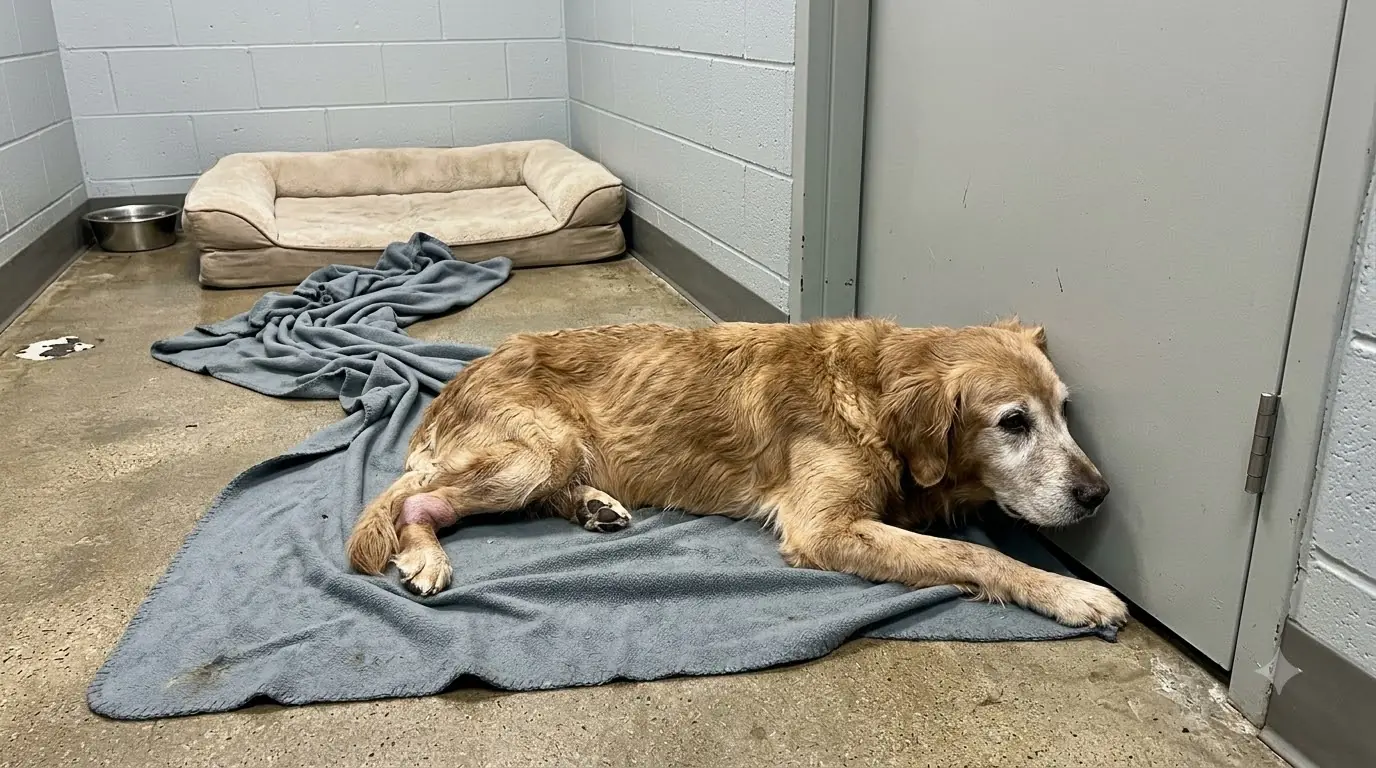
Milo had a soft bed waiting for him.
The 11-year-old Golden Retriever had been brought to the rescue center thin, dirty, and struggling to use one badly swollen hind leg.
His body needed rest.
So staff prepared a comfortable place away from the hard surfaces he had been lying on before his rescue.
But Milo kept moving the blanket.
He gripped an edge between his teeth.
Pulled.
Stopped to rest.
Then pulled again.
Little by little, he dragged it away from the bed and toward the doorway.
Once the blanket reached the spot he wanted, Milo lowered himself onto it.
His body faced the hall.
His swollen leg rested carefully beside him.
Then someone outside picked up a set of keys.
Milo's head immediately came up.
He stared toward the door.
The keys moved farther down the hallway.
Eventually the sound disappeared.
Milo slowly lowered his head again.
Hours later, another set of keys jingled.
His head came right back up.
Rescuers Had Found Him in Almost the Same Position
Before there was a rescue center, there had been a back porch.
The house attached to it was vacant.
Milo was lying outside, curled against the porch when rescuers found him.
His coat was badly matted.
His body had become painfully thin.
One hind leg was so swollen and uncomfortable that he barely wanted to put weight on it.
There was no one there who could provide a complete history.
Rescuers knew where Milo had been found.
They could see what condition he was in.
They did not know exactly how long every problem had been developing or why he had remained on that porch.
Those unanswered questions mattered.
But Milo's immediate physical needs mattered more.
Getting Milo Up Was Difficult
When rescuers encouraged him to move, Milo tried.
His front legs did most of the work.
He shifted his weight forward while protecting the swollen hind leg.
Standing required effort.
Walking was worse.
Milo was not simply an old dog moving a little slowly.
He was underweight and physically compromised, with a painful limb that needed veterinary evaluation.
So nobody expected him to walk normally just because he had finally been removed from the property.
His recovery would have to begin much more slowly.
The Swollen Leg Needed an Explanation
A severely swollen limb can have multiple possible causes.
Injury, inflammation, infection, joint problems, or other conditions can all affect whether a dog is willing or able to bear weight.
Milo's rescuers could not determine the exact cause by looking at him on the porch.
His veterinary team needed to evaluate the leg and decide what diagnostic and treatment steps were appropriate.
Until then, unnecessary walking made little sense.
Milo needed support.
He needed pain addressed.
And he needed a resting area that did not require him to repeatedly cross the room.
His Thin Body Raised Another Set of Concerns
Milo's weight loss was obvious beneath his coat.
Once caregivers began working through the mats and evaluating him more closely, his poor body condition became even harder to miss.
But being thin does not explain why a dog became thin.
The rescue needed to consider his overall health as well as his access to appropriate nutrition before he was found.
Food would be important.
So would monitoring how his body responded.
An elderly dog arriving in depleted condition is not restored by simply filling a bowl as high as possible.
Recovery needs to fit the animal's medical condition.
Then Milo Was Given a Real Bed
At the rescue center, staff wanted him off hard flooring.
His age alone made supportive bedding useful.
His poor body condition and painful hind leg made it even more important.
An orthopedic-style bed gave Milo somewhere to distribute his weight more comfortably.
A blanket was placed on top.
Milo used it.
Just not where staff expected.
He Started Pulling the Blanket Toward the Door
The first time, caregivers thought it had simply shifted.
Then Milo did it again.
He bit the blanket.
Pulled it several inches.
Rested.
Pulled again.
Because of his weak body and painful rear leg, the process was slow.
Milo did not drag the bedding across the room in one energetic movement.
He moved it in stages.
Eventually, the blanket reached the doorway.
Milo lowered himself onto it.
Then he turned his head toward the hall.
The Next Day, Staff Put the Blanket Back
Later, it was near the door again.
Milo had repeated the same process.
This time staff watched more carefully.
He seemed determined to rest at the front of the room despite the effort required to move his bedding there.
That raised an obvious question.
Why was that particular spot so important?
The Porch Made the Behavior Hard Not to Notice
Milo had been found outside a vacant house.
Now he was choosing to lie at another threshold.
The similarity was emotionally striking.
But staff could not claim that Milo believed the rescue-center doorway was the porch.
They could not say he was waiting for a specific person.
And they could not know exactly why he had remained outside that house before rescuers arrived.
Milo's behavior could show a pattern.
It could not narrate his thoughts.
What staff knew was that Milo repeatedly chose a position where he could face the doorway and monitor activity beyond it.
Then they noticed the keys.
The Sound Changed Milo Immediately
Milo could be resting with his head down.
Someone several yards away would pick up keys.
Jingle.
Milo's eyes opened.
His head lifted.
His ears shifted toward the sound.
If the keys came closer, Milo remained alert.
If they passed the room, his gaze followed as far as it could.
Then he waited.
The sound eventually faded.
Milo stayed facing the doorway for a while longer before lowering his head.
It happened often enough that staff stopped considering it coincidence.
But Keys Can Mean Many Things to a Dog
Dogs learn associations from repeated experiences.
A sound may become linked with doors opening, people arriving, people leaving, rides, meals, walks, or countless other routines.
Milo's response showed that keys were meaningful enough to get his attention.
It did not reveal the exact association.
Nobody at the rescue knew enough about his previous daily life to fill in that blank responsibly.
So staff didn't try.
They focused instead on what Milo did after hearing them.
The Bigger Problem Was What the Doorway Cost His Body
Milo wanted his blanket near the door.
Getting it there required physical work.
He had to grip it.
Pull.
Shift his body.
Pull again.
Then reposition himself on a hind leg he was already reluctant to use.
For a healthy dog, dragging a blanket several feet might be insignificant.
For Milo, it was unnecessary exertion.
His body needed that energy for recovery.
So staff stopped fighting his choice of location.
They Moved the Comfort to Milo
Instead of returning the blanket to the back of the room every time, caregivers began making the area Milo preferred safer and more comfortable.
He did not need to repeatedly drag bedding across the floor to tell them where he wanted to rest.
If medically appropriate, support could be positioned closer to that area.
His water could remain within easy reach.
Staff could reduce how often he had to get up.
The goal was not to teach Milo that the back of the room was the “correct” place to sleep.
The goal was to protect his body while giving him reasonable choices.
His Medical Recovery Continued at the Same Time
The doorway behavior was emotionally compelling.
It could not become more important than Milo's physical health.
His painful leg still required treatment.