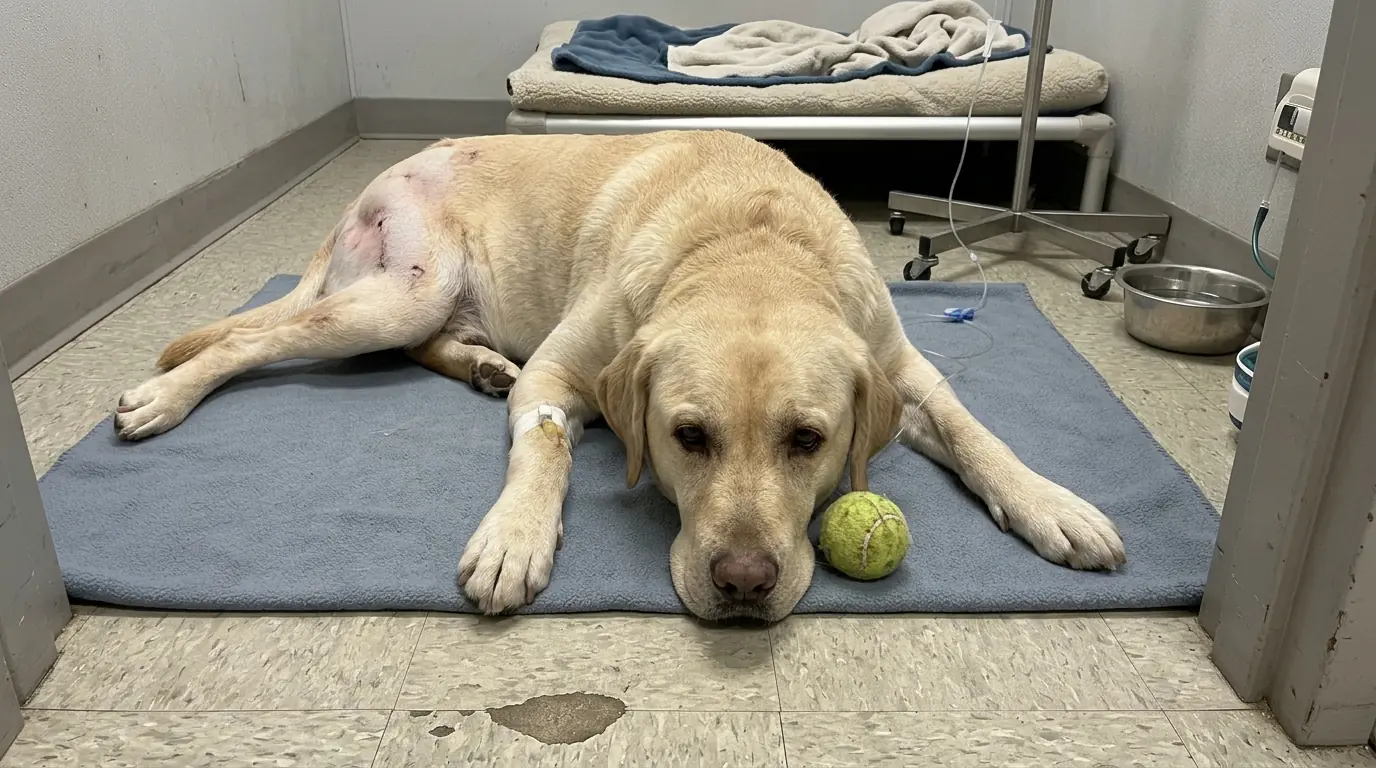
Milo is a 9-year-old Labrador Retriever in critical condition after suffering a severe pelvic injury and internal trauma.
His hip area has been shaved for treatment.
His hind legs can no longer support his weight.
He is weak enough to require continuous IV fluids while recovering in the shelter’s veterinary area.
Most of the time, Milo needs to remain on his medical bed.
But when someone comes into the room, Milo still notices.
And beside him is a tennis ball.
When he has enough strength, Milo picks it up.
Then he tries to crawl toward the door.
He does not get far.
The ball usually falls from his mouth before he reaches anyone.
Milo no longer has enough energy to pick it back up.
So he lies down beside it, places one front paw over the tennis ball, and gives a small wag of his tail when someone enters the room.
Milo Still Tries to Take the Ball With Him
The tennis ball stays beside Milo’s bed.
For a Labrador, a tennis ball is an ordinary thing.
For Milo right now, carrying one has become a physical challenge.
When he hears activity near the doorway, Milo reaches toward it.
He takes the ball into his mouth.
Then he begins pulling himself forward.
His back legs cannot properly support or propel him, so the work comes mostly from the front half of his body.
Milo plants his front paws.
He pulls.
His chest slides forward across the bedding.
His injured hindquarters follow behind as little as they can.
Then he tries again.
For a few moments, Milo still has the tennis ball in his mouth.
Eventually, his strength begins to disappear.
His jaw loosens.
The ball drops.
It may roll only a few inches away.
But for Milo, those few inches can now be too much.
The Ball Falls — and Milo Cannot Pick It Back Up
A healthy Labrador would simply grab the tennis ball again.
Milo cannot.
He has already used much of his remaining strength trying to move toward the door.
His body lowers.
He stops crawling.
The tennis ball lies beside him.
Milo does not have enough energy to lift himself and retrieve it again.
Instead, he reaches out with one front paw.
He places it over the ball.
Then he stays there.
The ball is trapped gently beneath his paw.
His body remains on the floor.