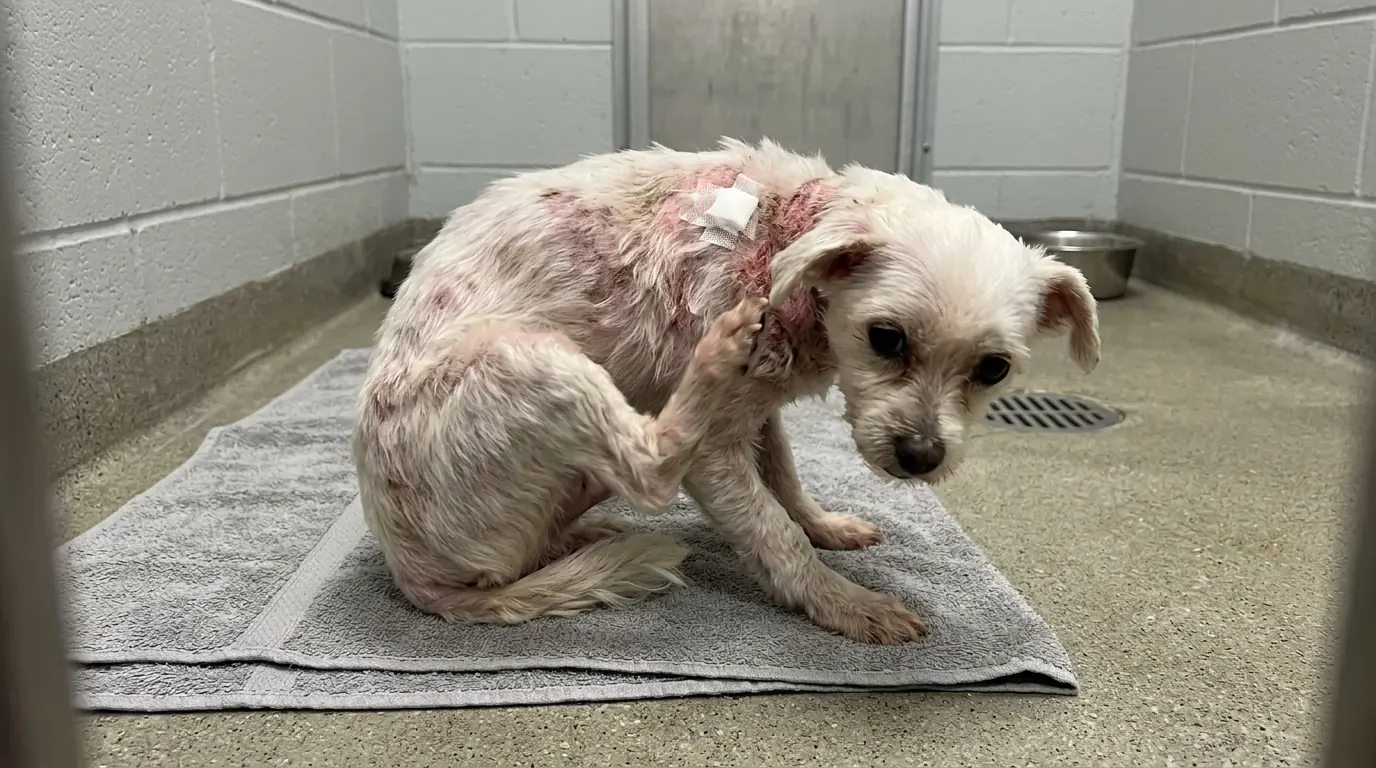
Mimi's back leg starts moving before the rest of her body does.
The five-year-old Maltese mix is lying on a folded towel inside an isolation kennel, her tiny body surrounded by the clean, controlled environment she desperately needs.
Much of the coat that should cover her in soft white hair is missing.
The remaining fur grows in uneven patches.
Large areas of skin are red and inflamed.
Several places where she has scratched herself raw are now being treated and protected.
For a few quiet seconds, Mimi rests.
Then the irritation begins again.
Her hind leg lifts.
The paw moves toward her neck.
Mimi tries to scratch.
The instant her toes touch the painful skin, her entire body jerks.
She pulls the leg away.
Her head drops.
Her body curls tightly into the towel.
But the urge does not disappear.
Minutes later, the same hind leg begins rising again.
Mimi is caught between two sensations she cannot escape.
Her skin tells her to scratch.
The wounds tell her not to touch them.
Mimi Arrived With More Than Missing Fur
At first glance, the hair loss is what stands out.
A Maltese-type dog is normally associated with a substantial coat.
Mimi's body looks almost unfinished without it.
Hair remains around some areas while others are nearly bare.
But the missing coat is only the visible surface of the problem.
Underneath it is skin that appears profoundly unhealthy.
Redness.
Inflammation.
Crusting.
Excoriated areas.
Places where repeated scratching has damaged tissue enough to require treatment.
This is not a grooming problem.
Mimi needs medical care.
Her Time as a Stray Left Too Many Questions
Mimi had been surviving outside for an extended period before entering the shelter.
Exactly how her skin disease developed cannot be determined simply from that history.
Parasites are one possibility.
Allergic skin disease can produce severe itching.
Bacterial or fungal infections may be involved.
Underlying medical conditions can affect skin and coat.
More than one problem can occur simultaneously.
And once intense itching begins, scratching itself can create additional wounds.
Mimi may have arrived with a complicated cycle rather than one simple condition.
The Scratching Is Almost Automatic
Mimi can be resting when it begins.
Her head lifts slightly.
The muscles in one hind leg tense.
Then the paw comes forward.
There is little hesitation.
It looks like the familiar scratching motion any dog might make after feeling an itch.